
Essential reading for beauty brand operators: Why do viral TikTok content always flop when moved to Instagram?
Xiao Liang, an operations manager for a beauty brand, frowned as she stared at the data in the Instagram backend—the same viral video that had been viewed 2.3 million times on TikTok only garnered 217 interactions within 48 hours after being moved to Instagram, less than 0.1% of her followers.
She's not an isolated case. Almost every beauty brand that operates on both TikTok and Instagram has fallen into this trap. What went wrong? It wasn't that the content wasn't good enough; it was that you threw a set of content optimized for the TikTok algorithm directly into the Instagram ecosystem—these two platforms are essentially two completely different worlds.
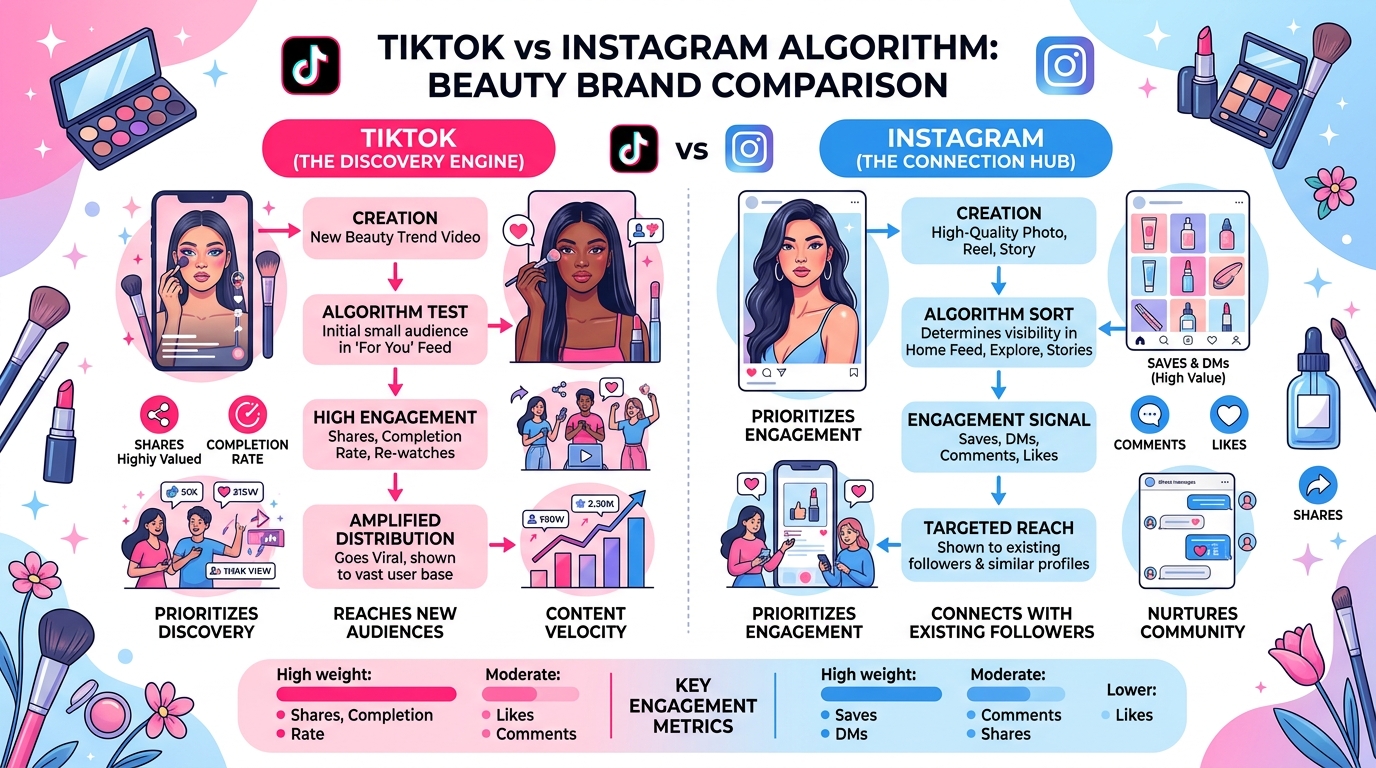
Scene 1: A TikTok hit ≠ an Instagram hit; they are based on two completely different algorithmic logics.
TikTok's logic: Completion rate driven, distribution to strangers.
TikTok's recommendation algorithm's core metric is completion rate . Whether a video can be pushed to more people depends first on "how many people have finished watching it." This means that: a captivating opening (the first 3 seconds must grab the viewer's attention), fast-paced editing, and strong visual impact are all designed to keep users from scrolling away.
More importantly, TikTok's distribution logic is based on strangers . When you post a video, the system first pushes it to a small group of users who don't follow you to test their reactions. If the completion rate and like rate of this group reach a threshold, it will then be pushed to a larger audience. This means that even if you have zero followers, as long as your content is captivating enough, it can still go viral .
This logic has given rise to the characteristics of TikTok's content:
- Vertical full-screen layout, visually filling the entire screen.
- The first 3 seconds must contain a hook (a question that addresses a pain point, a plot twist, or an exaggerated expression).
- The choice of background music is crucial; catchy melodies boost completion rates.
- The text is densely packed and can be read even when the audio is muted.
Reference data: On TikTok, videos with an average completion rate of 50% or higher will enter a period of accelerated streaming weighting, with exposure increasing exponentially. For a deeper understanding of the relationship between TikTok completion rate and streaming weighting, please refer to this analysis on TikTok engagement rate and streaming weighting .
Instagram's logic: Prioritize relationships, distribute through three channels.
Instagram's underlying logic is completely different from TikTok's: relationship-based recommendations . What's pushed to your feed is primarily based on who you follow, who you interact with most, and what types of content you've actively engaged with. The algorithm trusts "endorsements from acquaintances" more than purely stranger tests.
To complicate matters further, Instagram has three content channels, each with its own unique algorithm:
| aisle | Core Logic | Suitable content types |
|---|---|---|
| Reels | It's the closest to TikTok, with the ability to distribute content to strangers, but it has a higher aesthetic threshold. | Entertainment and tutorial short videos |
| Feed (images/carousels) | Strong relationship chains and engaging content with loyal fans | Brand story, product showcase, Carousel tutorial |
| Stories | Disappearing for 24 hours, intimate relationship scenario | Limited-time offers, behind-the-scenes footage, interactive Q&A |
Instagram has a much higher aesthetic threshold for content than TikTok . Filter quality, layout consistency, and overall account visual style are all factors users consider when deciding whether to follow a content. A makeup tutorial video that goes viral on TikTok for its "realism" might be met with negative scrolling on Instagram due to its poor image quality and cluttered composition.
Data speaks for itself: CTR differences for the same content across platforms can reach 70-80%.
According to data from multiple beauty brands, the click-through rate (CTR) of the same video content can differ by 70%-80% between TikTok and Instagram .
This gap isn't random fluctuation, but systemic—because the user expectations, content consumption habits, and algorithmic feedback mechanisms of the two platforms are different. If you use TikTok's data to predict Instagram's performance, you'll always be proven wrong.
The article " The same content posted on 5 platforms has 10 times the effect" contains more detailed cross-platform data comparisons and is worth bookmarking.
Act Two: The 3 Most Common Mistakes in Brand Operation
Now that we know the differences in the algorithms of the two platforms, let's look back at what mistakes Xiao Liang—and countless others like Xiao Liang—made.
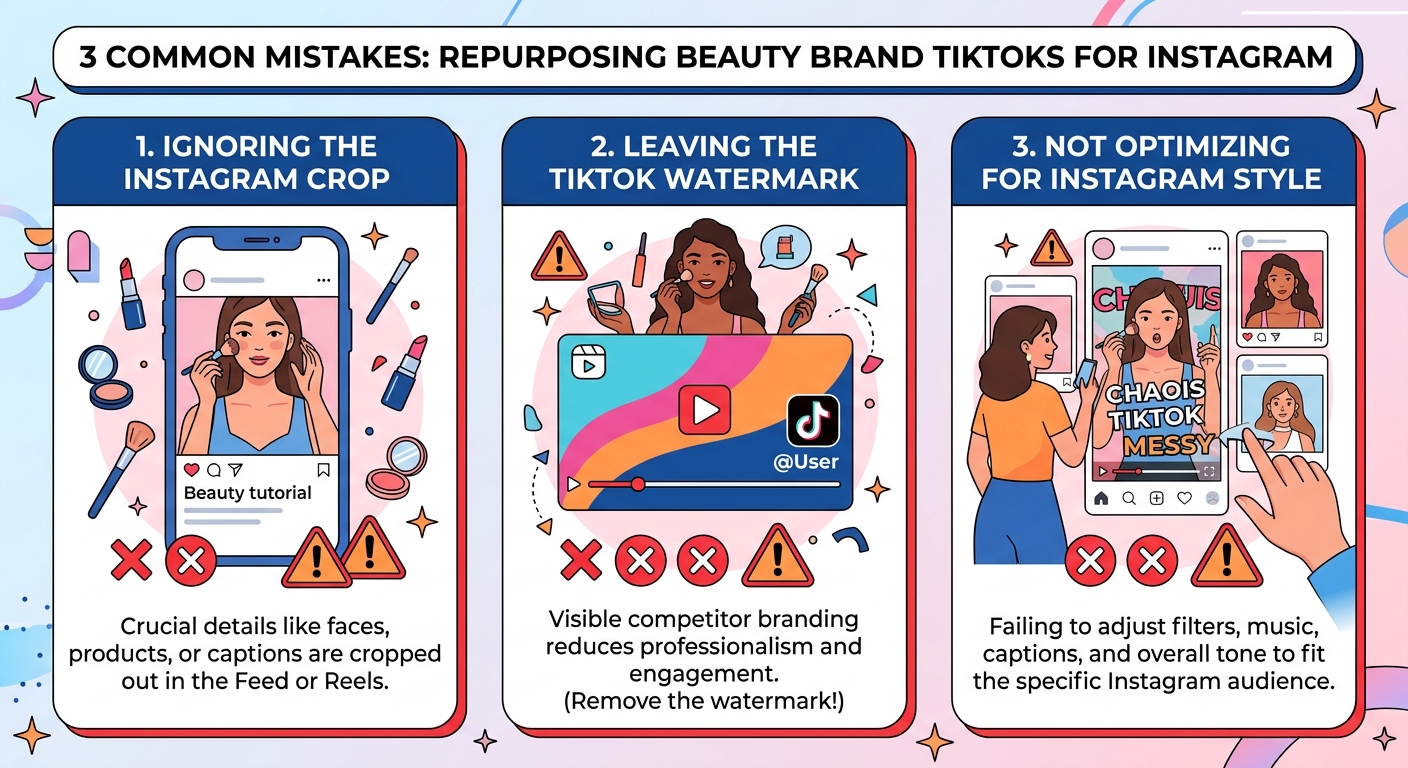
Error 1: Directly downloading the watermarked version of TikTok and posting it to Instagram (algorithm-driven demotion).
This is the most common and most damaging mistake.
Instagram's algorithm can now accurately identify the watermark (@username + TikTok logo) in the bottom right corner of TikTok videos. Once the watermark is detected, Reels will be proactively downgraded —the system won't directly block you, but it will reduce the content's exposure in the recommended feed. This is a mechanism that Instagram has officially confirmed.
A deeper issue is that even if you remove the watermark, the metadata of TikTok videos (resolution, frame rate, compression method) still has subtle differences from "original Instagram content." The algorithm can identify that this is "re-uploaded content," and there will also be slight streaming suppression.
Correct approach : Export the original footage again or re-render it using professional editing tools to ensure that the uploaded file is a clean, original file.
Mistake 2: Copying the same text and hashtags (the tag logic is completely different between the two platforms)
TikTok's hashtags are more like "topic traffic entry points"—broad hashtags like #makeuptutorials and #skincare can help you get into the corresponding content pool and gain exposure. TikTok's For You page relies more on keyword matching; keywords in the copy directly influence the recommended audience.
Instagram's hashtag logic is completely different:
- Instagram's algorithm has significantly reduced the weight of hashtags in terms of exposure (especially after 2023).
- Excessive use of popular, generic tags can actually make content more likely to be flagged as "spam."
- Instagram relies more on precise niche vertical hashtags (10,000-500,000 followers) and the account's own content hashtags.
Copying TikTok's copywriting structure also has problems: TikTok's copywriting tends to be conversational and suspenseful; Instagram's copywriting is more suitable for in-depth narratives or emotional resonance, and can be longer and more nuanced in its emotions.
Mistake 3: Only posting Reels and ignoring Stories and Carousels (missing out on a key channel for brand building)
Many brand operators saw the potential for Reels to "break out of their niche" and focused all their efforts on Reels, completely ignoring Stories and Carousel. This was a serious strategic mistake.
Stories are designed for close relationships . Users view Stories because they already follow and trust you. This is where conversion rates are highest—limited-time discount codes, new product previews, and fan Q&A all take root and flourish within Stories. For a beauty brand, the conversion rate from Stories is typically 3-5 times that of Reels.
Carousels are a format unique to Instagram, and TikTok has no corresponding product. Its algorithm has a hidden feature: if a user doesn't scroll through all the content, the system will push that content again later . This gives carousels a natural ability for "secondary exposure," making them ideal for in-depth content such as brand stories, ingredient analyses, and before & after comparisons.
Reels alone can generate traffic; however, Stories and Carousels are key to turning that traffic into brand equity. For insights on how posting timing affects engagement across different channels, refer to the section on the impact of content posting timing on engagement .
Act Three: Breaking the Mold – The Right Method for Multi-Platform Content Adaptation
Now that we know the problem, let's talk about the solution. The core idea is simple: produce multiple versions of the same material, instead of repeatedly releasing the same version .
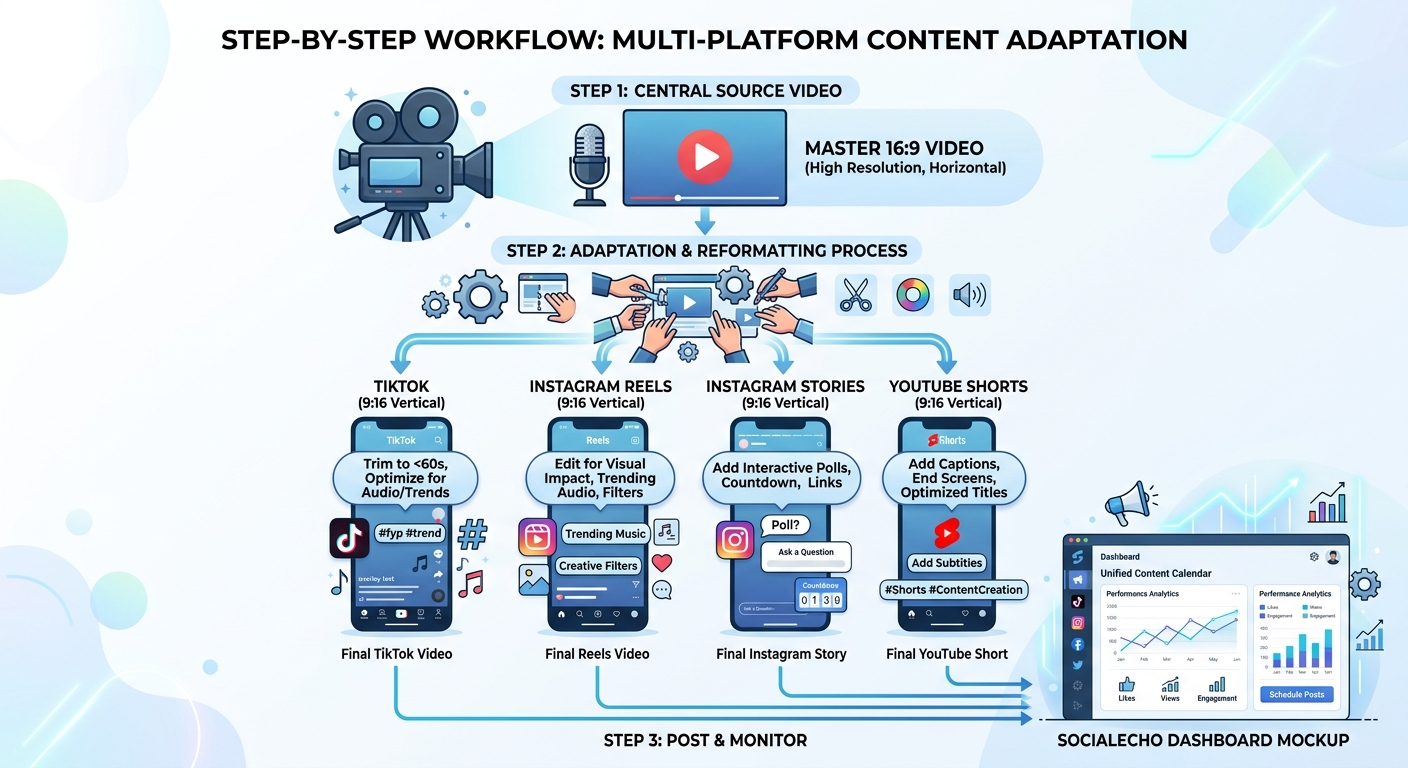
Content splitting method: Produce 3 versions from one source material.
Take a makeup tutorial video as an example:
Original footage : A 3-minute complete skincare routine demonstration, recorded in high definition in landscape mode.
TikTok version (15-30 seconds):
- The first 3 seconds: The most impactful transformation (first showing the finished face, then showing the initial bare face).
- catchy background music
- The core technique is summarized as subtitle overlay.
- Copywriting: Conversational style + suspense hook ("90% of people get this step wrong")
Instagram Reels version (30-60 seconds):
- The first three seconds also need to grab attention, but with a greater emphasis on aesthetic composition.
- The background music selection is more refined and the atmosphere is more immersive.
- Copywriting: Emotional narrative + precise vertical tags (such as #cleansingskincare #oilyskinskincaretips)
- Add a CTA at the end to guide users to Stories
Instagram Stories version (15 seconds x 3 images):
- Page 1: Product + Question Introduction ("A Must-Read for Oily Skin")
- Image 2: Close-up of the core steps
- Image 3: Effect demonstration + Purchase link sticker
YouTube Shorts Version (under 60 seconds):
- More details can be retained
- SEO-oriented titles and descriptions
- Guide users to watch the full-length video.
Platform Feature Comparison Table
| platform | Video length | Core Algorithm Metrics | Content Style | Monetization Path |
|---|---|---|---|---|
| TikTok | 15 seconds - 10 minutes | Completion rate, interaction rate | Realism and entertainment | Live streaming e-commerce, product showcase |
| Instagram Reels | Maximum 90 seconds | Share rate, save rate | Aesthetic quality and emotional resonance | Product tags, Stories conversion |
| Instagram Feed | — | Collection rate, relationship interaction | Brand tone and in-depth content | Account weight accumulation |
| YouTube Shorts | Maximum 60 seconds | Likes and subscription conversion | SEO-oriented, tutorial-based | Membership and advertising revenue sharing |
Use tools to unify the release schedule across multiple platforms.
Manually managing content versions and posting times across multiple platforms is a nightmare for every operator: the best posting times differ for different platforms (9-11 pm on TikTok, 7-9 am and 8-10 pm on Instagram), managing different versions of materials can easily become chaotic, and data scattered across various back-ends makes horizontal comparison difficult.
This is why more and more beauty brand operations teams are starting to use multi-platform content management tools like SocialEcho . SocialEcho supports unified management of content publishing plans across platforms such as TikTok, Instagram, and YouTube in a single backend, providing cross-platform data comparison dashboards to help teams quickly identify which platform's content version performs best.
This article provides a detailed comparison of the functional differences between mainstream multi -platform management tools. If you are choosing a tool, you can read this article first.
SocialEcho pricing: Basic plan starts at 12.5/month, Team plan starts at 18.75/month, with a 20% discount for annual payments. For brand operations teams that need to handle content from multiple platforms daily, this cost is far lower than the traffic loss caused by "content plagiarism pitfalls".
Case Study: Improved Interaction for a Beauty Brand After Adjustments
The overseas operations team of a domestic beauty brand originally followed a workflow of simply posting whatever was posted on TikTok on Instagram, just switching platforms. As a result, their Instagram account growth stagnated, with Reels averaging only 3,000-5,000 views, far below the industry average.
After adjusting the strategy (content production in versions + optimized release time + supplementary Stories/Carousel strategy), within 3 months:
- Instagram Reels averaged over 18,000 views (an increase of approximately 260%).
- The click-through rate for product links in Stories increased from 0.8% to 4.2%.
- The overall account follower growth rate increased by approximately 180%.
This result was not achieved by simply throwing money at advertising, but by a systematic adjustment of the content strategy .
FAQ
Q1: Why can't TikTok content be directly copied to Instagram?
A : There are three main reasons: ① Instagram's algorithm can identify TikTok watermarks and demote them; ② The user expectations and content consumption habits of the two platforms are different - TikTok users accept rough realism, while Instagram users have higher requirements for aesthetic quality; ③ The core indicators of the platform algorithms are different (TikTok has a completion rate, while Instagram focuses more on save rate and share rate), and the same content performs completely differently under the two algorithms.
Q2: What are the fundamental differences between Instagram Reels and TikTok videos?
A : Both are vertical short videos in format, but their underlying logic is very different. TikTok mainly distributes content to strangers, and even accounts with zero followers can go viral; Instagram Reels has a weaker ability to distribute content to strangers and relies more on the account's existing social network. In terms of content style, TikTok leans towards instant entertainment and authenticity, while Instagram Reels has a higher aesthetic threshold, and the consistency of the overall account's visual style also affects the reach of individual posts.
Q3: How much manpower does a beauty brand need to operate both TikTok and Instagram simultaneously?
A : If following the correct "version-based production" strategy, it is recommended to have at least the following personnel: 1 content planner (overseeing topic selection and copywriting), 1 photographer/editor (responsible for producing materials for multiple versions), and 1 operations manager (responsible for release scheduling, data monitoring, and fan interaction). Using multi-platform management tools such as SocialEcho can significantly reduce repetitive work on the operations side, and a small team of 3 can stably operate 2-3 platforms.
Q4: Are there any tools that can manage content postings on both TikTok and Instagram simultaneously?
A : Yes. SocialEcho is one of the tools currently available that supports unified management across multiple platforms, including TikTok, Instagram, and YouTube. It supports features such as content scheduling, cross-platform data comparison, and team collaboration. The basic version starts at 12.5/month, and the team version starts at 18.75/month, with a 20% discount for annual payments. For beauty brand teams that need to operate multiple platforms simultaneously, using a single backend for unified management is much more efficient than having separate backends for each platform.
Q5: How should Instagram Stories and Reels divide their functions?
A : The two have different positioning. Reels ' core value is reaching new users (breaking out of its niche), making it a "user acquisition" tool; Stories ' core value is serving existing fans (conversion), making it a "retention + monetization" tool. Suggested division of labor: Reels should feature lightweight, entertaining, and tutorial-style content, focusing on exposure; Stories should feature limited-time offers, behind-the-scenes footage, product usage details, and interactive Q&A, focusing on conversion and building intimacy. Both complement each other and neither should be neglected.
Q6: How to quickly produce multiple platform versions of the same material?
A : The key is to consider the needs of multiple platforms during the shooting stage: ① Ensure there is enough vertical footage during shooting (to cover the needs of TikTok and Reels); ② When editing, first cut the full version, then trim it into 15-second, 30-second, and 60-second versions; ③ Write the copy separately, do not copy and paste; ④ Use tools such as SocialEcho to manage the release plans of different versions in a unified manner to avoid release chaos.
Q7: What are the most common pitfalls in cross-platform operations?
A : Besides the "directly copying the watermarked version" mentioned in this article, the most easily overlooked pitfall is data fragmentation leading to decision-making errors . Many teams assume their content strategy is flawed because TikTok's data is good while Instagram's is poor, but in reality, it might simply be that the posting time, content version, and hashtag strategies for the two platforms weren't optimized separately. It's recommended to use a unified data dashboard to compare performance across multiple platforms to truly identify the root cause of the problem, rather than adjusting based on intuition.
;}.cls-2{fill:%230868f7;}.cls-3{fill:url(%23未命名的渐变_44);}.cls-4{fill:%23333;}%3c/style%3e%3clinearGradient%20id='未命名的渐变_8'%20x1='33.73'%20y1='100.61'%20x2='-0.03'%20y2='-1.06'%20gradientUnits='userSpaceOnUse'%3e%3cstop%20offset='0'%20stop-color='%237ae9fb'/%3e%3cstop%20offset='0.67'%20stop-color='%232b90f8'/%3e%3cstop%20offset='1'%20stop-color='%230868f7'/%3e%3c/linearGradient%3e%3clinearGradient%20id='未命名的渐变_44'%20x1='27.86'%20y1='18.67'%20x2='68.36'%20y2='22.22'%20gradientUnits='userSpaceOnUse'%3e%3cstop%20offset='0'%20stop-color='%235ac7f2'/%3e%3cstop%20offset='1'%20stop-color='%230868f7'/%3e%3c/linearGradient%3e%3c/defs%3e%3cpath%20class='cls-1'%20d='M29,28.74V81.91l-9.51-3.68v0L8.52,74A7.17,7.17,0,0,1,4,67.32V24.54A3.76,3.76,0,0,1,9.08,21Z'/%3e%3cpath%20class='cls-2'%20d='M68.09,78.07a13.15,13.15,0,0,1-17.9,12.06L29,81.91h0V28.74L50.19,37A13.17,13.17,0,0,0,68.08,25.3h0Z'/%3e%3cpath%20class='cls-3'%20d='M68.08,25.3a13.19,13.19,0,0,1-6.73,10.87A13.09,13.09,0,0,1,50.19,37L29,28.74V6A3.76,3.76,0,0,1,34.1,2.52l25.59,9.91A13.22,13.22,0,0,1,68.08,25.3Z'/%3e%3cpath%20class='cls-4'%20d='M129.06,81.76a4.33,4.33,0,0,1-3.19-1.31,4.4,4.4,0,0,1-1.31-3.24V56.86H97.65V77.21a4.36,4.36,0,0,1-1.35,3.2A4.68,4.68,0,0,1,93,81.76a4.32,4.32,0,0,1-3.19-1.31,4.37,4.37,0,0,1-1.32-3.24V27.27A4.58,4.58,0,0,1,89.83,24a4.59,4.59,0,0,1,7.82,3.27V48.15h26.91V27.27A4.58,4.58,0,0,1,125.91,24a4.59,4.59,0,0,1,7.82,3.27V77.21a4.37,4.37,0,0,1-1.36,3.2A4.65,4.65,0,0,1,129.06,81.76Z'/%3e%3cpath%20class='cls-4'%20d='M163.77,81.66c-6.57,0-11.76-1.92-15.44-5.7s-5.54-9.07-5.54-15.74a26.76,26.76,0,0,1,2.09-10.43,17.72,17.72,0,0,1,6.67-8.06,19.15,19.15,0,0,1,10.68-2.95,19,19,0,0,1,10.46,2.8,18.7,18.7,0,0,1,6.55,7.36,22.53,22.53,0,0,1,2.36,10.28A4.51,4.51,0,0,1,177,63.77H152.23a10.8,10.8,0,0,0,3.49,6.65c2,1.68,4.88,2.52,8.66,2.52a22.25,22.25,0,0,0,7.54-1.21c.74-.3,1.55-.67,2.37-1.07a3.75,3.75,0,0,1,1.84-.4,4.09,4.09,0,0,1,3,1.15,4,4,0,0,1,1.12,3,4.38,4.38,0,0,1-2.58,3.82,32.34,32.34,0,0,1-6.36,2.61A28.67,28.67,0,0,1,163.77,81.66ZM172.4,55.9a9.72,9.72,0,0,0-1.63-4.56A9.9,9.9,0,0,0,167,48a10.38,10.38,0,0,0-4.64-1.14,12,12,0,0,0-4.77,1.06,9.54,9.54,0,0,0-4.89,5.66,11.78,11.78,0,0,0-.51,2.3Z'/%3e%3cpath%20class='cls-4'%20d='M193,81.64a4.49,4.49,0,0,1-4.51-4.55V27.28A4.58,4.58,0,0,1,189.84,24a4.48,4.48,0,0,1,3.28-1.36A4.36,4.36,0,0,1,196.35,24a4.46,4.46,0,0,1,1.31,3.31V77.09a4.34,4.34,0,0,1-1.35,3.2A4.67,4.67,0,0,1,193,81.64Z'/%3e%3cpath%20class='cls-4'%20d='M263.79,81.71a5.7,5.7,0,0,1-4.2-1.74,5.76,5.76,0,0,1-1.73-4.19V27.37a4.58,4.58,0,0,1,1.35-3.27A4.59,4.59,0,0,1,267,27.37V72.53h24a4.58,4.58,0,0,1,3.27,7.82A4.66,4.66,0,0,1,291,81.71Z'/%3e%3cpath%20class='cls-4'%20d='M424.48,81.74a4.71,4.71,0,0,1-2.71-.88,5.43,5.43,0,0,1-1-1l-.07-.09-12.41-17-5.41,5v9.44a4.31,4.31,0,0,1-1.36,3.19,4.66,4.66,0,0,1-3.3,1.36A4.29,4.29,0,0,1,395,80.42a4.36,4.36,0,0,1-1.32-3.23V27.37A4.58,4.58,0,0,1,395,24.1a4.52,4.52,0,0,1,6.58.12,4.54,4.54,0,0,1,1.24,3.15V56.31l17.72-16.38.05,0a4.8,4.8,0,0,1,2.94-1.11,4.4,4.4,0,0,1,3.27,1.2,4.57,4.57,0,0,1,1.2,3.27,4.44,4.44,0,0,1-.77,2.33,7.45,7.45,0,0,1-1.43,1.65l-11,9.64,13.34,17.68a5,5,0,0,1,1,2.71,4.12,4.12,0,0,1-1.36,3.24A4.64,4.64,0,0,1,424.48,81.74Z'/%3e%3cpath%20class='cls-4'%20d='M317.93,81.76a21.5,21.5,0,1,1,21.17-21.5A21.37,21.37,0,0,1,317.93,81.76Zm0-34.1a12.61,12.61,0,1,0,12.42,12.6A12.52,12.52,0,0,0,317.93,47.66Z'/%3e%3cpath%20class='cls-4'%20d='M212.18,101.22a4.12,4.12,0,0,1-3.05-1.26,4.17,4.17,0,0,1-1.26-3.1V43.34a4.37,4.37,0,0,1,1.3-3.14,4.26,4.26,0,0,1,3.13-1.3,4.19,4.19,0,0,1,3.1,1.26,4.32,4.32,0,0,1,1.26,3.16,20.77,20.77,0,0,1,13-4.54,21.51,21.51,0,0,1,0,43,20.51,20.51,0,0,1-13-4.57V96.86a4.15,4.15,0,0,1-1.3,3.06A4.5,4.5,0,0,1,212.18,101.22Zm17.43-53.63c-6.23,0-12.93,4.11-12.93,12.72a12.73,12.73,0,0,0,25.46,0A12.71,12.71,0,0,0,229.61,47.59Z'/%3e%3cpath%20class='cls-4'%20d='M365.76,81.76a21.5,21.5,0,1,1,21.18-21.5A21.37,21.37,0,0,1,365.76,81.76Zm0-34.1a12.61,12.61,0,1,0,12.42,12.6A12.52,12.52,0,0,0,365.76,47.66Z'/%3e%3c/svg%3e)