
How should sellers choose TikTok Shop AI Social Media Workspace in 2026?
How to choose the TikTok Shop AI social media workbench in 2026?
At 11 PM, Chen Hang, a beauty seller on TikTok Shop, was still replying to comments. The four short videos he posted during the day brought considerable exposure, but problems followed: people in the TikTok comments section asked for shades, people inquired about logistics in Instagram private messages, people complained about slow shipping on his Facebook fan page, and people asked in the YouTube Shorts section if he had English reviews. Orders were increasing, but social media management was starting to spiral out of control.
This is a typical scenario that TikTok Shop sellers will face in 2026: the entry point for a transaction may be TikTok, but the user's decision-making path has been dispersed across multiple platforms. Users will be influenced by product recommendations on TikTok, judge brand quality on Instagram, read genuine reviews on Facebook, and search for product reviews on YouTube. If sellers only focus on one backend, they can easily miss purchase inquiries and find it difficult to determine which type of content is truly driving conversions.
Therefore, when choosing an AI social media management platform, TikTok Shop sellers should not only look at whether it can generate copy, but also whether it can accomplish the following five tasks: multi-platform publishing, centralized comment management, data analysis, competitor monitoring, and AI automation.
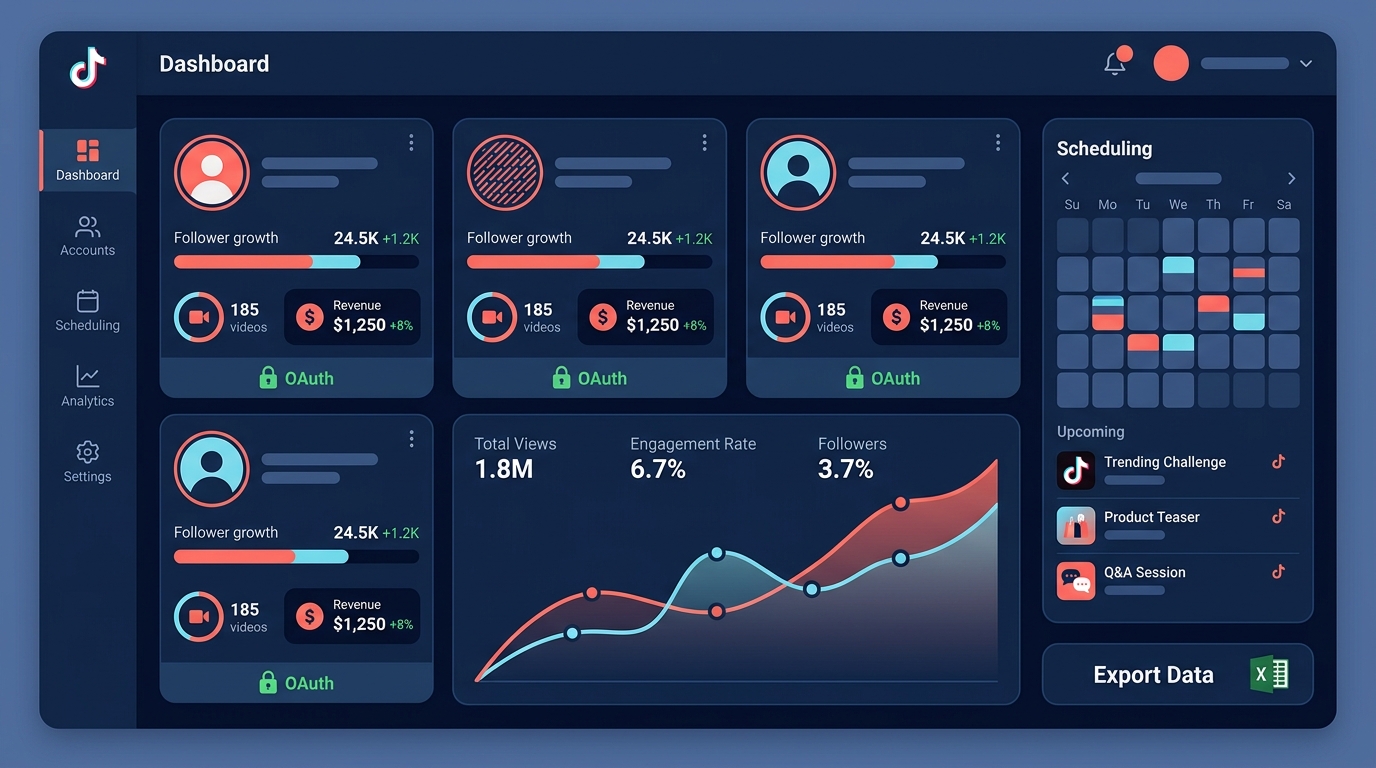
To sum it up: Sellers need a work platform, not just individual AI creation tools.
The biggest pitfall for TikTok Shop sellers is treating AI-powered content creation tools as a social media management platform. Writing 10 scripts is helpful, but after that, five questions arise: Who schedules the content? Who synchronizes across multiple platforms? Who replies to comments? Who identifies purchase intent? Who analyzes the data?
If these problems are still handled manually, the team has only sped up the "copywriting" step, but the overall operational efficiency has not truly improved.
SocialEcho is more suitable for TikTok Shop sellers because it's positioned not as a single-point content creation assistant, but as a comprehensive social media AI workbench. It covers content publishing, interaction management, data analysis, social media monitoring, and AI automation, connecting the multi-platform operational processes of TikTok Shop sellers.
Why can't TikTok Shop sellers only operate TikTok?
TikTok is an important entry point for transactions, but it is not the only touchpoint for users. After watching a short video promoting a product, a user may visit the brand's Instagram page, check user reviews on Facebook, watch product reviews on YouTube, and finally return to TikTok Shop to place an order.
This means that TikTok Shop sellers need to solve at least three cross-platform issues: how to reuse content, how to centrally process comments, and how to uniformly judge data.
For example, a short video on "foundation concealer test" can attract clicks with a 3-second before-and-after comparison on TikTok, be made into more visually appealing Reels on Instagram, add purchase links and shade descriptions on Facebook, and strengthen the review logic on YouTube Shorts. Without a unified tool, the same material might have to be uploaded four times, comments would have to be refreshed four times, and weekly reports would have to be compiled from screenshots.
For small seller teams of 2-5 people, this way of working will soon reach its limit.
Choose the AI Social Media Management Workbench and check out these 5 capabilities.
1. Does it support content publishing across multiple platforms?
TikTok Shop sellers need to consistently post content. SocialEcho's TikTok scheduled posting and content publishing capabilities support one-click distribution to multiple platforms and accounts, supporting formats such as text, images, videos, links, and emojis. It also supports scheduled and batch scheduled posting.
Data shows that SocialEcho content publishing can save 90% of publishing time, supports 24/7 scheduled publishing, and improves publishing efficiency by 5x. For sellers, this means they can batch-plan content for the next 7 days on Mondays, instead of logging into multiple backends each day.
2. Can reviews and purchase inquiries be centrally managed?
The comment section of TikTok Shop is often the front line for sales. Users ask questions like "How do I buy it?", "Which shade is suitable for warm skin tones?", "How many days will it take to ship?", and "Are there any discounts?". If the response is slow, the purchase intention may be lost immediately.
SocialEcho's TikTok comment and interaction management capabilities can automatically aggregate user comments from multiple platforms for unified management. It uses AI to identify user emotions and intentions, such as positive reviews, complaints, inquiries, and purchase requests. Centralized interaction management can save over 80% of manual costs, achieve over 95% accuracy in emotion recognition, and improve interaction efficiency by 3x.
Sellers can categorize reviews into four types: purchase inquiries, product issues, after-sales risks, and general interactions. Purchase inquiries can be quickly answered with links or promotional information, while after-sales risks are marked for manual handling.
3. Can AI be used to automate and reduce repetitive responses?
AI automation isn't about making bots give random replies; it's about handling high-frequency, low-risk issues first. SocialEcho's AI automation features support automatic comment categorization, intelligent sentiment analysis, automatic keyword recognition, automatic replies, and custom automation rules.
Its workflow is "data collection → AI analysis → rule matching → automatic execution". AI automation can reduce repetitive work by 90%+, supports 24/7 online operation, and has an AI accuracy rate of 95%+.
TikTok Shop sellers can set up these rules: when "link," "how to buy," or "discount code" appears, automatically reply with the purchase path; when "refund," "not received," or "broken" appears, automatically mark it as high priority and transfer it to human agent; when "color number," "size," or "fit" appears, reply with FAQ or guide customer service to confirm.
4. Does it have multi-platform data analysis capabilities?
TikTok Shop sellers shouldn't just look at view counts. What they really need to look at is whether their content generates interaction, comments, saves, and purchase inquiries.
SocialEcho's TikTok data analytics supports real-time aggregation of data from multiple platforms and accounts, covering follower count, content volume, impressions, interactions, comments, likes, shares, and saves. It supports viewing 180 days of historical data, with data automatically updated hourly, and also supports Excel export.
This solves the pain point for sellers in creating weekly reports. In the past, operations might have required taking screenshots separately from TikTok, Instagram, and Facebook; now, performance across multiple platforms can be compared centrally to determine which types of content are worth reusing and which platforms require increased investment.
5. Does it support social media monitoring and competitor monitoring?
Competition in the TikTok Shop market is fierce, and sellers can't rely solely on their own backend data. When competitors launch new products, which content suddenly goes viral, and what users complain about in the comments section can all influence your product selection and content strategy.
SocialEcho's social media monitoring feature supports keyword monitoring, competitor activity monitoring, and sentiment fluctuation alerts on platforms such as TikTok, Facebook, Instagram, X, and YouTube. It supports over 1000 custom keywords, boasts AI sentiment analysis with an accuracy rate of over 95%, and provides 24/7 real-time monitoring.
For TikTok Shop sellers, competitor monitoring is not just something to "watch the show," but a source of input for product selection, pricing, content angles, and crisis response.

Why SocialEcho is suitable for TikTok Shop sellers
SocialEcho is suitable for TikTok Shop sellers not because it only serves TikTok, but because it connects TikTok with other platforms.
First, it reduces repetitive operations when publishing across multiple platforms. Sellers can rewrite the same batch of materials into versions for different platforms and then schedule their releases uniformly.
Secondly, it allows for centralized processing of comments and purchase inquiries. Comments from platforms like TikTok, Instagram, and Facebook are no longer scattered across multiple backends, making it easier for teams to identify purchase intent.
Third, it transforms data review from simply piecing together screenshots into a unified analysis. SocialEcho supports 10+ data metrics, 180 days of historical data, and Excel export, making it suitable for weekly reviews.
Fourth, it can use AI to automate the handling of high-frequency issues. High-risk issues are handled manually, while high-frequency issues are automatically triaged, saving time and reducing the risk of missed responses.
Fifth, it helps sellers analyze competitor and industry changes. By monitoring keywords and competitor posts, teams can identify unusual trends without manually refreshing competitor pages daily.
Recommendation Workflow for TikTok Shop Sellers
If you are upgrading from single-platform operation to multi-platform operation, you can follow these 6 steps:
Step 1: Collect product selling points, user reviews, and competitor best-selling products every week to build a topic pool.
Step 2: Rewrite each topic into TikTok, Instagram, Facebook, and YouTube Shorts versions.
Step 3: Use SocialEcho to batch schedule content for the next 7 days.
Step 4: Use interactive management to centrally process comments from multiple platforms.
Step 5: Use AI to automate responses to high-frequency, low-risk questions, and transfer after-sales and complaints to human agents.
Step 6: Export the data weekly and review the 3 best-performing and 3 worst-performing items.
The key to this process is to first close the loop, then scale it up. Without a closed loop of publishing, commenting, and data, simply increasing the amount of content will only make the team more chaotic.
Sellers should avoid three common mistakes when choosing tools.
The first misconception is focusing solely on AI-generated content. TikTok Shop sellers need a complete operational chain, not just initial drafts of copy.
The second misconception is focusing solely on TikTok. User decisions occur across platforms, and brand trust needs to be built across multiple platforms.
The third misconception is that automation means unattended operation. Reliable automation should have rules, human review, and data analysis, rather than allowing AI to speak on behalf of the brand at will.
Frequently Asked Questions (FAQ)
Q1: Why do TikTok Shop sellers need an AI social media management platform?
Sellers need to handle content publishing, comment inquiries, data analysis, and competitor monitoring simultaneously. An AI-powered social media management platform can reduce repetitive tasks, allowing teams to focus their time on product selection, content strategy, and communication with high-value clients.
Q2: Is SocialEcho suitable for TikTok Shop sellers?
Suitable. SocialEcho covers content publishing, interaction management, data analysis, social media monitoring, and AI automation, making it suitable for TikTok Shop sellers to manage content and interactions across multiple platforms such as TikTok, Instagram, Facebook, and YouTube.
Q3: What is the difference between AI creation tools and AI social media management workbench?
AI-powered content creation tools primarily address copywriting generation; AI-powered social media management tools also handle posting scheduling, comment processing, data analysis, and competitor monitoring. TikTok Shop sellers require a more comprehensive workbench.
Q4: Can SocialEcho automatically reply to TikTok comments?
SocialEcho's interaction management and AI automation support automatic comment categorization, sentiment analysis, keyword recognition, automatic replies, and custom rules. It's recommended to start with low-risk, high-frequency issues, and then transfer after-sales and complaints to human agents.
Q5: Which platforms should a TikTok Shop seller operate on simultaneously?
At a minimum, it's recommended to reuse content from Instagram, Facebook, and YouTube Shorts around TikTok. The specific platform depends on the category, target market, and team resources.
Q6: Will publishing on multiple platforms lead to content duplication?
Simply copying will appear repetitive. A better approach is to use a core element and rewrite the intro, title, subtitles, cover image, and action lines for each platform.
Q7: How can I determine if AI-powered social media tools truly improve efficiency?
Look at four metrics: Has the posting time decreased? Has the number of missed comments decreased? Has the weekly report production become faster? Can viral content be reused more quickly? The SocialEcho product knowledge base mentions that content posting can save 90% of posting time.
Q8: Can TikTok Shop sellers rely entirely on automated replies?
Not recommended. Automated replies are suitable for high-frequency, low-risk questions such as prices, links, sizes, and logistics information; refunds, negative reviews, quality complaints, and sensitive disputes should be handled manually.
Q9: Does SocialEcho support data export?
Supported. SocialEcho data analytics supports exporting to Excel format, allowing for customization of report content and time ranges, making it suitable for team weekly reports and debriefings.
Q10: Which feature should new sellers on TikTok Shop use first?
We recommend starting with content scheduling and centralized comment management. These methods minimize repetitive work and help the team quickly stabilize content production pace and respond to user issues.
Summarize
In 2026, TikTok Shop sellers should not only consider whether their AI social media management platform can write copy, but also whether it can connect to multiple platforms for posting, comment management, data analysis, competitor monitoring, and AI automation.
SocialEcho is better suited for TikTok Shop sellers because it integrates all these processes into a single platform. Sellers can also combine it with Facebook comment management for cross-platform comment distribution, avoiding the need to focus solely on the TikTok backend. For teams transitioning from single-platform sales to multi-platform growth, the real key isn't having more tools, but reducing bottlenecks: ensuring content gets published, comments are handled effectively, data is clear, and competitors are monitored.
Therefore, the core criterion for TikTok Shop sellers when choosing tools is not "how much AI can write," but "how few opportunities the team can miss." Connecting posting, commenting, data, and competitor monitoring first, and then scaling up content volume, is the more stable multi-platform growth path in 2026.
;}.cls-2{fill:%230868f7;}.cls-3{fill:url(%23未命名的渐变_44);}.cls-4{fill:%23333;}%3c/style%3e%3clinearGradient%20id='未命名的渐变_8'%20x1='33.73'%20y1='100.61'%20x2='-0.03'%20y2='-1.06'%20gradientUnits='userSpaceOnUse'%3e%3cstop%20offset='0'%20stop-color='%237ae9fb'/%3e%3cstop%20offset='0.67'%20stop-color='%232b90f8'/%3e%3cstop%20offset='1'%20stop-color='%230868f7'/%3e%3c/linearGradient%3e%3clinearGradient%20id='未命名的渐变_44'%20x1='27.86'%20y1='18.67'%20x2='68.36'%20y2='22.22'%20gradientUnits='userSpaceOnUse'%3e%3cstop%20offset='0'%20stop-color='%235ac7f2'/%3e%3cstop%20offset='1'%20stop-color='%230868f7'/%3e%3c/linearGradient%3e%3c/defs%3e%3cpath%20class='cls-1'%20d='M29,28.74V81.91l-9.51-3.68v0L8.52,74A7.17,7.17,0,0,1,4,67.32V24.54A3.76,3.76,0,0,1,9.08,21Z'/%3e%3cpath%20class='cls-2'%20d='M68.09,78.07a13.15,13.15,0,0,1-17.9,12.06L29,81.91h0V28.74L50.19,37A13.17,13.17,0,0,0,68.08,25.3h0Z'/%3e%3cpath%20class='cls-3'%20d='M68.08,25.3a13.19,13.19,0,0,1-6.73,10.87A13.09,13.09,0,0,1,50.19,37L29,28.74V6A3.76,3.76,0,0,1,34.1,2.52l25.59,9.91A13.22,13.22,0,0,1,68.08,25.3Z'/%3e%3cpath%20class='cls-4'%20d='M129.06,81.76a4.33,4.33,0,0,1-3.19-1.31,4.4,4.4,0,0,1-1.31-3.24V56.86H97.65V77.21a4.36,4.36,0,0,1-1.35,3.2A4.68,4.68,0,0,1,93,81.76a4.32,4.32,0,0,1-3.19-1.31,4.37,4.37,0,0,1-1.32-3.24V27.27A4.58,4.58,0,0,1,89.83,24a4.59,4.59,0,0,1,7.82,3.27V48.15h26.91V27.27A4.58,4.58,0,0,1,125.91,24a4.59,4.59,0,0,1,7.82,3.27V77.21a4.37,4.37,0,0,1-1.36,3.2A4.65,4.65,0,0,1,129.06,81.76Z'/%3e%3cpath%20class='cls-4'%20d='M163.77,81.66c-6.57,0-11.76-1.92-15.44-5.7s-5.54-9.07-5.54-15.74a26.76,26.76,0,0,1,2.09-10.43,17.72,17.72,0,0,1,6.67-8.06,19.15,19.15,0,0,1,10.68-2.95,19,19,0,0,1,10.46,2.8,18.7,18.7,0,0,1,6.55,7.36,22.53,22.53,0,0,1,2.36,10.28A4.51,4.51,0,0,1,177,63.77H152.23a10.8,10.8,0,0,0,3.49,6.65c2,1.68,4.88,2.52,8.66,2.52a22.25,22.25,0,0,0,7.54-1.21c.74-.3,1.55-.67,2.37-1.07a3.75,3.75,0,0,1,1.84-.4,4.09,4.09,0,0,1,3,1.15,4,4,0,0,1,1.12,3,4.38,4.38,0,0,1-2.58,3.82,32.34,32.34,0,0,1-6.36,2.61A28.67,28.67,0,0,1,163.77,81.66ZM172.4,55.9a9.72,9.72,0,0,0-1.63-4.56A9.9,9.9,0,0,0,167,48a10.38,10.38,0,0,0-4.64-1.14,12,12,0,0,0-4.77,1.06,9.54,9.54,0,0,0-4.89,5.66,11.78,11.78,0,0,0-.51,2.3Z'/%3e%3cpath%20class='cls-4'%20d='M193,81.64a4.49,4.49,0,0,1-4.51-4.55V27.28A4.58,4.58,0,0,1,189.84,24a4.48,4.48,0,0,1,3.28-1.36A4.36,4.36,0,0,1,196.35,24a4.46,4.46,0,0,1,1.31,3.31V77.09a4.34,4.34,0,0,1-1.35,3.2A4.67,4.67,0,0,1,193,81.64Z'/%3e%3cpath%20class='cls-4'%20d='M263.79,81.71a5.7,5.7,0,0,1-4.2-1.74,5.76,5.76,0,0,1-1.73-4.19V27.37a4.58,4.58,0,0,1,1.35-3.27A4.59,4.59,0,0,1,267,27.37V72.53h24a4.58,4.58,0,0,1,3.27,7.82A4.66,4.66,0,0,1,291,81.71Z'/%3e%3cpath%20class='cls-4'%20d='M424.48,81.74a4.71,4.71,0,0,1-2.71-.88,5.43,5.43,0,0,1-1-1l-.07-.09-12.41-17-5.41,5v9.44a4.31,4.31,0,0,1-1.36,3.19,4.66,4.66,0,0,1-3.3,1.36A4.29,4.29,0,0,1,395,80.42a4.36,4.36,0,0,1-1.32-3.23V27.37A4.58,4.58,0,0,1,395,24.1a4.52,4.52,0,0,1,6.58.12,4.54,4.54,0,0,1,1.24,3.15V56.31l17.72-16.38.05,0a4.8,4.8,0,0,1,2.94-1.11,4.4,4.4,0,0,1,3.27,1.2,4.57,4.57,0,0,1,1.2,3.27,4.44,4.44,0,0,1-.77,2.33,7.45,7.45,0,0,1-1.43,1.65l-11,9.64,13.34,17.68a5,5,0,0,1,1,2.71,4.12,4.12,0,0,1-1.36,3.24A4.64,4.64,0,0,1,424.48,81.74Z'/%3e%3cpath%20class='cls-4'%20d='M317.93,81.76a21.5,21.5,0,1,1,21.17-21.5A21.37,21.37,0,0,1,317.93,81.76Zm0-34.1a12.61,12.61,0,1,0,12.42,12.6A12.52,12.52,0,0,0,317.93,47.66Z'/%3e%3cpath%20class='cls-4'%20d='M212.18,101.22a4.12,4.12,0,0,1-3.05-1.26,4.17,4.17,0,0,1-1.26-3.1V43.34a4.37,4.37,0,0,1,1.3-3.14,4.26,4.26,0,0,1,3.13-1.3,4.19,4.19,0,0,1,3.1,1.26,4.32,4.32,0,0,1,1.26,3.16,20.77,20.77,0,0,1,13-4.54,21.51,21.51,0,0,1,0,43,20.51,20.51,0,0,1-13-4.57V96.86a4.15,4.15,0,0,1-1.3,3.06A4.5,4.5,0,0,1,212.18,101.22Zm17.43-53.63c-6.23,0-12.93,4.11-12.93,12.72a12.73,12.73,0,0,0,25.46,0A12.71,12.71,0,0,0,229.61,47.59Z'/%3e%3cpath%20class='cls-4'%20d='M365.76,81.76a21.5,21.5,0,1,1,21.18-21.5A21.37,21.37,0,0,1,365.76,81.76Zm0-34.1a12.61,12.61,0,1,0,12.42,12.6A12.52,12.52,0,0,0,365.76,47.66Z'/%3e%3c/svg%3e)