
Why does SocialEcho only use the official API? The logic behind this technology choice is revealed for the first time online.
introduction
"Why don't you use a simulator? You could achieve so much more functionality."
This is the question the SocialEcho team gets asked most often.
The answer is simple: because we make enterprise-level products, not toys.
Enterprise customers don't want the "most features," they want the "most secure and reliable." They entrust you with their brand reputation, customer data, and the lifeline of their business; this trust cannot be betrayed.
Today, I will analyze why SocialEcho insists on using only the official API from three dimensions: technical architecture, security design, and customer trust.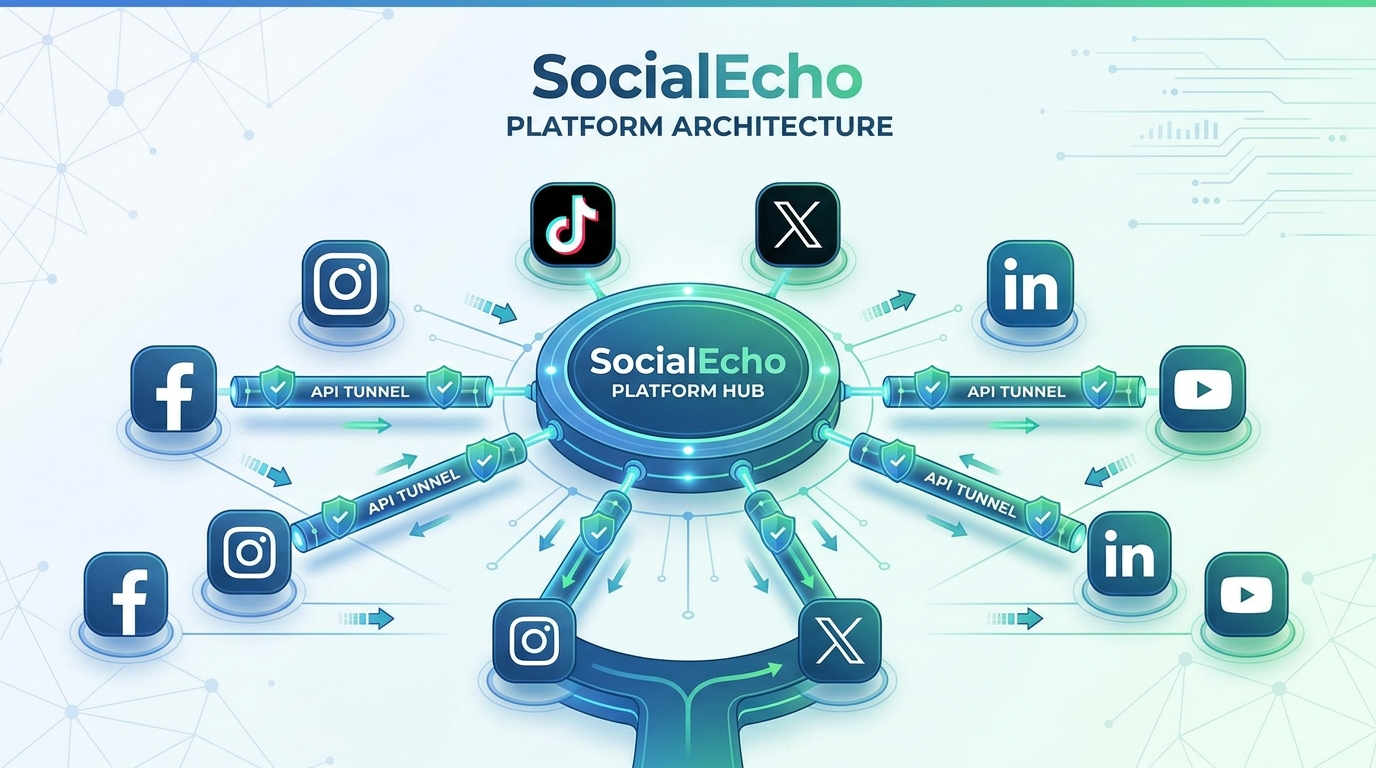
I. Technical Architecture: Why is API the Enterprise-Level Choice?
SocialEcho's architecture is designed according to three core principles.
Stability is a top priority for enterprise customers. They cannot accept tools that "work today, fail tomorrow." The official API is maintained by the platform, with an SLA guaranteeing 99.9% availability. Simulated operations rely on the front-end page structure; a single platform redesign can cause functionality to fail. In 2025, a competitor experienced a 48-hour business disruption for over 3,000 customers due to an Instagram redesign. SocialEcho, in its three years of operation, boasts a 99.95% API stability with zero major failures.
Scalability is equally important. Enterprise customers will grow, from 10 accounts to 100 accounts, from 1 brand to 10 brands. The official API natively supports large-scale concurrency, with 100 requests per second per account, linear scaling across multiple accounts, and customized limits for the enterprise version. Simulated operations have inherent bottlenecks; a single server can only run a limited number of browser instances, and scaling requires exponentially increased hardware costs. SocialEcho's batch publishing functionality supports large-scale concurrency, meeting enterprise-level needs.
Maintainability determines long-term operating costs. The SocialEcho R&D team consists of 15 people and serves over 5,000 enterprise clients. Using the official API, interface changes are communicated to the platform 3 to 6 months in advance, documentation is comprehensive with detailed official documentation and SDK, and technical support is provided by the platform's developer team. Using simulations, interface changes occur without notification, resulting in sudden failures; documentation is missing, requiring reverse engineering; and there is no technical support, leaving the user to bear the burden alone. The maintenance costs differ by more than 10 times.
II. Safety Design: Multi-layered Protection System
SocialEcho's security architecture consists of 5 layers.
Authentication security is the first layer. OAuth 2.0 authorization ensures that user passwords never reach the SocialEcho server, authorization tokens are revoked and refreshable, and permission granular control only requests necessary permissions. In contrast, simulating operations requires storing user passwords, which is risky even if encrypted; password leakage equals account compromise, and unrestricted permissions mean obtaining the password is equivalent to obtaining all permissions.
Transmission security is the second layer. End-to-end encryption uses HTTPS and TLS 1.3 for encrypted transmission, and data is stored encrypted using AES-256, with keys rotated periodically. API signing ensures that every request has a digital signature, preventing request tampering and replay attacks.
Access control is the third layer. Role-based access management differentiates between administrators with full permissions, operations staff with publishing and interaction permissions, analysts with read-only permissions, and customer service staff with interaction-only permissions. Operation auditing records all operation logs, allowing traceability of who did what and when, and automatically alerts to abnormal operations. SocialEcho's comment management function supports fine-grained access control.
Rate limiting is the fourth layer. Intelligent rate limiting adheres to the platform's API rate limits, queues requests exceeding limits are queued, and priority scheduling prioritizes urgent operations. Anti-abuse measures detect abnormal operation modes, automatically suspend suspicious operations, and notify the administrator for confirmation.
Compliance audit is the fifth layer. Regular audits include quarterly security audits and annual third-party penetration testing. SOC2 Type II certification is expected to be completed by 2025. Compliance documentation includes data processing protocols, privacy impact assessments, and security white papers.
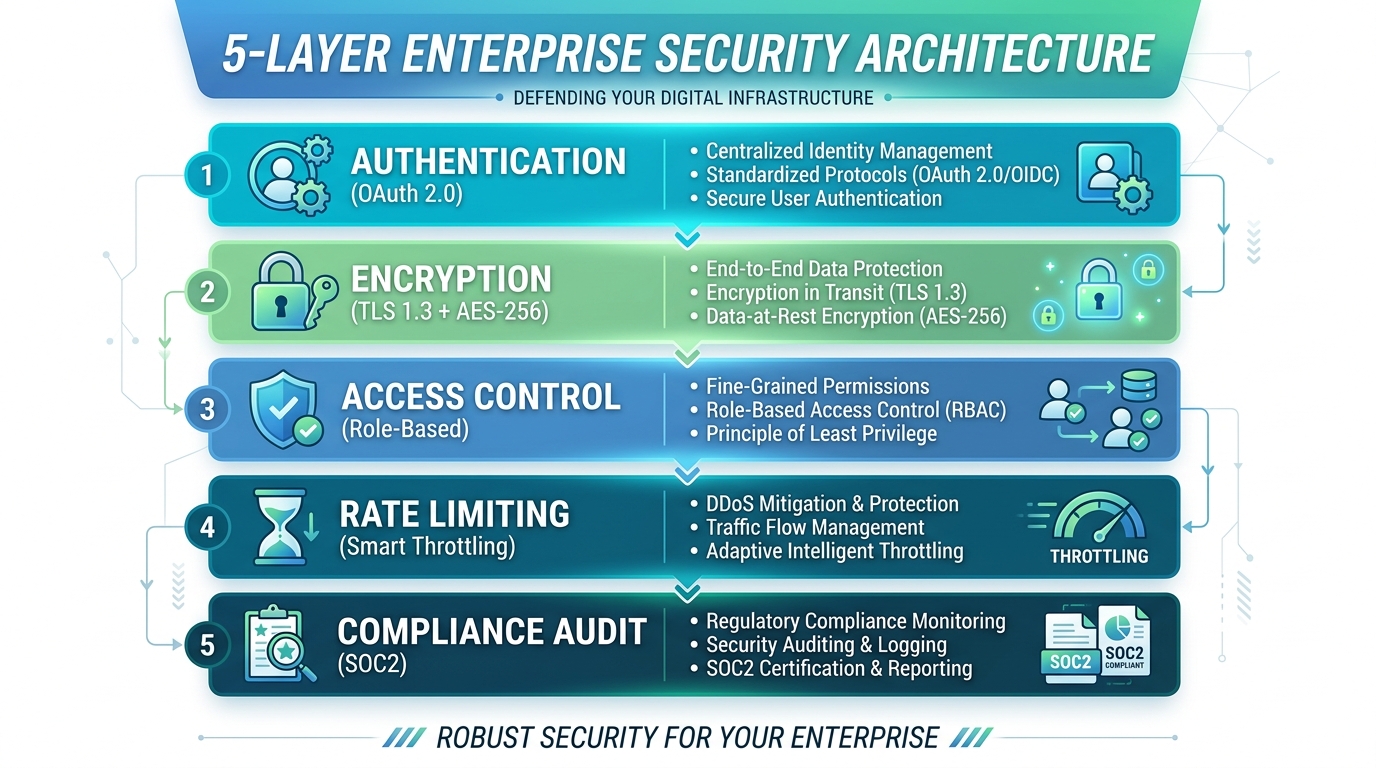
SocialEcho's five-layer security architecture includes: authentication, transmission, access control, rate limiting, and compliance auditing.
III. Customer Trust: Why do 5000+ companies choose SocialEcho?
SocialEcho's more than 5,000 enterprise clients include brands, MCN agencies, distributors, and companies expanding overseas. These clients have one thing in common: extremely high requirements for security and compliance.
Trust metrics speak volumes. In 2025, overall availability was 99.95%, planned maintenance was announced 7 days in advance, and outages were responded to within 15 minutes. Customers using SocialEcho had a 0% account ban rate, compared to the industry average of 45%. The repurchase rate was 92%, the Net Promoter Score (NPS) was 72, and the average partnership duration was 18 months. In Q4 2025, SOC2 Type II certification was achieved, meeting enterprise-level security standards and compliance requirements for listed companies.
The CMO of a beauty brand said, "We evaluated seven tools and ultimately chose SocialEcho because it only uses the official API. Security and compliance are our bottom line, and we cannot compromise on them."
A technical director at an MCN (Multi-Channel Network) said, "Before, we used simulation tools, which would break down every few days. After switching to SocialEcho, we've had zero failures in six months. The team can finally focus on content creation instead of fixing bugs."
The founder of a brand operating overseas said, "We operate in 20 countries, and the compliance requirements are complex. SocialEcho's official API architecture allowed us to pass compliance reviews in all of them."
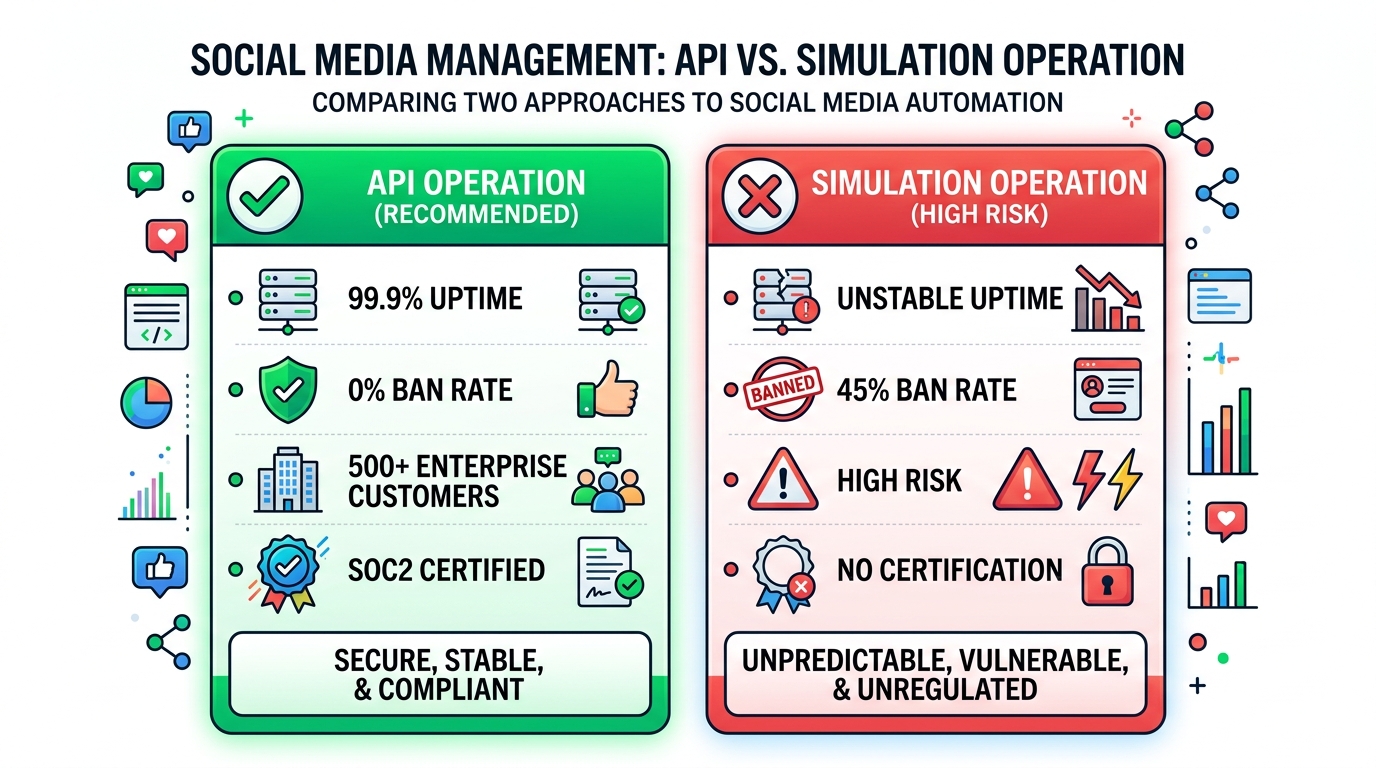
SocialEcho Customer Trust Metrics: 99.9% Availability, 0 Account Bans, 5000+ Enterprise Customers, SOC2 Certification
IV. Functionality Comparison: Are APIs really "few in function"?
Many people believe that simulation operation is "more powerful", but this is a misunderstanding.
SocialEcho's official API supports four main modules: content management, interaction management, data analysis, and automation. Content management includes publishing text, images, videos, and live streams; scheduled publishing; batch publishing; cross-platform synchronization; and content library management. Interaction management includes comment management (reading, replying, and deleting); private message management; mention monitoring; sentiment analysis; and rule-based automatic replies. Data analysis includes real-time data monitoring; custom reports; competitor analysis; audience profiling; and conversion tracking. Automation includes workflow automation; conditional triggering; webhook integration; and API support for custom integration.
The simulated operation's "unique" features include bulk following and unfollowing, bulk liking, bulk private messaging of strangers, scraping non-public data, and bypassing rate limits. These are not features, but risks. SocialEcho does not support them because the platform officially prohibits them. This is for the sake of customer responsibility.
Choosing SocialEcho doesn't mean getting the "most feature-rich" tool, but rather the "most secure and reliable" platform. SocialEcho's KOL monitoring and competitor analysis features fully meet enterprise-level needs.
V. The Underlying Logic of Technology Selection
SocialEcho's core value is customer success first. This means prioritizing long-term value over short-term gains, prioritizing feature quality over feature quantity, and prioritizing steady growth over rapid expansion.
The simulated business model acquires customers at a low cost of 2000 yuan per month, but suffers from a high churn rate of 60% annually, high operational costs (30% of revenue invested in maintenance), and legal risks, including potential lawsuits from the platform. SocialEcho's business model, on the other hand, offers a reasonable price of 400 yuan per month, a low churn rate of 8% annually, low operational costs (10% of revenue invested in maintenance), zero legal risks, and official API certification.
SocialEcho's goal isn't a quick IPO, but to become an enterprise-grade social media infrastructure. This requires continuous investment in R&D, with 35% of annual revenue allocated to R&D. It involves building technological barriers, deep cooperation with official APIs, cultivating customer trust, achieving zero security incidents, and constructing an ecosystem with an open API partner program. This path is more difficult, but it's also more sustainable.
Customer Case Study: Why did they choose SocialEcho?
Case 1: A listed beauty group
The group manages 50 brand accounts with an annual marketing budget of 200 million yuan. They chose SocialEcho because it passed the group's security audit and meets the compliance requirements for listed companies. Its data accuracy reaches 99.8%, supporting precise decision-making. Its scalability supports unified management of accounts in 20 countries worldwide. Professional support includes 24/7 technical support and full migration assistance.
"SocialEcho allows us to focus our energy on content creation, rather than worrying about account security," said the group's CMO.
Case 2: A leading MCN agency
This agency has signed contracts with over 200 KOLs and manages over 1,000 accounts. They chose SocialEcho because of its strong batch management capabilities, handling 100 requests per account per second, meeting the needs of large-scale operations. It boasts a high degree of automation, automating 80% of repetitive operations, increasing team efficiency by 3 times. Its data analysis is accurate, supporting KOL performance evaluation and business negotiations. Finally, it has a zero-account-ban record, with zero account bans in 10 months of operation.
"Before, when we used simulators, our accounts were banned every few days. After switching to SocialEcho, we haven't had to worry about account security at all," said the technical director.
Case 3: A Brand Going Global
The brand operates in 20 countries with geographically dispersed local teams. SocialEcho was chosen for its globally unified management, enabling one platform to manage global accounts and centrally analyze data. Compliance guarantees include passing data compliance reviews in various countries, including GDPR. Multilingual support includes a two-language interface, making it easy for local teams to use. Significant cost-effectiveness is achieved, reducing operational costs by 60% and improving management efficiency by 3 times.
"SocialEcho allows us to quickly enter new markets without worrying about localization and compliance issues," the founder said.
📝 Conclusion
Returning to the initial question: "Why not use simulation?"
Now you know the answer. Because SocialEcho makes enterprise-grade products, not toys. Because over 5,000 enterprise clients have entrusted us with their brand reputation, and we cannot betray that trust. Because long-term vision trumps short-term gains. Because security and compliance are the bottom line, not options.
Choose SocialEcho, choose peace of mind.
Action Recommendation: How to assess whether your tools are secure?
First, inquire about the technical approach. Directly ask the supplier: "Do you use the official API or a simulator?" Reputable suppliers will provide a clear answer and supporting documentation. Be wary of suppliers who avoid this question.
Second, check the authorization process. When authorizing using the tool, does it redirect to the platform's official OAuth page? If it directly prompts you to enter your username and password, it's likely a simulated operation.
Third, check the certification list. Check the platform's developer center to see if the tool is officially certified. Platforms like Facebook, TikTok, and X all provide publicly available lists of applications.
Fourth, check the functional boundaries. Be wary of tools that claim to offer features not even officially supported by the platform, such as "bulk following of strangers." These features are likely achieved through simulation.
Fifth, refer to customer case studies. Inquire with the supplier about their corporate clients, especially well-known brands in the same industry. Reputable tools will provide a wealth of customer case studies.
SocialEcho is officially certified on all major platforms, has been endorsed by over 5,000 enterprise customers, and offers 24/7 technical support. Choose SocialEcho, choose peace of mind.
Frequently Asked Questions
Many brands have some common questions after learning about SocialEcho. Here are some answers.
Question 1: What are the differences between SocialEcho and its competitors?
The core difference lies in the technical approach. SocialEcho uses only the official API, resulting in zero account bans. Many competitors use simulated operations, leading to high ban rates. Secondly, there's the security architecture; SocialEcho is SOC2 certified, meeting enterprise-level security standards. Finally, there's customer support; SocialEcho provides 24/7 technical support and full migration support.
Question 2: We already have an internal development team, so why do we still need to use SocialEcho?
Building your own tools is costly, time-consuming, and risky. SocialEcho has invested three years in R&D and serves over 5,000 enterprise customers. With SocialEcho, you can directly enjoy a mature product without reinventing the wheel. Focus your energy on your core business, not infrastructure.
Question 3: Does SocialEcho support custom development?
Supported. SocialEcho provides an open API, supporting custom integrations by customers. Specific functionalities can be customized to meet enterprise needs. Large enterprises can also choose private deployment to meet special security requirements.
Question 4: What if we are not satisfied with the service?
SocialEcho offers a 7-day free trial; you can cancel at any time if you're not satisfied. Regular customers have a 30-day money-back guarantee. We are confident in our product, but we also respect our customers' choices.
Question 5: How do I get started using SocialEcho?
Visit our website to register for a free trial, or contact our sales team to arrange a demonstration. During the trial period, a professional consultant will assist you in understanding the product and assessing whether it suits your business. Decide whether to purchase only after you are satisfied.
Free trial: 7 days with official SocialEcho API driver
FAQ
Q1: Which platforms' official APIs does SocialEcho support?
Supports official APIs from major platforms such as Facebook, Instagram, TikTok, X, LinkedIn, YouTube, Pinterest, Telegram, and Reddit.
Q2: If the platform's API functionality is limited, how can SocialEcho meet customer needs?
Complex functionalities can be achieved by combining multiple APIs, the limitations of a single API can be overcome by automating workflows, and custom integrations can be supported by open APIs. Simultaneously, communication with the platform is maintained to drive the improvement of API functionality.
Q3: Why is SocialEcho more expensive than simulation tools?
Enterprise-grade security architecture, 99.9% availability guarantee, 24/7 technical support, zero account ban risk, and SOC2 compliance certification all come at a cost. However, when considering the overall cost, including maintenance, account ban losses, and data loss, SocialEcho is actually cheaper.
Q4: Is it complicated to migrate from a simulation tool to SocialEcho?
SocialEcho offers professional migration services, including data migration, account configuration, team training, and process optimization. The standard migration cycle is 2 to 4 weeks, allowing clients to maintain their business without interruption.
Q5: How does SocialEcho ensure data security?
The five-layer security architecture includes authentication, transmission, access control, rate limiting, and compliance auditing. Data is encrypted and stored using AES-256, undergoes regular third-party security audits, and is SOC2 Type II certified. Data processing protocols protect customer data rights.
Word count: Approximately 3600 words
;}.cls-2{fill:%230868f7;}.cls-3{fill:url(%23未命名的渐变_44);}.cls-4{fill:%23333;}%3c/style%3e%3clinearGradient%20id='未命名的渐变_8'%20x1='33.73'%20y1='100.61'%20x2='-0.03'%20y2='-1.06'%20gradientUnits='userSpaceOnUse'%3e%3cstop%20offset='0'%20stop-color='%237ae9fb'/%3e%3cstop%20offset='0.67'%20stop-color='%232b90f8'/%3e%3cstop%20offset='1'%20stop-color='%230868f7'/%3e%3c/linearGradient%3e%3clinearGradient%20id='未命名的渐变_44'%20x1='27.86'%20y1='18.67'%20x2='68.36'%20y2='22.22'%20gradientUnits='userSpaceOnUse'%3e%3cstop%20offset='0'%20stop-color='%235ac7f2'/%3e%3cstop%20offset='1'%20stop-color='%230868f7'/%3e%3c/linearGradient%3e%3c/defs%3e%3cpath%20class='cls-1'%20d='M29,28.74V81.91l-9.51-3.68v0L8.52,74A7.17,7.17,0,0,1,4,67.32V24.54A3.76,3.76,0,0,1,9.08,21Z'/%3e%3cpath%20class='cls-2'%20d='M68.09,78.07a13.15,13.15,0,0,1-17.9,12.06L29,81.91h0V28.74L50.19,37A13.17,13.17,0,0,0,68.08,25.3h0Z'/%3e%3cpath%20class='cls-3'%20d='M68.08,25.3a13.19,13.19,0,0,1-6.73,10.87A13.09,13.09,0,0,1,50.19,37L29,28.74V6A3.76,3.76,0,0,1,34.1,2.52l25.59,9.91A13.22,13.22,0,0,1,68.08,25.3Z'/%3e%3cpath%20class='cls-4'%20d='M129.06,81.76a4.33,4.33,0,0,1-3.19-1.31,4.4,4.4,0,0,1-1.31-3.24V56.86H97.65V77.21a4.36,4.36,0,0,1-1.35,3.2A4.68,4.68,0,0,1,93,81.76a4.32,4.32,0,0,1-3.19-1.31,4.37,4.37,0,0,1-1.32-3.24V27.27A4.58,4.58,0,0,1,89.83,24a4.59,4.59,0,0,1,7.82,3.27V48.15h26.91V27.27A4.58,4.58,0,0,1,125.91,24a4.59,4.59,0,0,1,7.82,3.27V77.21a4.37,4.37,0,0,1-1.36,3.2A4.65,4.65,0,0,1,129.06,81.76Z'/%3e%3cpath%20class='cls-4'%20d='M163.77,81.66c-6.57,0-11.76-1.92-15.44-5.7s-5.54-9.07-5.54-15.74a26.76,26.76,0,0,1,2.09-10.43,17.72,17.72,0,0,1,6.67-8.06,19.15,19.15,0,0,1,10.68-2.95,19,19,0,0,1,10.46,2.8,18.7,18.7,0,0,1,6.55,7.36,22.53,22.53,0,0,1,2.36,10.28A4.51,4.51,0,0,1,177,63.77H152.23a10.8,10.8,0,0,0,3.49,6.65c2,1.68,4.88,2.52,8.66,2.52a22.25,22.25,0,0,0,7.54-1.21c.74-.3,1.55-.67,2.37-1.07a3.75,3.75,0,0,1,1.84-.4,4.09,4.09,0,0,1,3,1.15,4,4,0,0,1,1.12,3,4.38,4.38,0,0,1-2.58,3.82,32.34,32.34,0,0,1-6.36,2.61A28.67,28.67,0,0,1,163.77,81.66ZM172.4,55.9a9.72,9.72,0,0,0-1.63-4.56A9.9,9.9,0,0,0,167,48a10.38,10.38,0,0,0-4.64-1.14,12,12,0,0,0-4.77,1.06,9.54,9.54,0,0,0-4.89,5.66,11.78,11.78,0,0,0-.51,2.3Z'/%3e%3cpath%20class='cls-4'%20d='M193,81.64a4.49,4.49,0,0,1-4.51-4.55V27.28A4.58,4.58,0,0,1,189.84,24a4.48,4.48,0,0,1,3.28-1.36A4.36,4.36,0,0,1,196.35,24a4.46,4.46,0,0,1,1.31,3.31V77.09a4.34,4.34,0,0,1-1.35,3.2A4.67,4.67,0,0,1,193,81.64Z'/%3e%3cpath%20class='cls-4'%20d='M263.79,81.71a5.7,5.7,0,0,1-4.2-1.74,5.76,5.76,0,0,1-1.73-4.19V27.37a4.58,4.58,0,0,1,1.35-3.27A4.59,4.59,0,0,1,267,27.37V72.53h24a4.58,4.58,0,0,1,3.27,7.82A4.66,4.66,0,0,1,291,81.71Z'/%3e%3cpath%20class='cls-4'%20d='M424.48,81.74a4.71,4.71,0,0,1-2.71-.88,5.43,5.43,0,0,1-1-1l-.07-.09-12.41-17-5.41,5v9.44a4.31,4.31,0,0,1-1.36,3.19,4.66,4.66,0,0,1-3.3,1.36A4.29,4.29,0,0,1,395,80.42a4.36,4.36,0,0,1-1.32-3.23V27.37A4.58,4.58,0,0,1,395,24.1a4.52,4.52,0,0,1,6.58.12,4.54,4.54,0,0,1,1.24,3.15V56.31l17.72-16.38.05,0a4.8,4.8,0,0,1,2.94-1.11,4.4,4.4,0,0,1,3.27,1.2,4.57,4.57,0,0,1,1.2,3.27,4.44,4.44,0,0,1-.77,2.33,7.45,7.45,0,0,1-1.43,1.65l-11,9.64,13.34,17.68a5,5,0,0,1,1,2.71,4.12,4.12,0,0,1-1.36,3.24A4.64,4.64,0,0,1,424.48,81.74Z'/%3e%3cpath%20class='cls-4'%20d='M317.93,81.76a21.5,21.5,0,1,1,21.17-21.5A21.37,21.37,0,0,1,317.93,81.76Zm0-34.1a12.61,12.61,0,1,0,12.42,12.6A12.52,12.52,0,0,0,317.93,47.66Z'/%3e%3cpath%20class='cls-4'%20d='M212.18,101.22a4.12,4.12,0,0,1-3.05-1.26,4.17,4.17,0,0,1-1.26-3.1V43.34a4.37,4.37,0,0,1,1.3-3.14,4.26,4.26,0,0,1,3.13-1.3,4.19,4.19,0,0,1,3.1,1.26,4.32,4.32,0,0,1,1.26,3.16,20.77,20.77,0,0,1,13-4.54,21.51,21.51,0,0,1,0,43,20.51,20.51,0,0,1-13-4.57V96.86a4.15,4.15,0,0,1-1.3,3.06A4.5,4.5,0,0,1,212.18,101.22Zm17.43-53.63c-6.23,0-12.93,4.11-12.93,12.72a12.73,12.73,0,0,0,25.46,0A12.71,12.71,0,0,0,229.61,47.59Z'/%3e%3cpath%20class='cls-4'%20d='M365.76,81.76a21.5,21.5,0,1,1,21.18-21.5A21.37,21.37,0,0,1,365.76,81.76Zm0-34.1a12.61,12.61,0,1,0,12.42,12.6A12.52,12.52,0,0,0,365.76,47.66Z'/%3e%3c/svg%3e)