
Why Does Simulation Get Your Account Banned? Unveiling Platform Detection Mechanisms
Introduction
"Our accounts didn't do anything wrong—why were they all banned?"
That was the first thing Wang Lei, the operations director of an e-commerce company in Hangzhou, said to me over the phone in August 2025. Five of their TikTok accounts were banned on the same day, with absolutely no warning. No email notification, no in-app alert, no gradual restriction—just a sudden, complete shutdown of their entire social media presence.
I asked them to share their operation logs. The logs revealed that their management tool had published 12 videos within a single minute, liked 47 posts, and followed 23 accounts. All of this happened while the team was asleep.
"Is this normal behavior?" I asked.
Wang Lei fell silent.

This wasn't "doing nothing wrong"—it was "doing too much, too artificially." In the eyes of a platform's risk control system, this is like a person blinking 50 times per second—obviously not a real human. The platform didn't ban them because they did something wrong; it banned them because they did something impossible for a real person to do.
Today, I'm going to pull back the curtain on how platforms detect simulated operations. I'll walk you through the four major detection dimensions, share real-world case studies, and explain why using official APIs is the only sustainable path forward. Understanding your enemy's weapons is the first step to protecting yourself—and in the world of social media marketing, your accounts are your most valuable asset.
1. IP Fingerprint Detection: Your "Network Identity Card"
It's not just about your IP address. Platforms collect far more dimensions of IP-related information than most people realize, and understanding these dimensions is critical to avoiding detection.
The first dimension is IP geolocation and type—data center IPs and residential broadband IPs look completely different to a platform. Simulation tools typically run on servers using data center IPs, while real users connect through residential broadband or mobile networks. This distinction is immediately obvious to any platform's detection system. Data center IPs are registered to cloud providers like AWS, Google Cloud, or Alibaba Cloud, and platforms maintain extensive databases mapping IP ranges to their owners. When your account logs in from an AWS data center in Virginia, but your profile says you're based in Los Angeles, the platform's alarm bells start ringing.
IP history matters just as much. If a single IP address has been associated with multiple accounts, the platform will flag it as "high risk." Even more critically, a single data center IP might be shared by hundreds or even thousands of accounts. To the platform, this is ironclad evidence of bulk operations. In 2025, a bulk management tool was banned by TikTok because its server IP range was flagged as "data center IPs," and over 3,000 associated accounts were all restricted as a result. The ripple effect was devastating: brands lost months of content, influencers lost their follower base, and agencies lost client trust—all because of a single IP range.
IP switching frequency is another detection dimension. Normal users have relatively stable IP addresses unless they change their network environment. Simulation tools, in an attempt to evade detection, may frequently rotate IPs—but this abnormal behavior actually makes them easier to identify. Think about it: how often does a real person switch from a home Wi-Fi network to a mobile data network to a coffee shop Wi-Fi within the span of an hour? Platforms track these transitions and flag accounts that exhibit impossible mobility patterns. When using the official API for TikTok analytics, all requests originate from SocialEcho's official server IPs, which are registered with the platform and will never be misidentified as suspicious. This is because the platform knows exactly who owns those IPs and has approved them for legitimate API access.
2. Device Fingerprint Detection: Your "Device DNA"
Platforms collect multiple characteristics from your device and combine them into a unique "device fingerprint." This fingerprint is far more sophisticated than most people realize, and it's nearly impossible to spoof convincingly.
Browser type and version are the most basic pieces of information. Operating system version, screen resolution, installed font lists, hardware configuration (CPU core count, memory size), timezone, and language settings—all of these combine to form a device identifier that is nearly impossible to forge convincingly. Even if you manage to spoof your browser's user agent string, the underlying hardware characteristics will still betray you. For example, if your browser claims to be running on an iPhone but your screen resolution and touch capabilities don't match any known iPhone model, the platform will immediately flag the discrepancy.
Browser automation tools have clearly identifiable signatures. Tools like Selenium and Puppeteer set the navigator.webdriver property to true, which is the primary signal platforms look for. This property was specifically designed to help websites detect automated browsing, and platforms use it as a first-line defense. Additionally, these tools often lack certain browser extensions, have abnormal font lists, and their hardware configuration doesn't match the browser version—all of which expose their true identity. Even advanced tools that attempt to hide the navigator.webdriver flag can be detected through more subtle means, such as analyzing the timing of JavaScript execution or checking for the presence of specific browser APIs that automation tools don't fully implement.
In 2025, Instagram upgraded its risk control system by adding "micro-movement detection"—tracking the tiny jitters in mouse movements. Real humans have natural tremors and acceleration variations when moving a mouse, and these variations follow predictable statistical patterns. Automated scripts, on the other hand, produce perfectly straight lines or mathematically smooth curves. This "too perfect" movement actually became the telltale sign. Tens of thousands of accounts using simulated operations were banned as a result, and the tool developers behind them had to completely rewrite their movement simulation algorithms. The lesson is clear: even the smallest details matter when platforms are determined to catch you.
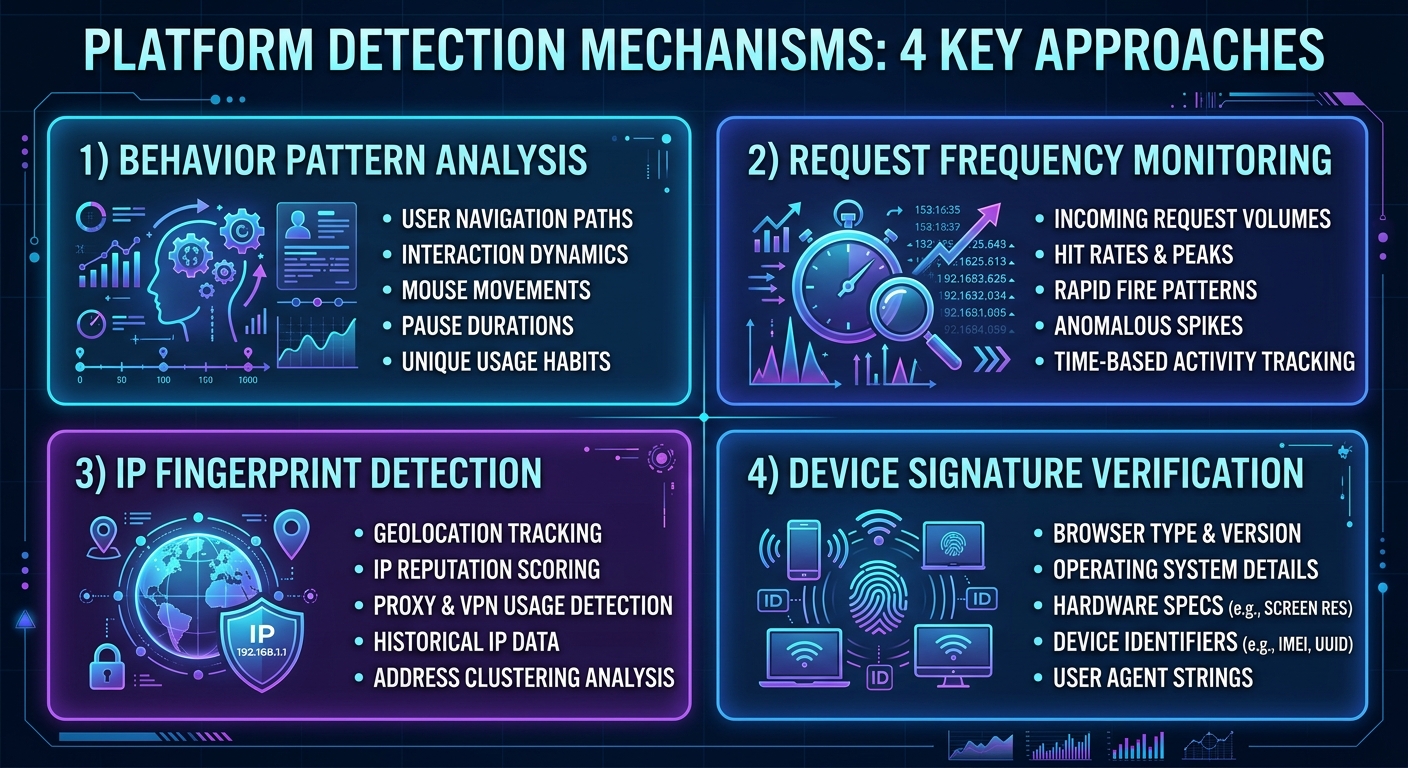
Four major detection dimensions of platform risk control: IP fingerprint, device fingerprint, behavioral patterns, and temporal characteristics
3. Behavioral Pattern Detection: Are You Really "Human"?
This is the most critical detection dimension, and it's also the one that most simulation tools fail to replicate convincingly. Platforms analyze every single action you take to determine whether it matches genuine human behavior patterns, and they use sophisticated machine learning models to make these determinations.
Click behavior reveals a surprising amount of information. Real humans have slight positional offsets when clicking—they don't hit the exact center of an element every single time. Studies have shown that human click positions follow a Gaussian distribution around the target center, with a standard deviation of several pixels. Automated clicks are always perfectly precise, and that precision is itself suspicious. Real humans hesitate briefly before clicking; automated clicks execute instantly. Real humans make accidental misclicks; automated systems never miss. These subtle differences might escape human notice, but machine learning models trained on millions of interaction samples can identify them with remarkable accuracy. Platforms don't need to catch every single anomaly—they just need enough statistical evidence to flag an account for further review.
Scrolling behavior follows similar patterns. Real humans scroll at uneven speeds—starting slow, accelerating in the middle, and slowing down at the end. This is the natural rhythm of human muscle movement, governed by the biomechanics of finger and wrist motion. Automated scrolling moves at a constant speed, lacking this organic variation. Real humans scroll varying distances with randomness; automated scrolling covers fixed distances. By analyzing scroll trajectories, platforms can accurately determine whether an operation is performed by a real person. Some platforms even analyze the pressure applied to touch screens, using the device's touch sensors to detect whether the input comes from a human finger or a simulated touch event.
Typing behavior shows even more obvious differences. Real humans type at fluctuating speeds, slowing down for complex words or unfamiliar phrases. The timing between keystrokes follows a pattern that is unique to each individual, much like a fingerprint. Automated input maintains a constant speed. Real humans make typos and then delete them; automated input contains zero errors. Real humans pause to think before typing; automated systems begin immediately. These details form the foundation of a platform's "human authenticity" assessment, and they're incredibly difficult to fake convincingly.
Browsing behavior can also expose your identity. Real humans scroll through pages, pause to read content, and switch back and forth between sections. They might open a link, read for a few seconds, then return to the previous page. Automated systems tend to jump directly to their target action, skipping the intermediate steps. If an account opens a page, immediately likes, comments, and closes it—without any browsing traces—the platform will flag it as abnormal. When using X platform AI post automation, SocialEcho simulates realistic browsing behavior, including dwell time and scrolling actions, to avoid being flagged as automated. This is possible because SocialEcho uses the official API, which allows it to operate within the platform's defined parameters rather than trying to mimic human behavior through deception.
4. Temporal Characteristic Detection: Your "Daily Rhythm"
Operation frequency is at the core of temporal detection. Real humans have reasonable intervals between actions. After publishing a post, they typically wait a few minutes before checking the results. Likes aren't fired off continuously—they come with natural gaps. Following accounts doesn't happen at a rate of 20 per minute. Simulation tools, in pursuit of efficiency, often exceed these reasonable ranges—and that "efficiency" is precisely what gives them away. The official API's bulk publishing feature automatically adds reasonable intervals between requests, mimicking the rhythm of a real user's operations. This means you can still achieve high-volume publishing without triggering the platform's frequency-based detection systems.
Active hours tell their own story. Real humans have daily routines—they're active during the day, rest at night, and may be less active on weekends. These patterns are so consistent that platforms can build a "behavioral profile" for each account based on its historical activity. Simulation tools might run 24 hours a day without pause, or concentrate operations during unusual time windows. If an account publishes content precisely at 3:00 AM every single day, the platform will suspect automated behavior. Even worse, if an account that normally operates during business hours suddenly starts posting at midnight, the platform will flag this as a potential account takeover or automation switch.
The regularity of time distribution matters equally. Real humans' operation times are distributed randomly, while simulated operations often follow fixed intervals. For example, executing an action every exactly 5 seconds—this mechanical regularity stands out to a platform like a strobe light in a nightclub. Platforms use statistical analysis to detect these patterns, looking for operations that occur at mathematically precise intervals. Even tools that add random delays often fail to generate truly random distributions, and platforms can detect the difference between genuine randomness and pseudo-random number generation.
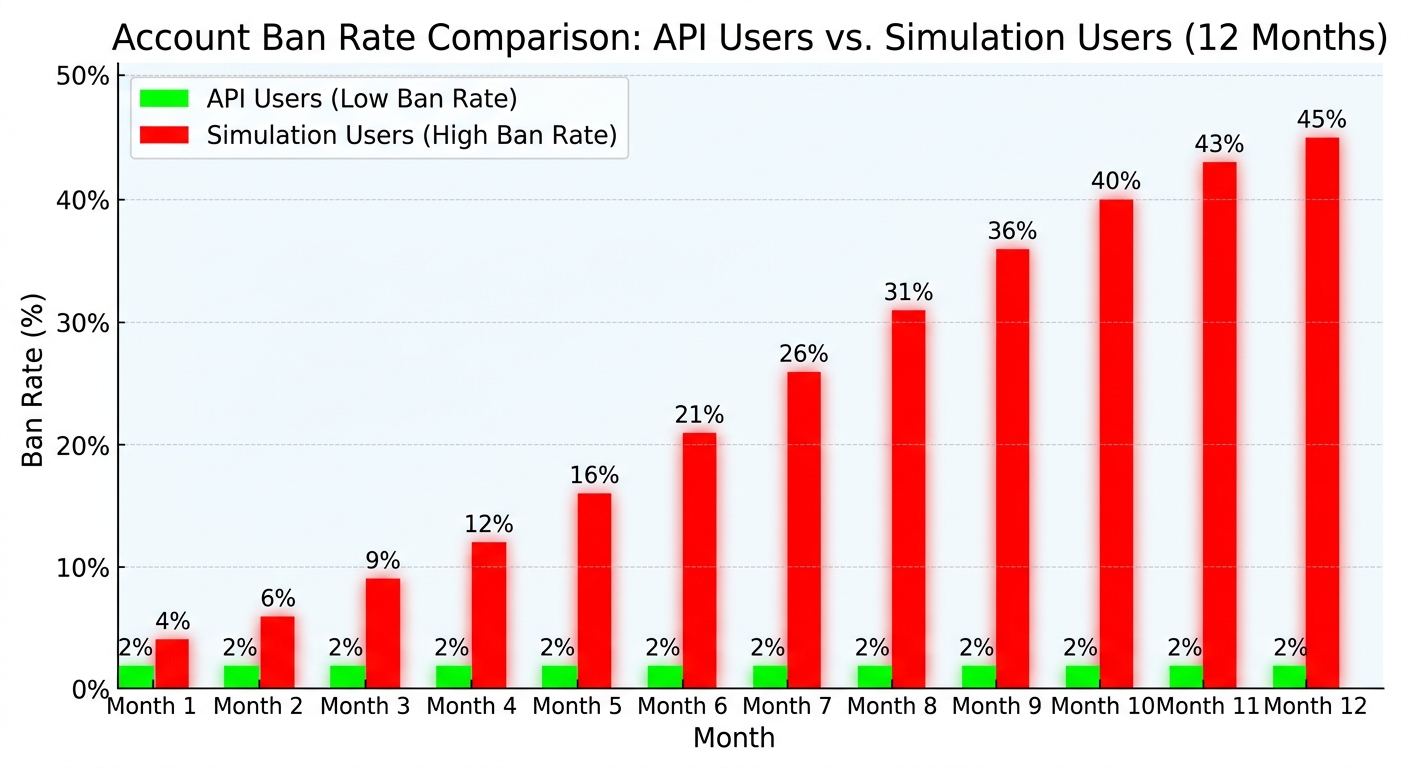
API users face a ban rate of only 0.2%, while simulation operation users face rates as high as 45%
5. The Evolution of Platform Risk Control Systems
Understanding how platform risk control has evolved over time helps explain why simulation tools that worked perfectly fine a few years ago are now getting accounts banned left and right. The arms race between platforms and automation tool developers has been escalating rapidly, and the platforms are winning.
Before 2020, platform risk control relied primarily on simple rule-based detection. Systems checked whether IPs were switching too frequently, whether operation frequencies exceeded limits, and whether passwords were entered incorrectly too many times. These rules were relatively easy to understand and circumvent. During this phase, simulation tools could bypass detection simply by controlling their frequency. Many of these tools were developed during this era, and their core architectures were designed around these simple rules. Tool developers would set conservative rate limits, rotate IPs periodically, and avoid obvious patterns—and for the most part, it worked.
Between 2020 and 2023, platforms began deploying machine learning models to identify abnormal behavior. They established behavioral baselines for users and flagged deviations. Cross-platform data correlation meant that multiple accounts on the same device would be analyzed together. During this phase, simple simulation tools began getting banned in large numbers, forcing many tool developers to upgrade their technology. The introduction of machine learning meant that platforms could detect patterns that were invisible to rule-based systems. For example, a tool might stay within the rate limits but exhibit a behavioral pattern that was statistically unlikely for a human user. Machine learning models could identify these subtle anomalies and flag accounts for review.
From 2024 to the present, platforms have entered the era of deep learning and multimodal detection. Deep learning models analyze behavioral sequences, multimodal detection combines IP, device, behavior, and temporal dimensions, real-time risk control achieves millisecond-level response times, and relationship graphs can identify entire account networks. In this phase, simulated operations have virtually nowhere to hide. Platforms can now detect not just individual anomalies but complex patterns of behavior that span multiple dimensions. An account might have a legitimate IP address, a genuine device fingerprint, and reasonable operation frequencies—but if the combination of all these factors doesn't match the expected profile of a real user, the platform will still flag it. This is why modern simulation tools are essentially fighting a losing battle: the detection systems are simply too sophisticated to fool consistently.
6. Real-World Cases: Three Brands' Ban Lessons
Case 1: Cross-Border E-Commerce Bulk Operations
In June 2025, a cross-border e-commerce company in Shenzhen used a simulation tool to manage 50 Facebook accounts. The tool was configured to publish 5 posts per hour, generate 100 likes, and follow 50 accounts per hour. After two weeks of operation, 42 accounts were banned.
The problem was that the operation frequency was too mechanical. Every account published content on the hour, and like intervals were identical across all accounts. This level of regularity was precisely captured by the platform's risk control system. The company's operations team had assumed that as long as each individual account stayed within the platform's published rate limits, they would be safe. But the platform wasn't just looking at individual accounts—it was looking at patterns across all 50 accounts simultaneously. When 50 accounts all exhibit the same mechanical behavior pattern, the statistical evidence becomes overwhelming. They later switched to the bulk publishing feature with randomized intervals, and their accounts have not experienced any issues since.
Case 2: MCN Agency Sharing a Single IP
An MCN agency in Beijing ran simulation scripts for 200 Instagram accounts from a single server. All accounts sent requests from the same data center IP, and within three days, every single account was banned.
The platform's risk control system detected that a single IP was associated with 200 accounts and immediately classified it as bulk operations. Even though each account's individual operation frequency was normal, the IP association alone was sufficient to trigger a ban. This case illustrates a critical point: even if your individual account behavior is perfectly normal, the context in which that behavior occurs can still get you banned. The agency had invested significant resources in building these accounts—creating content, growing followers, and establishing brand partnerships—and lost everything in just 72 hours.
Case 3: Scheduled Publishing at 3:00 AM
A brand in Shanghai used a simulation tool to schedule content publishing every day at 3:00 AM. After one month of consistent operation, the account's publishing privileges were restricted.
The platform's analysis revealed that the account was only active at 3:00 AM and completely inactive at all other times. This abnormal作息 pattern was clearly not human behavior. No real person maintains a consistent schedule of being active only at 3:00 AM every single day. They later switched to a scheduled publishing feature that distributed posts across different time periods randomly, and the account returned to normal. This case demonstrates that even seemingly harmless automation—like scheduling posts—can trigger detection if the pattern is too rigid.
7. Why API Usage Doesn't Get You Banned?
APIs are actively opened by platforms for developers—using an API is, by definition, "permitted behavior." It's like entering an amusement park with a legitimate ticket; no one questions your identity because you've been explicitly invited.
API requests must carry an API Key or OAuth Token, so the platform knows exactly who is making the request and what permissions they have. This transparency is precisely what makes it safe. The platform doesn't need to guess your intentions because every request you make is documented and traceable. When you use an API, you're essentially telling the platform: "Here's who I am, here's what I want to do, and here's my authorization to do it." This level of transparency eliminates the need for the platform to run complex detection algorithms on your behavior.
APIs have clearly defined functional boundaries and rate limits. The platform knows what you'll do and how much you can do. This predictability gives platforms confidence. If an API user violates policies, the platform can trace the violation back to a specific developer account and take appropriate action. This accountability mechanism creates an effective deterrent. Unlike simulation tools, which operate in a gray area of deception, API usage operates in a well-defined space of permission and accountability.
API developers must comply with platform policies, and violations result in API access revocation. This creates a filtering mechanism that ensures only compliant developers use the API. Choosing a tool like SocialEcho, which explicitly uses official APIs, fundamentally eliminates the risk of account bans. SocialEcho's comment management features and all other functions strictly comply with platform policies, maintaining a zero-ban record. This isn't just a marketing claim—it's a structural guarantee built into the way the tool operates.
📝 Conclusion
Let's return to the story at the beginning—Wang Lei's company eventually switched to a tool that uses official APIs, and their account ban rate dropped from 45% to zero. The transition wasn't immediate, and it required rethinking their entire social media operations strategy. But the results spoke for themselves: no more banned accounts, no more lost content, no more damaged brand reputation.
"If I had known this earlier, I never would have tried to cut corners," Wang Lei said. "The cost of those banned accounts—lost followers, lost content, lost business opportunities—far exceeded any savings we thought we were getting from the simulation tool."
Platform risk control isn't about "false positives"—it's about precision strikes. Every characteristic of simulated operations is a glaring signal flare in the eyes of the platform. Using official APIs might not feel as "powerful," but it's safe. Using simulated operations might feel satisfying in the short term, but getting banned is only a matter of time.
The question isn't whether your accounts will be banned if you use simulation tools. The question is when. And when that happens, the cost will far exceed any perceived benefit.
How many more bans can your accounts afford?
Free Trial: 7-day SocialEcho Official API-Driven
❓ FAQ
Q1: Why was my account banned even though I didn't do anything?
It's very likely that the tool you're using is performing simulated operations in the background. Even if you haven't taken any actions manually, the tool may be automatically liking posts, following accounts, or publishing content—and these behaviors trigger the platform's risk control system. Many social media management tools operate in a gray area, using simulation techniques that users may not even be aware of. We recommend checking your tool's authorization method and reviewing its operation logs. If the tool doesn't provide transparent logs or refuses to disclose its methods, that's a red flag.
Q2: Is using an API absolutely guaranteed to prevent bans?
The API itself is safe, but if you abuse it—for example, by exceeding rate limits or publishing violating content—you may still face restrictions. Compliance with platform rules is the key. Tools that use official APIs normally have a ban rate of less than 0.2%. This small percentage typically represents cases where the user violated content policies or engaged in spam-like behavior, not cases where the API itself was detected as suspicious. The API is a tool, and like any tool, it can be misused.
Q3: How often do platforms update their risk control systems?
Major platforms update their risk control systems almost daily. In 2025, Instagram updated its detection models an average of 2 to 3 times per week. Facebook and TikTok have similar update frequencies. Simulation tools simply cannot keep up with this pace of change. Every time a platform updates its detection algorithms, simulation tools need to reverse-engineer the changes and update their own code. This creates a constant lag that eventually leads to detection. By contrast, API-based tools don't need to play this cat-and-mouse game because they operate with the platform's explicit permission.
Q4: Can a banned account be recovered?
It depends on the reason for the ban. If the ban was caused by simulated operations and is permanent, the chances of recovery are extremely low. Platforms take automated behavior very seriously because it undermines the authenticity of their ecosystem. If it's a temporary restriction, the account may recover after you stop the violating behavior. We recommend contacting the platform's customer support to file an appeal and explaining that you've switched to an official API tool. In some cases, demonstrating a genuine commitment to compliance can help your case.
Q5: How can I verify whether a tool is safe?
Ask whether it uses official APIs, check the platform's developer center for certified tool listings, and request security compliance documentation. Legitimate tools will proactively provide this information. If a tool avoids answering these questions, recommends using proxy servers or VPNs to "avoid detection," or claims to have "special techniques" for bypassing platform restrictions, we recommend looking elsewhere. A safe tool has nothing to hide and will be transparent about its methods.
Word count: approximately 3,800 words
;}.cls-2{fill:%230868f7;}.cls-3{fill:url(%23未命名的渐变_44);}.cls-4{fill:%23333;}%3c/style%3e%3clinearGradient%20id='未命名的渐变_8'%20x1='33.73'%20y1='100.61'%20x2='-0.03'%20y2='-1.06'%20gradientUnits='userSpaceOnUse'%3e%3cstop%20offset='0'%20stop-color='%237ae9fb'/%3e%3cstop%20offset='0.67'%20stop-color='%232b90f8'/%3e%3cstop%20offset='1'%20stop-color='%230868f7'/%3e%3c/linearGradient%3e%3clinearGradient%20id='未命名的渐变_44'%20x1='27.86'%20y1='18.67'%20x2='68.36'%20y2='22.22'%20gradientUnits='userSpaceOnUse'%3e%3cstop%20offset='0'%20stop-color='%235ac7f2'/%3e%3cstop%20offset='1'%20stop-color='%230868f7'/%3e%3c/linearGradient%3e%3c/defs%3e%3cpath%20class='cls-1'%20d='M29,28.74V81.91l-9.51-3.68v0L8.52,74A7.17,7.17,0,0,1,4,67.32V24.54A3.76,3.76,0,0,1,9.08,21Z'/%3e%3cpath%20class='cls-2'%20d='M68.09,78.07a13.15,13.15,0,0,1-17.9,12.06L29,81.91h0V28.74L50.19,37A13.17,13.17,0,0,0,68.08,25.3h0Z'/%3e%3cpath%20class='cls-3'%20d='M68.08,25.3a13.19,13.19,0,0,1-6.73,10.87A13.09,13.09,0,0,1,50.19,37L29,28.74V6A3.76,3.76,0,0,1,34.1,2.52l25.59,9.91A13.22,13.22,0,0,1,68.08,25.3Z'/%3e%3cpath%20class='cls-4'%20d='M129.06,81.76a4.33,4.33,0,0,1-3.19-1.31,4.4,4.4,0,0,1-1.31-3.24V56.86H97.65V77.21a4.36,4.36,0,0,1-1.35,3.2A4.68,4.68,0,0,1,93,81.76a4.32,4.32,0,0,1-3.19-1.31,4.37,4.37,0,0,1-1.32-3.24V27.27A4.58,4.58,0,0,1,89.83,24a4.59,4.59,0,0,1,7.82,3.27V48.15h26.91V27.27A4.58,4.58,0,0,1,125.91,24a4.59,4.59,0,0,1,7.82,3.27V77.21a4.37,4.37,0,0,1-1.36,3.2A4.65,4.65,0,0,1,129.06,81.76Z'/%3e%3cpath%20class='cls-4'%20d='M163.77,81.66c-6.57,0-11.76-1.92-15.44-5.7s-5.54-9.07-5.54-15.74a26.76,26.76,0,0,1,2.09-10.43,17.72,17.72,0,0,1,6.67-8.06,19.15,19.15,0,0,1,10.68-2.95,19,19,0,0,1,10.46,2.8,18.7,18.7,0,0,1,6.55,7.36,22.53,22.53,0,0,1,2.36,10.28A4.51,4.51,0,0,1,177,63.77H152.23a10.8,10.8,0,0,0,3.49,6.65c2,1.68,4.88,2.52,8.66,2.52a22.25,22.25,0,0,0,7.54-1.21c.74-.3,1.55-.67,2.37-1.07a3.75,3.75,0,0,1,1.84-.4,4.09,4.09,0,0,1,3,1.15,4,4,0,0,1,1.12,3,4.38,4.38,0,0,1-2.58,3.82,32.34,32.34,0,0,1-6.36,2.61A28.67,28.67,0,0,1,163.77,81.66ZM172.4,55.9a9.72,9.72,0,0,0-1.63-4.56A9.9,9.9,0,0,0,167,48a10.38,10.38,0,0,0-4.64-1.14,12,12,0,0,0-4.77,1.06,9.54,9.54,0,0,0-4.89,5.66,11.78,11.78,0,0,0-.51,2.3Z'/%3e%3cpath%20class='cls-4'%20d='M193,81.64a4.49,4.49,0,0,1-4.51-4.55V27.28A4.58,4.58,0,0,1,189.84,24a4.48,4.48,0,0,1,3.28-1.36A4.36,4.36,0,0,1,196.35,24a4.46,4.46,0,0,1,1.31,3.31V77.09a4.34,4.34,0,0,1-1.35,3.2A4.67,4.67,0,0,1,193,81.64Z'/%3e%3cpath%20class='cls-4'%20d='M263.79,81.71a5.7,5.7,0,0,1-4.2-1.74,5.76,5.76,0,0,1-1.73-4.19V27.37a4.58,4.58,0,0,1,1.35-3.27A4.59,4.59,0,0,1,267,27.37V72.53h24a4.58,4.58,0,0,1,3.27,7.82A4.66,4.66,0,0,1,291,81.71Z'/%3e%3cpath%20class='cls-4'%20d='M424.48,81.74a4.71,4.71,0,0,1-2.71-.88,5.43,5.43,0,0,1-1-1l-.07-.09-12.41-17-5.41,5v9.44a4.31,4.31,0,0,1-1.36,3.19,4.66,4.66,0,0,1-3.3,1.36A4.29,4.29,0,0,1,395,80.42a4.36,4.36,0,0,1-1.32-3.23V27.37A4.58,4.58,0,0,1,395,24.1a4.52,4.52,0,0,1,6.58.12,4.54,4.54,0,0,1,1.24,3.15V56.31l17.72-16.38.05,0a4.8,4.8,0,0,1,2.94-1.11,4.4,4.4,0,0,1,3.27,1.2,4.57,4.57,0,0,1,1.2,3.27,4.44,4.44,0,0,1-.77,2.33,7.45,7.45,0,0,1-1.43,1.65l-11,9.64,13.34,17.68a5,5,0,0,1,1,2.71,4.12,4.12,0,0,1-1.36,3.24A4.64,4.64,0,0,1,424.48,81.74Z'/%3e%3cpath%20class='cls-4'%20d='M317.93,81.76a21.5,21.5,0,1,1,21.17-21.5A21.37,21.37,0,0,1,317.93,81.76Zm0-34.1a12.61,12.61,0,1,0,12.42,12.6A12.52,12.52,0,0,0,317.93,47.66Z'/%3e%3cpath%20class='cls-4'%20d='M212.18,101.22a4.12,4.12,0,0,1-3.05-1.26,4.17,4.17,0,0,1-1.26-3.1V43.34a4.37,4.37,0,0,1,1.3-3.14,4.26,4.26,0,0,1,3.13-1.3,4.19,4.19,0,0,1,3.1,1.26,4.32,4.32,0,0,1,1.26,3.16,20.77,20.77,0,0,1,13-4.54,21.51,21.51,0,0,1,0,43,20.51,20.51,0,0,1-13-4.57V96.86a4.15,4.15,0,0,1-1.3,3.06A4.5,4.5,0,0,1,212.18,101.22Zm17.43-53.63c-6.23,0-12.93,4.11-12.93,12.72a12.73,12.73,0,0,0,25.46,0A12.71,12.71,0,0,0,229.61,47.59Z'/%3e%3cpath%20class='cls-4'%20d='M365.76,81.76a21.5,21.5,0,1,1,21.18-21.5A21.37,21.37,0,0,1,365.76,81.76Zm0-34.1a12.61,12.61,0,1,0,12.42,12.6A12.52,12.52,0,0,0,365.76,47.66Z'/%3e%3c/svg%3e)