
X platform keyword monitoring isn't just about taking a few more glances; it's about detecting potential problems for a brand earlier.
Many teams start seriously monitoring X for the first time, often at the same moment: a discussion suddenly goes viral, the boss sends the link to the group chat, and everyone starts digging around to find out who posted it first, why it was suddenly shared, whether users are praising or criticizing it, and whether this trend will continue to spread.
The problem isn't that the team isn't working hard enough, but rather that most brands' previous "monitoring" was more like manual searching. They'd search for the brand name to see if anyone mentioned it; then search for competitors' names to see if they had any recent viral content. Such actions certainly have value, but they're far from truly "detecting changes immediately."
Because on X, real change almost never begins with a formal "@brand name". It's more common to start with a user complaining about a feature suddenly malfunctioning, someone comparing you to competitors, or a contextual discussion where people start mentioning your industry without explicitly naming you.
Therefore, the real issue that keyword monitoring needs to address is not "whether anyone is mentioning me," but rather "whether market sentiment has begun to change." If you want to transform X from a platform that passively tries to extinguish fires into a frontline for brand early warning and opportunity discovery, then you should do this as a separate task.

Why is it worthwhile to monitor keywords separately on platform X?
What makes X special is not just its fast information flow, but also its high density of viewpoints, direct expression of emotions, and ruthless speed of dissemination. A small issue that might take days to ferment on other platforms can turn from scattered complaints into a concentrated discussion on X in just a few hours.
For brands, this means two things.
First, issues often surface earlier than formal support tickets, customer service backends, or sales feedback. Users may not necessarily contact you first, but they are very likely to express their feelings in public discussions first.
Secondly, X is also the place where opportunities are most likely to be spotted early. Some people are complaining that a certain type of tool is not easy to use, some are asking for recommendations for alternatives, and some are starting to re-compare market options because of new moves by competitors—these can all be clues, but they won't all be lined up neatly for you to pick up.
If you're already using SocialEcho for social media monitoring , then the most valuable aspect of X keyword monitoring is precisely extracting these scattered, vague, but very early signals from the massive amount of noise. Combined with X platform management capabilities and subsequent data analysis , the team will see not just "how many mentions there are," but "where this discussion is heading."
It's not just the brand name that should be monitored.
Many teams initially understand "keyword monitoring" as "monitoring brand keywords." This step is not wrong, but if you stop there, you will mostly see what has already happened, not what is about to happen.
A more effective approach is to think of the word pack as a four-layer radar.
The innermost layer, of course, is the brand name. Besides the full brand name and product name, you also need to include common abbreviations, acronyms, spelling errors, and even colloquial terms used by users. Many brands don't miss the number of mentions; they miss the fact that users simply don't mention them according to the official wording.
Going one layer further out, there are business scenario terms. Users don't always say the brand name directly, but they will talk about their needs, such as "multi-account management," "comment reply tool," "social media scheduling software," and "competitor monitoring tool." These terms reveal purchase intent earlier than brand names and are more likely to help you identify those who haven't yet entered the conversion funnel but have already started looking for solutions.
The third layer consists of risky keywords. This layer determines whether you can detect problems earlier than others. Expressions like "lag," "account suspension," "login failure," "unable to receive verification code," "refund," "scam," and "invalid" inherently carry strong warning connotations. Once they appear alongside brand terms, product names, or core functional terms, their priority should not be the same as in ordinary discussions.
The fourth layer is competitor keywords. Many teams monitor competitors, focusing only on what features they've updated; but what's more valuable is understanding what users are complaining about, praising, sharing, and searching for alternatives. You don't necessarily need to copy their actions, but you must understand which direction market sentiment is tilting.

A monitoring method that more closely resembles a real team
If you ask the operations team what kind of monitoring system they fear most, the answer is usually not "not enough features," but rather "too much information, but nobody knows how to use it."
Therefore, I would suggest making the monitoring of the keyword X into a three-layer system, rather than laying down a bunch of complex rules right away.
The first layer is routine monitoring. It serves the need for "continuous market observation." This focuses on brand keywords and a small number of core business keywords to help the team understand how others are talking about you and your industry. It doesn't necessarily need to be processed hourly, but it must be stable and continuous.
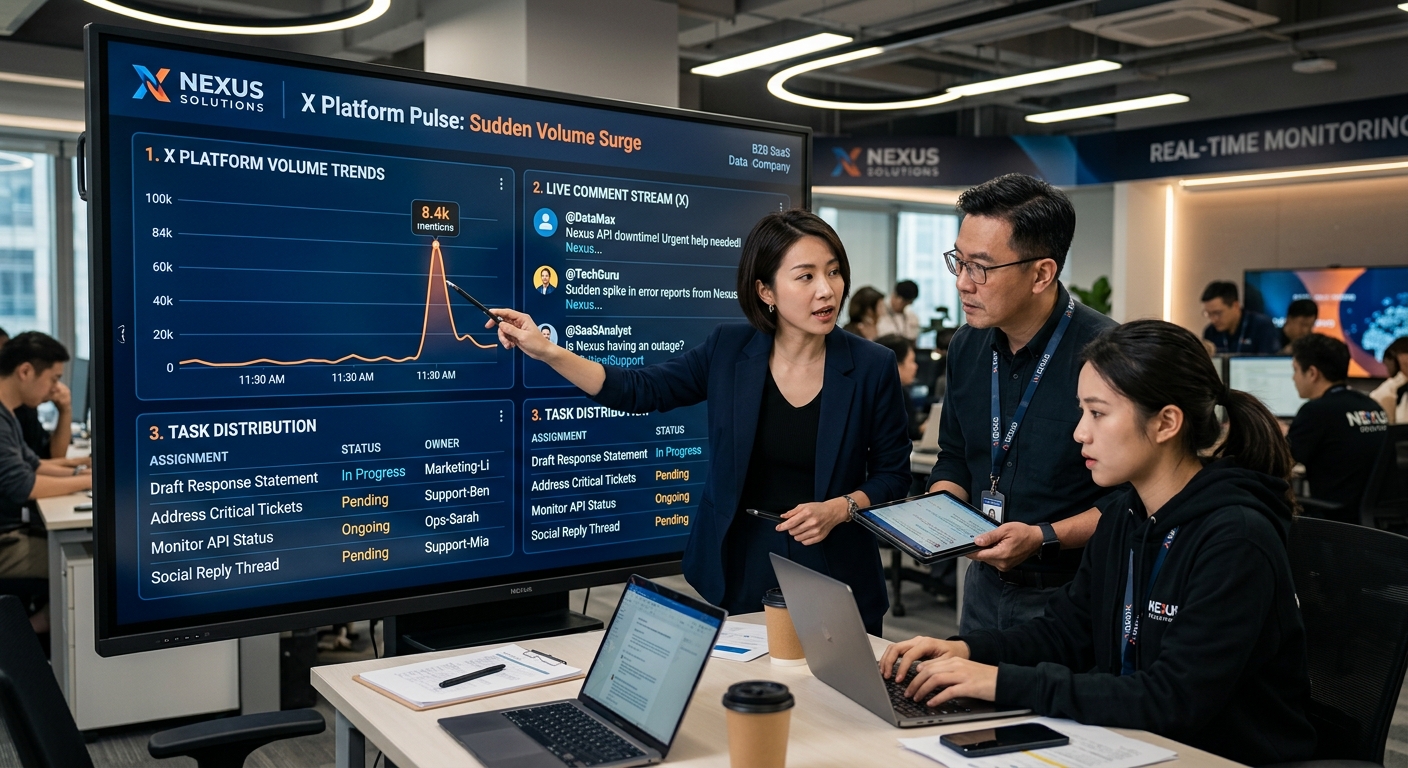
The second layer is anomaly alerts. Here, the focus isn't on broad coverage, but on speed of response. Brand names with negative connotations, product names with malfunction-related terms, event names with controversial expressions—if these appear in clusters, the system should immediately push the alert to the relevant personnel. Many crises don't need to be addressed only when they escalate; someone should be there the moment things start to go wrong.
The third layer is opportunity discovery. This is the best place to put competitor keywords, alternative keywords, and high-intent scenario keywords. You'll see discussions that haven't yet been formally defined as business opportunities: users asking for recommendations, comparing options, and complaining that current solutions aren't good enough. For growth teams, these signals often come earlier and are more contextual than the data from the campaign backend.
If your team wants to streamline this process even further, X monitoring should ideally remain integrated with subsequent actions. For example, when a high-risk mention is detected, can it be immediately forwarded to customer service or customer success? When users discuss specific experience issues, can this be synchronized with product and operations? After a high-value discussion is detected, can the interaction management team take over and follow up? Monitoring only truly amplifies its value when it goes beyond simply "seeing."
Changes in brand awareness are often hidden in these details.
Many brands mistakenly believe that changes in brand awareness simply mean a "surge in mentions." However, in practice, what is often more concerning is not the quantity, but the structure.
For example, the number of mentions may not have increased significantly, but the proportion of negative expressions may suddenly rise; or the brand name may not be discussed extensively, but a specific functional term may start to appear frequently with "ineffective" or "difficult to use"; or a competitor may suddenly receive a lot of positive discussion, and the keyword context that originally belonged to yours may be gradually taken away. These are all called changes in voice volume, but they don't always appear in the form of trending topics.
The challenge of X monitoring lies precisely here. You're not looking at an isolated post, but rather at whether brand perception has subtly shifted after words, emotions, context, and the speed of dissemination are all combined.
This is why many teams, after working on something for a while, find that "just looking at the numbers" is far from enough. The numbers can tell you if there's any activity, but what truly helps a team make judgments is the context in which the discussion takes place, who is talking about it, how focused the discussion is, and whether it will spread further.
Ultimately, surveillance must come down to teamwork.
A mature monitoring system is not just about operations staff staring at dashboards. It's truly useful because different teams know when they should take over.
When X appears in daily mentions, operations can quickly determine whether to respond or leverage the trend to create content; when keywords and risky expressions rise together, customer service or customer success teams should intervene earlier to prevent the problem from spreading further; when a certain type of scenario-based keyword starts to gain momentum, the marketing team can determine whether it is worthwhile to create content, advertise, or collaborate; when a trend has shifted for several consecutive days, management should treat it as a strategic signal, not just a minor social media episode.
To put it bluntly, keyword monitoring is not a "Kanban project," but a "collaborative project." Without the subsequent division of labor, even the most sophisticated alerts will only remain in message notifications.
The easiest pitfall to fall into isn't not knowing how to choose words, but rather choosing them and then neglecting to write them.
When monitoring X keywords, the most common problem is not the technology, but the judgment.
The first scenario is that the keyword list is too broad. The team wants to include every trending keyword in the industry, but as a result, most of what they see every day is irrelevant noise, and eventually no one wants to continue reading.
The second scenario involves focusing solely on quantity without considering the context. A sudden surge in the appearance of a word doesn't necessarily indicate a crisis; it could simply be someone sharing a giveaway, or a discussion happen to have the same name. Looking at data without considering the original context easily leads to misjudgment.
The third scenario is focusing only on oneself, ignoring competitors and the overall market situation. The problem with this approach is that you can only see what has already happened to you, but you can't see when the market trend has already shifted.
There's another very real situation: everyone thinks surveillance is important, but there's no clear definition of who's responsible for making judgments, responding, or escalating the system. As a result, even if someone sees something, it's as if they didn't see it at all.
If you're just starting out, make the vocabulary package smaller first.
For Chinese teams, the safest way to start is never to "cover everything", but to "get the first mechanism working."
You can start with a very small keyword package: a set of brand keywords, 2 to 3 core business keywords, 2 to 3 high-risk keywords, plus 2 keywords from the most noteworthy competitors. Observe for a week or two to get a feel for the noise ratio, alert hit rate, and team processing pace before deciding whether to expand.
Once the basic processes are stable, gradually add regional keywords, activity keywords, product feature keywords, alternative solution keywords, and high-intent scenario keywords. The advantage of doing this is that you won't be overwhelmed by data at the beginning, and it's also easier to build the team's trust in the monitoring results.
For many brands, truly effective monitoring doesn't necessarily come from the largest keyword database, but rather from a mechanism that can be consistently implemented. A system can be very intelligent, but ultimately, what makes it effective is whether the team is willing to use it long-term.
Finally, I'd like to say...
The value of keyword monitoring on the X platform lies not in showing you more information, but in letting you see changes earlier.
The sooner you know what users are complaining about, the better you have to stop the problem from spreading; the sooner you see why competitors are suddenly being discussed, the easier it is to understand the shift in market sentiment; the sooner you discover the needs and discussions of brands that haven't yet been named, the more likely you are to turn them into content opportunities, sales leads, or even new product decisions.
If you want to truly make this a reality, rather than just "occasionally searching," I suggest starting with a combination that's more suitable for team implementation: use social media monitoring for data collection and alerts, use the X platform management page to align platform capabilities, and then combine data analysis and interaction management to integrate findings into subsequent actions.
The result of this is not "you know more," but rather that when brand voice begins to shift, you are no longer always the last to know.
FAQ
What are the differences between keyword monitoring and regular search on the X platform?
Regular searches are more like temporary checks, while keyword monitoring is more like continuous observation. It focuses not only on "whether anyone mentioned you," but also on changes in sentiment, contextual keywords, competitor keywords, and early fluctuations in risky keywords.
When monitoring X keywords, are there enough brand keywords?
That's not enough. Brand keywords are just the most basic layer. You should also add business keywords, risk keywords, competitor keywords, and trending scenario keywords to identify opportunities and risks earlier.
Why are so many brands always slow to react?
Because they only start watching after being explicitly named, while real changes often emerge first from vague discussions, complaints, comparisons, or reposts.
Which teams are best suited for X keyword monitoring?
It is especially suitable for teams that need to conduct brand public opinion, competitor observation, lead discovery, customer service alerts, and high-frequency content operation, because X has a strong speed of dissemination and emotional amplification effect.
After keyword monitoring, what's the next step?
Instead of piling up the results in a table, we should categorize them as quickly as possible: which are risk signals, which are content opportunities, which require customer service intervention, and which are worth leaving to the marketing and product teams for further follow-up.
;}.cls-2{fill:%230868f7;}.cls-3{fill:url(%23未命名的渐变_44);}.cls-4{fill:%23333;}%3c/style%3e%3clinearGradient%20id='未命名的渐变_8'%20x1='33.73'%20y1='100.61'%20x2='-0.03'%20y2='-1.06'%20gradientUnits='userSpaceOnUse'%3e%3cstop%20offset='0'%20stop-color='%237ae9fb'/%3e%3cstop%20offset='0.67'%20stop-color='%232b90f8'/%3e%3cstop%20offset='1'%20stop-color='%230868f7'/%3e%3c/linearGradient%3e%3clinearGradient%20id='未命名的渐变_44'%20x1='27.86'%20y1='18.67'%20x2='68.36'%20y2='22.22'%20gradientUnits='userSpaceOnUse'%3e%3cstop%20offset='0'%20stop-color='%235ac7f2'/%3e%3cstop%20offset='1'%20stop-color='%230868f7'/%3e%3c/linearGradient%3e%3c/defs%3e%3cpath%20class='cls-1'%20d='M29,28.74V81.91l-9.51-3.68v0L8.52,74A7.17,7.17,0,0,1,4,67.32V24.54A3.76,3.76,0,0,1,9.08,21Z'/%3e%3cpath%20class='cls-2'%20d='M68.09,78.07a13.15,13.15,0,0,1-17.9,12.06L29,81.91h0V28.74L50.19,37A13.17,13.17,0,0,0,68.08,25.3h0Z'/%3e%3cpath%20class='cls-3'%20d='M68.08,25.3a13.19,13.19,0,0,1-6.73,10.87A13.09,13.09,0,0,1,50.19,37L29,28.74V6A3.76,3.76,0,0,1,34.1,2.52l25.59,9.91A13.22,13.22,0,0,1,68.08,25.3Z'/%3e%3cpath%20class='cls-4'%20d='M129.06,81.76a4.33,4.33,0,0,1-3.19-1.31,4.4,4.4,0,0,1-1.31-3.24V56.86H97.65V77.21a4.36,4.36,0,0,1-1.35,3.2A4.68,4.68,0,0,1,93,81.76a4.32,4.32,0,0,1-3.19-1.31,4.37,4.37,0,0,1-1.32-3.24V27.27A4.58,4.58,0,0,1,89.83,24a4.59,4.59,0,0,1,7.82,3.27V48.15h26.91V27.27A4.58,4.58,0,0,1,125.91,24a4.59,4.59,0,0,1,7.82,3.27V77.21a4.37,4.37,0,0,1-1.36,3.2A4.65,4.65,0,0,1,129.06,81.76Z'/%3e%3cpath%20class='cls-4'%20d='M163.77,81.66c-6.57,0-11.76-1.92-15.44-5.7s-5.54-9.07-5.54-15.74a26.76,26.76,0,0,1,2.09-10.43,17.72,17.72,0,0,1,6.67-8.06,19.15,19.15,0,0,1,10.68-2.95,19,19,0,0,1,10.46,2.8,18.7,18.7,0,0,1,6.55,7.36,22.53,22.53,0,0,1,2.36,10.28A4.51,4.51,0,0,1,177,63.77H152.23a10.8,10.8,0,0,0,3.49,6.65c2,1.68,4.88,2.52,8.66,2.52a22.25,22.25,0,0,0,7.54-1.21c.74-.3,1.55-.67,2.37-1.07a3.75,3.75,0,0,1,1.84-.4,4.09,4.09,0,0,1,3,1.15,4,4,0,0,1,1.12,3,4.38,4.38,0,0,1-2.58,3.82,32.34,32.34,0,0,1-6.36,2.61A28.67,28.67,0,0,1,163.77,81.66ZM172.4,55.9a9.72,9.72,0,0,0-1.63-4.56A9.9,9.9,0,0,0,167,48a10.38,10.38,0,0,0-4.64-1.14,12,12,0,0,0-4.77,1.06,9.54,9.54,0,0,0-4.89,5.66,11.78,11.78,0,0,0-.51,2.3Z'/%3e%3cpath%20class='cls-4'%20d='M193,81.64a4.49,4.49,0,0,1-4.51-4.55V27.28A4.58,4.58,0,0,1,189.84,24a4.48,4.48,0,0,1,3.28-1.36A4.36,4.36,0,0,1,196.35,24a4.46,4.46,0,0,1,1.31,3.31V77.09a4.34,4.34,0,0,1-1.35,3.2A4.67,4.67,0,0,1,193,81.64Z'/%3e%3cpath%20class='cls-4'%20d='M263.79,81.71a5.7,5.7,0,0,1-4.2-1.74,5.76,5.76,0,0,1-1.73-4.19V27.37a4.58,4.58,0,0,1,1.35-3.27A4.59,4.59,0,0,1,267,27.37V72.53h24a4.58,4.58,0,0,1,3.27,7.82A4.66,4.66,0,0,1,291,81.71Z'/%3e%3cpath%20class='cls-4'%20d='M424.48,81.74a4.71,4.71,0,0,1-2.71-.88,5.43,5.43,0,0,1-1-1l-.07-.09-12.41-17-5.41,5v9.44a4.31,4.31,0,0,1-1.36,3.19,4.66,4.66,0,0,1-3.3,1.36A4.29,4.29,0,0,1,395,80.42a4.36,4.36,0,0,1-1.32-3.23V27.37A4.58,4.58,0,0,1,395,24.1a4.52,4.52,0,0,1,6.58.12,4.54,4.54,0,0,1,1.24,3.15V56.31l17.72-16.38.05,0a4.8,4.8,0,0,1,2.94-1.11,4.4,4.4,0,0,1,3.27,1.2,4.57,4.57,0,0,1,1.2,3.27,4.44,4.44,0,0,1-.77,2.33,7.45,7.45,0,0,1-1.43,1.65l-11,9.64,13.34,17.68a5,5,0,0,1,1,2.71,4.12,4.12,0,0,1-1.36,3.24A4.64,4.64,0,0,1,424.48,81.74Z'/%3e%3cpath%20class='cls-4'%20d='M317.93,81.76a21.5,21.5,0,1,1,21.17-21.5A21.37,21.37,0,0,1,317.93,81.76Zm0-34.1a12.61,12.61,0,1,0,12.42,12.6A12.52,12.52,0,0,0,317.93,47.66Z'/%3e%3cpath%20class='cls-4'%20d='M212.18,101.22a4.12,4.12,0,0,1-3.05-1.26,4.17,4.17,0,0,1-1.26-3.1V43.34a4.37,4.37,0,0,1,1.3-3.14,4.26,4.26,0,0,1,3.13-1.3,4.19,4.19,0,0,1,3.1,1.26,4.32,4.32,0,0,1,1.26,3.16,20.77,20.77,0,0,1,13-4.54,21.51,21.51,0,0,1,0,43,20.51,20.51,0,0,1-13-4.57V96.86a4.15,4.15,0,0,1-1.3,3.06A4.5,4.5,0,0,1,212.18,101.22Zm17.43-53.63c-6.23,0-12.93,4.11-12.93,12.72a12.73,12.73,0,0,0,25.46,0A12.71,12.71,0,0,0,229.61,47.59Z'/%3e%3cpath%20class='cls-4'%20d='M365.76,81.76a21.5,21.5,0,1,1,21.18-21.5A21.37,21.37,0,0,1,365.76,81.76Zm0-34.1a12.61,12.61,0,1,0,12.42,12.6A12.52,12.52,0,0,0,365.76,47.66Z'/%3e%3c/svg%3e)