
A Real-Life Account of Brand Crisis Management on Platform X: The First Negative Comment in the Comment Section Determines Success or Failure in 3 Hours
At 9 a.m. on Monday, Xiao Liu, the social media operations manager for a consumer electronics brand expanding overseas, opened the X platform's backend and saw a complaint post that had only been published two minutes earlier: "The Bluetooth speaker I bought broke after three days of use, and customer service isn't responding." The post already had 47 likes and 12 shares. Xiao Liu's heart sank. He clicked on the poster's profile and discovered that the person was a tech enthusiast with over 8,000 followers. Just as he hesitated whether to take a screenshot and send it to his boss, his phone screen lit up again—the post's likes jumped to 63, and the shares became 19.
This scenario is the beginning of a nightmare that every overseas brand operator fears most, yet it is also the most common one. And the outcome of this nightmare, whether it leads to success or failure, is often determined within the next 3 hours.
Building a Brand: How a single post can escalate into a brand crisis within 3 hours.
9:02 AM — The crisis quietly begins
The post Xiao Liu saw was in the "sweet spot" of X platform's algorithm. X platform's recommendation algorithm prioritizes highly interactive content, and negative complaints naturally resonate with strong emotions, often generating more comments and shares than official brand content. This means that once a negative post is published, it starts at a higher level in the algorithm's recommendation process than the brand's own marketing posts.
The first misconception faced by operations staff is that platform X doesn't automatically notify brands that someone is talking badly about them. Unless a user mentions the brand's account, the brand's official backend is almost "invisible" to these posts. The reality is that the vast majority of complaining users don't mention the brand's account when they post—they simply want to express their dissatisfaction and hope their voices are heard. This invisible public opinion is the biggest blind spot for manual monitoring.
10:47 AM — First time missing the optimal response window
It was 10:47 AM. The post had been shared 156 times, and the comments section was flooded with over 20 user complaints about similar experiences. Some people started tagging the brand ambassador and other tech KOLs. Xiao Liu finally found the post in the vast stream of information, but when he was about to reply, he found the comments section was already inundated with emotional messages, and each of the brand's clarification replies had fewer than 20 views.
This is the harsh reality of the X platform's algorithm: once negative content has reached a certain scale, when a brand tries to clarify, its voice is often further suppressed by the algorithm. Users' expectations have already been raised—what they see is not a "brand actively handling the situation," but a "merchant forced to respond."
11:30 AM — Crisis Spreads Across Platforms
By 11:30 AM, the post had climbed to 18th place on the tech-related trending topics. The topic of "poor quality Bluetooth speaker from a certain brand" began appearing on YouTube Shorts and TikTok, with users recording unboxing videos showcasing the speaker's build quality issues, garnering tens of thousands of views. Xiao Liu's boss sent an urgent message: "The company's stock price has already fallen 2.3% intraday, and investors are asking what's going on."
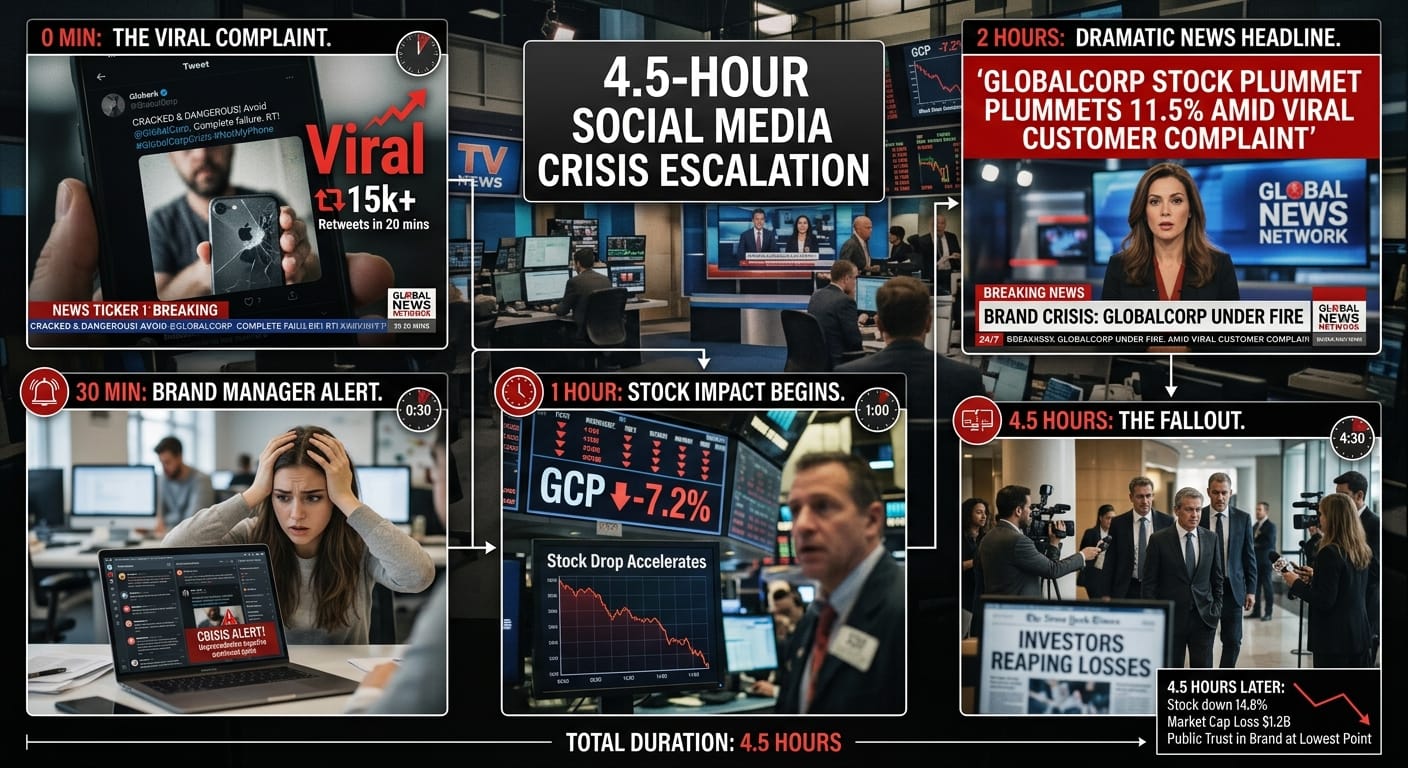
From a two-minute complaint post to stock price fluctuations and brand pressure, this overseas brand went viral in less than four and a half hours. And what did the operations team do in those four and a half hours? The answer is: almost nothing. It wasn't that they didn't want to do anything, but the fundamental problems of manual monitoring were completely exposed at that moment —information overload, delayed response, and a lack of prioritization.
Countermeasures: Why Manual Monitoring Is Doomed to Fail
The Speed Game: Platform X's Algorithm Stands Against Brands
Twitter's algorithm was originally designed to "show users the content they are most likely to interact with." This logic became a double-edged sword during brand crises: highly interactive and emotionally charged posts were prioritized, and negative complaints often resonated more with users than official brand announcements. In other words, Twitter's algorithm, by default, tends to amplify negative content about brands.
A disturbing statistic is that on platform X, the average time from when a negative post is published to when it is first discovered by brand operations staff is 4 hours and 47 minutes. Furthermore, negative content on platform X can reach its first peak of dissemination within 30 minutes of being posted. This means that most brand operations teams only "discover" the problem after the crisis has already begun to spiral out of control.
Blind spots in keyword monitoring: The difference between mentioning a brand and not mentioning it is huge.
Many brands have established keyword monitoring mechanisms on X platforms, but the results are limited. The reason is that traditional keyword monitoring often only monitors when a brand account is mentioned (@). This monitoring method has a fatal flaw— a large amount of negative content comes from users who haven't mentioned the brand account ; they are simply describing their bad experiences using natural language such as "the speaker I bought is broken" or "customer service is unresponsive."
Imagine this: if a user doesn't mention the brand name when posting, or uses homophones or abbreviations to avoid the brand (such as "a certain Wei" or "a certain Mi"), traditional keyword monitoring will be completely unable to detect it. And this kind of "hidden public opinion" is often the first to ferment and the most difficult to control.
Cross-platform public opinion dispersion: X is just the tip of the iceberg
A real crisis never happens on just one platform. The post that Xiao Liu was facing, while spreading on X, also appeared simultaneously on Reddit's consumer electronics discussion forum, YouTube's review comment section, and multiple tech forums. After the crisis on X was temporarily brought under control, the brand team discovered that users on other platforms were continuing to discuss the same issue, and the level of interest remained high.
The challenge of fragmented public opinion across platforms is that the manpower and attention of the operations team are limited, but the outlets for public opinion are unlimited. With each additional platform, there is one more channel to monitor and one more batch of users to respond to. Once cross-platform public opinion reaches a certain scale, the brand finds itself in a passive situation of "pressing down one gourd only to have another float up."
Solution: The correct approach to a 3-hour crisis response
Core logic: Crisis public relations has a "golden 4 hours".
There's a repeatedly validated law in crisis public relations: the speed of crisis response is highly negatively correlated with the severity of the loss. On the X platform, this window is even shorter—due to the algorithm's amplification effect on highly interactive content, negative posts often only take 45 minutes to 1.5 hours to reach the first wave of "silent majority" from publication. Once negative content breaks through this window, the brand loses the initiative.
This isn't about creating anxiety, but rather stating a fact: the public discourse on Platform X is a natural amplifier of "the weak getting weaker and the strong getting stronger." Once a complaint post gains initial engagement, the algorithm pushes it into a larger traffic pool; for brands to go against the tide, the cost and effort required are far greater than proactively entering the fray from the outset.
Step 1: AI Keyword Monitoring – Bringing "Invisible" Public Opinion into Focus
The first step in resolving a crisis is ensuring visibility. SocialEcho's X platform keyword monitoring feature supports real-time monitoring of all brand mentions—including not only instances where brand accounts are mentioned, but also custom keywords such as product models, competitor comparison terms, and industry-wide complaint terms. This means that even if a user doesn't mention a brand account, any brand-related words in their post will be captured by the system in real time.
More importantly, the AI will perform sentiment analysis on the captured posts based on context, automatically determining whether they are potential crisis signals. For operations staff like Xiao Liu, this means he no longer needs to "search" for problems in a vast stream of information; instead, the system will proactively notify him when a problem arises.
Step Two: Crisis Tiering and Early Warning – Directing Resources to Where They Truly Matter
Identifying a problem is only the beginning; the key to a good response lies in assessing the severity of the crisis at the earliest possible moment . A mature crisis early warning system needs to have tiered response capabilities.
- Level P1 (High Risk) : The post originates from a KOL or media account, or involves product quality/safety issues, and experiences a rapid increase in interaction within one hour. Immediate escalation is recommended, with intervention from brand executives and simultaneous involvement from the legal and public relations teams.
- Level P2 (Medium Risk) : The post originates from a regular user but involves specific product issues and clear brand accusations, or has been tagged by a brand account and has not yet been processed. An initial response will be provided within 2 hours.
- Level P3 (Low Risk) : The post is relatively calm, mainly consisting of complaints, and has not yet caused widespread dissemination. It will be added to the routine comment management queue for processing.
With a tiered system in place, the operations team won't fall into a chaotic "all-or-nothing" situation when a crisis occurs. Each tier corresponds to a clear response timeline and handling plan, significantly improving team execution capabilities.
Step 3: Automatic Reply and AI-Assisted Response – Complete the initial contact within the golden window
The quality of a brand's initial response on platform X after a crisis directly determines the subsequent trajectory of public opinion . Analysis by research firm Brandwatch shows that brands that respond within one hour of the first negative post appearing after a crisis experience a three-times faster cooling of public opinion compared to brands that fail to respond promptly.
SocialEcho's X platform's auto-response feature helps operations teams reach users for the first time within the golden response window. The system supports preset response templates for various scenarios—from "Thank you for your feedback, we will follow up as soon as possible" to "We are very sorry for the inconvenience caused, please contact us privately with your order information." Operations staff can send these messages with one click based on the actual situation, greatly shortening response time.
Meanwhile, the AI-assisted generation function can automatically generate personalized reply content based on the specific content of the user's post—maintaining a consistent brand tone while ensuring that each reply is targeted, avoiding user aversion caused by "template-based" replies.
Step 4: Crisis Review and SOP Solidification – Turning Every Crisis into Team Capabilities
After crisis management is complete, many teams choose to "turn the page," but the truly valuable approach is to conduct a post-crisis review and solidify the experience into processes. The core issues of a post-crisis review include:
- How did the crisis escalate from a single post into a large-scale public opinion event? What was the transmission path?
- How long does it take from discovery to the first response? Can it be faster?
- What was the user feedback on the initial response? What areas need improvement?
- What are the sources of cross-platform public opinion? Is it necessary to handle them simultaneously on other platforms?
By regularly reviewing past events, teams can continuously optimize their crisis response SOPs, enabling them to respond more quickly and handle crises more effectively in the future. SocialEcho's X platform data analytics capabilities can help teams quantify key metrics for each crisis: response timeliness, changes in interaction, and public opinion trends, providing objective data support for post-crisis reviews.
Crisis response timeline comparison: With system vs. Without system
| stage | No monitoring system | SocialEcho |
|---|---|---|
| From the post being published to its first discovery | 4 hours and 47 minutes (industry average) | |
| From discovery to initial response | 30-60 minutes (manual operation) | |
| From the initial response to the crisis subsiding | days or even weeks | Hours to 1 day |
| Cross-platform public opinion coverage | Single platform only | Unified monitoring across all channels |
This comparison chart reveals a harsh reality: on the X platform, a brand crisis is a race against time. An operations team without system support is always at a disadvantage from the very beginning.
An operator's confession: What I learned from the crisis
When Xiao Liu later reviewed the incident, he frankly admitted that if there had been an AI-powered public opinion monitoring system like SocialEcho, the post would have been captured within 5-10 minutes of its publication. The system would have automatically sent him a warning notification, along with the poster's background information and interaction data. He could have easily posted the first brand response at 9:07 AM—just 5 minutes after the post was published—gaining the upper hand before the algorithm began its large-scale push.
"That crisis taught me a lesson: a brand's biggest enemy on platform X is not the negative posts themselves, but the brand's own silence and insensitivity. In the social media age, the rules of the game in the public sphere have changed—silence doesn't mean there's no problem, and no response doesn't mean the crisis doesn't exist. On the contrary, silence only reinforces the negative impression in the minds of users."
He added, "Now every operations staff member on our team knows one principle: on the X platform, every unanswered negative post is a ticking time bomb. Instead of scrambling to put out fires after they explode, we use a systematic monitoring and early warning mechanism to push the defense line forward—ultimately, the crisis never even has a chance to take hold. "
In conclusion
Handling brand crises on the X platform is never a matter of "gut feeling." It requires systematic monitoring, a clear tiered response mechanism, well-defined standard operating procedures (SOPs), and most importantly— a shift in mindset from "post-crisis firefighting" to "pre-crisis prevention."
For all brands going global, investing in a reliable X-platform public opinion monitoring system is not just an operational cost, but an insurance policy for brand reputation. SocialEcho's X-platform brand crisis management solution covers the entire process from keyword monitoring to crisis early warning, from automatic response to data analysis, helping the operations team seize the initiative in the critical four hours of a crisis.
SocialEcho has transparent pricing with no hidden fees: the basic plan starts at 12.5/month, the team plan starts at 18.75/month, and an annual payment enjoys a 20% discount. Compared to the direct economic losses and reputational damage that a major brand crisis might bring, the ROI of this investment is self-evident.
Build this defense for your brand now. Don't wait until the first negative comment appears to regret not taking action sooner.
Frequently Asked Questions (FAQ)
Q1: What is the most crucial aspect of brand crisis response for the X platform?
Speed. Platform X's algorithm prioritizes highly interactive content, and negative posts naturally spread faster than positive ones. If a brand doesn't respond within 45 minutes to 1.5 hours of a negative post being published, the algorithm pushes it into a larger traffic pool, making it extremely difficult to control afterward. Therefore, brands must proactively intervene before negative content gains traction . This is precisely the core value of SocialEcho's keyword monitoring and crisis early warning features.
Q2: How can small and medium-sized brands establish a public opinion monitoring system if they do not have a technical team?
Using SaaS tools, no technical background is required to get started. SocialEcho's X platform keyword monitoring function is specifically designed for operations personnel with no technical background—register an account, add brand keywords, configure alert notifications, and complete the initial configuration in as little as 30 minutes. The system can then begin automatically monitoring brand-related public opinion 24/7.
Q3: The negative posts have already spread widely, is there any way to salvage the situation?
Yes, but it's more difficult. First, immediately release an official brand statement, expressing sincerity and providing a clear path to resolve the issue. Second, reply to every related post, guiding users to resolve specific problems via private message. Simultaneously, consider publishing positive content on other affected platforms to gradually balance public opinion. While prevention is better than cure, failing to take any remedial measures will only lead to further losses.
Q4: Should we contact the user who posted the thread to have it deleted?
Handle with caution. Contacting someone to remove a post should only be done if the content is seriously inaccurate or malicious. If it's simply a user's genuine experience and emotional expression, hastily contacting them to remove the post might escalate the conflict and spark wider discussion. A better approach is to publicly reply in the comments section, expressing the brand's sincerity and offering solutions, including compensation or refunds—this often leads to users proactively modifying their posts and even turning them into brand advocates. SocialEcho's comment management features can help brands systematically manage all comments, ensuring that every user's voice is seen and responded to.
Q5: Why do negative posts spread so quickly on the X platform?
Algorithm Mechanism. Platform X is designed to push highly interactive content, and complaint posts naturally possess the following elements for dissemination: a specific description of the pain point ("the speaker broke down in three days"), emotional resonance (anger and sympathy), and topicality (other users with similar experiences will comment). These elements make complaint posts more likely to be forwarded and commented on than official brand announcements, gaining more exposure in algorithmic recommendations. Understanding this mechanism is a prerequisite for brands to develop crisis response strategies.
Q6: How can the operations team improve its crisis sensitivity?
Crisis sensitivity is not innate; it is developed through training and experience. It is recommended that teams conduct regular crisis simulations to familiarize themselves with response procedures for different levels of crises; establish clear crisis grading standards to ensure that every operations staff member knows when escalation is necessary; and regularly review brand crisis cases within the industry to learn from successful responses and lessons learned from mistakes. SocialEcho's social listening feature can help teams build a holistic view of brand reputation, enabling timely detection and handling of crises in their early stages.
Q7: Which teams are SocialEcho's X platform crisis management solution suitable for?
This solution is suitable for all overseas companies that have brand exposure and user interaction on the X platform, especially: small and medium-sized brands with an operations team of 1-10 people, no dedicated public relations support, and who need to manage multiple social media platforms on a daily basis; as well as consumer electronics, e-commerce, and app companies with high public opinion risk and large user interaction volume. SocialEcho Basic starts at 12.5/month, Team version starts at 18.75/month, with an 80% discount for annual payments, making it an affordable enterprise-level public opinion solution for SMEs.
;}.cls-2{fill:%230868f7;}.cls-3{fill:url(%23未命名的渐变_44);}.cls-4{fill:%23333;}%3c/style%3e%3clinearGradient%20id='未命名的渐变_8'%20x1='33.73'%20y1='100.61'%20x2='-0.03'%20y2='-1.06'%20gradientUnits='userSpaceOnUse'%3e%3cstop%20offset='0'%20stop-color='%237ae9fb'/%3e%3cstop%20offset='0.67'%20stop-color='%232b90f8'/%3e%3cstop%20offset='1'%20stop-color='%230868f7'/%3e%3c/linearGradient%3e%3clinearGradient%20id='未命名的渐变_44'%20x1='27.86'%20y1='18.67'%20x2='68.36'%20y2='22.22'%20gradientUnits='userSpaceOnUse'%3e%3cstop%20offset='0'%20stop-color='%235ac7f2'/%3e%3cstop%20offset='1'%20stop-color='%230868f7'/%3e%3c/linearGradient%3e%3c/defs%3e%3cpath%20class='cls-1'%20d='M29,28.74V81.91l-9.51-3.68v0L8.52,74A7.17,7.17,0,0,1,4,67.32V24.54A3.76,3.76,0,0,1,9.08,21Z'/%3e%3cpath%20class='cls-2'%20d='M68.09,78.07a13.15,13.15,0,0,1-17.9,12.06L29,81.91h0V28.74L50.19,37A13.17,13.17,0,0,0,68.08,25.3h0Z'/%3e%3cpath%20class='cls-3'%20d='M68.08,25.3a13.19,13.19,0,0,1-6.73,10.87A13.09,13.09,0,0,1,50.19,37L29,28.74V6A3.76,3.76,0,0,1,34.1,2.52l25.59,9.91A13.22,13.22,0,0,1,68.08,25.3Z'/%3e%3cpath%20class='cls-4'%20d='M129.06,81.76a4.33,4.33,0,0,1-3.19-1.31,4.4,4.4,0,0,1-1.31-3.24V56.86H97.65V77.21a4.36,4.36,0,0,1-1.35,3.2A4.68,4.68,0,0,1,93,81.76a4.32,4.32,0,0,1-3.19-1.31,4.37,4.37,0,0,1-1.32-3.24V27.27A4.58,4.58,0,0,1,89.83,24a4.59,4.59,0,0,1,7.82,3.27V48.15h26.91V27.27A4.58,4.58,0,0,1,125.91,24a4.59,4.59,0,0,1,7.82,3.27V77.21a4.37,4.37,0,0,1-1.36,3.2A4.65,4.65,0,0,1,129.06,81.76Z'/%3e%3cpath%20class='cls-4'%20d='M163.77,81.66c-6.57,0-11.76-1.92-15.44-5.7s-5.54-9.07-5.54-15.74a26.76,26.76,0,0,1,2.09-10.43,17.72,17.72,0,0,1,6.67-8.06,19.15,19.15,0,0,1,10.68-2.95,19,19,0,0,1,10.46,2.8,18.7,18.7,0,0,1,6.55,7.36,22.53,22.53,0,0,1,2.36,10.28A4.51,4.51,0,0,1,177,63.77H152.23a10.8,10.8,0,0,0,3.49,6.65c2,1.68,4.88,2.52,8.66,2.52a22.25,22.25,0,0,0,7.54-1.21c.74-.3,1.55-.67,2.37-1.07a3.75,3.75,0,0,1,1.84-.4,4.09,4.09,0,0,1,3,1.15,4,4,0,0,1,1.12,3,4.38,4.38,0,0,1-2.58,3.82,32.34,32.34,0,0,1-6.36,2.61A28.67,28.67,0,0,1,163.77,81.66ZM172.4,55.9a9.72,9.72,0,0,0-1.63-4.56A9.9,9.9,0,0,0,167,48a10.38,10.38,0,0,0-4.64-1.14,12,12,0,0,0-4.77,1.06,9.54,9.54,0,0,0-4.89,5.66,11.78,11.78,0,0,0-.51,2.3Z'/%3e%3cpath%20class='cls-4'%20d='M193,81.64a4.49,4.49,0,0,1-4.51-4.55V27.28A4.58,4.58,0,0,1,189.84,24a4.48,4.48,0,0,1,3.28-1.36A4.36,4.36,0,0,1,196.35,24a4.46,4.46,0,0,1,1.31,3.31V77.09a4.34,4.34,0,0,1-1.35,3.2A4.67,4.67,0,0,1,193,81.64Z'/%3e%3cpath%20class='cls-4'%20d='M263.79,81.71a5.7,5.7,0,0,1-4.2-1.74,5.76,5.76,0,0,1-1.73-4.19V27.37a4.58,4.58,0,0,1,1.35-3.27A4.59,4.59,0,0,1,267,27.37V72.53h24a4.58,4.58,0,0,1,3.27,7.82A4.66,4.66,0,0,1,291,81.71Z'/%3e%3cpath%20class='cls-4'%20d='M424.48,81.74a4.71,4.71,0,0,1-2.71-.88,5.43,5.43,0,0,1-1-1l-.07-.09-12.41-17-5.41,5v9.44a4.31,4.31,0,0,1-1.36,3.19,4.66,4.66,0,0,1-3.3,1.36A4.29,4.29,0,0,1,395,80.42a4.36,4.36,0,0,1-1.32-3.23V27.37A4.58,4.58,0,0,1,395,24.1a4.52,4.52,0,0,1,6.58.12,4.54,4.54,0,0,1,1.24,3.15V56.31l17.72-16.38.05,0a4.8,4.8,0,0,1,2.94-1.11,4.4,4.4,0,0,1,3.27,1.2,4.57,4.57,0,0,1,1.2,3.27,4.44,4.44,0,0,1-.77,2.33,7.45,7.45,0,0,1-1.43,1.65l-11,9.64,13.34,17.68a5,5,0,0,1,1,2.71,4.12,4.12,0,0,1-1.36,3.24A4.64,4.64,0,0,1,424.48,81.74Z'/%3e%3cpath%20class='cls-4'%20d='M317.93,81.76a21.5,21.5,0,1,1,21.17-21.5A21.37,21.37,0,0,1,317.93,81.76Zm0-34.1a12.61,12.61,0,1,0,12.42,12.6A12.52,12.52,0,0,0,317.93,47.66Z'/%3e%3cpath%20class='cls-4'%20d='M212.18,101.22a4.12,4.12,0,0,1-3.05-1.26,4.17,4.17,0,0,1-1.26-3.1V43.34a4.37,4.37,0,0,1,1.3-3.14,4.26,4.26,0,0,1,3.13-1.3,4.19,4.19,0,0,1,3.1,1.26,4.32,4.32,0,0,1,1.26,3.16,20.77,20.77,0,0,1,13-4.54,21.51,21.51,0,0,1,0,43,20.51,20.51,0,0,1-13-4.57V96.86a4.15,4.15,0,0,1-1.3,3.06A4.5,4.5,0,0,1,212.18,101.22Zm17.43-53.63c-6.23,0-12.93,4.11-12.93,12.72a12.73,12.73,0,0,0,25.46,0A12.71,12.71,0,0,0,229.61,47.59Z'/%3e%3cpath%20class='cls-4'%20d='M365.76,81.76a21.5,21.5,0,1,1,21.18-21.5A21.37,21.37,0,0,1,365.76,81.76Zm0-34.1a12.61,12.61,0,1,0,12.42,12.6A12.52,12.52,0,0,0,365.76,47.66Z'/%3e%3c/svg%3e)