
YouTube Competitive Monitoring in Practice: How Overseas Brands Can Unearth Topics from Competitor Video Comment Sections
Xiao Li stared at the competitor's YouTube video on the screen—it had over a million views, and the comments section had three pages full of English users asking "where to buy" and "does it work for oily skin"—while her own brand's five carefully crafted videos from last month had a combined total of less than 20,000 views.
Her first reaction wasn't, "Their filming is better," but rather, "I have absolutely no idea what kind of topics they're working on."
This is the real dilemma facing overseas brands operating on YouTube: it's not that they don't know how to create content, but that they simply don't know what their audience really wants to see.

Act One: Where did your topic come from?
Most brands rely on three sources when choosing topics for their overseas operations: the boss's guess, benchmarking against domestic best-selling products, and reading a few blog posts abroad.
These three sources share a common problem: they are all guessing about the market, rather than listening to it.
The logic of domestic social media doesn't entirely apply overseas. Chinese users love watching product reviews and recommendations, while Western users are more focused on "solving their problems." A beautifully crafted product demonstration video might just be seen as an advertisement by Western users; but a competitor's video, "Why is my skin always dry during seasonal changes? After using this product...", garners millions of views and thousands of genuine reviews.
The difference lies not in production, but in understanding the user's language.
The most authentic language from users is hidden in the comments section of competitors' products.
Act Two: The comments section is the cheapest user survey.
You might spend tens of thousands of dollars commissioning a research firm to conduct consumer insights, but the thousands of comments under your competitor's YouTube video are users actively , for free , telling you in their own words what they want.
This is a principle that everyone involved in overseas operations knows, but 90% of people never use it systematically.
The reason is: manually digging through the comments is too painful.
A video with a million views might have 2,000 comments. Scrolling through them would take 40 minutes. If you have 10 competing accounts, each updating 20 videos per month, that adds up to 160 hours a month spent "reading comments"—that's the workload of a full-time employee.
So most people made the rational choice: not to look at it, or just casually browse through it occasionally.
The result is that topic selection is always guesswork, and the transformation is always unstable.
The truly valuable signals in the comments section
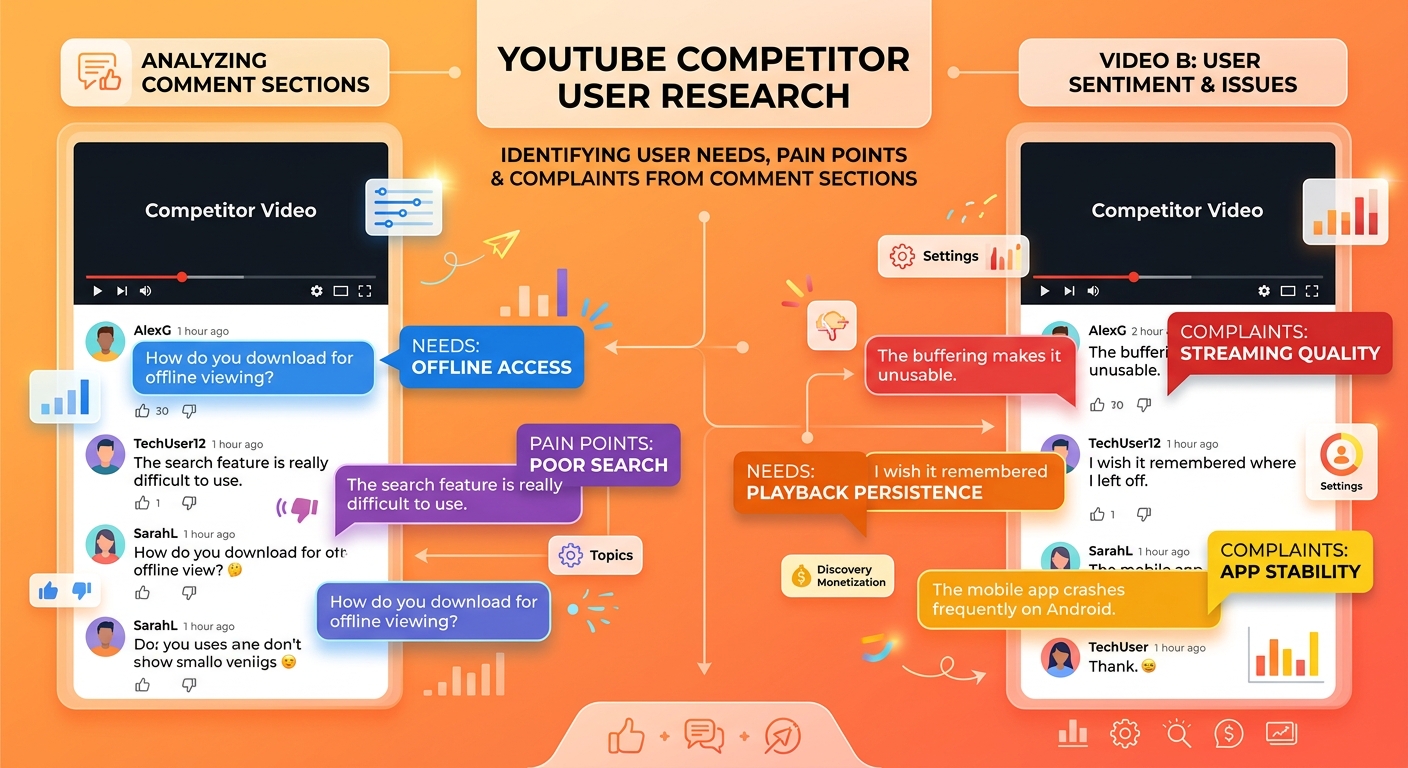
If you really read the comments section of your competitors carefully, you'll find that the comments are divided into several categories:
Demand-driven comments like "Can this work for combination skin?" or "Is there a travel size?" directly tell you what product extensions the user wants.
Pain point type : "I've tried three products and none of them worked for my issue..." These kinds of comments are excellent source material—users are describing their pain, and your next video can directly address this pain point.
Comparative type : "Is this better than [Competitor B]?" Users are actively comparing products with competitors, which means they are in the decision-making stage—at this time, an objective comparison video can capture traffic.
Complaint-based : Complaints in competitors' review sections are your goldmine. Users complain about overly large packaging, irritating ingredients, or the lack of a certain feature—these are all opportunities for you to differentiate yourself.
Once these four types of comments are collected and analyzed by the system, they will become the raw materials for your content matrix over the next three months.
Act Three: How to Systematically Conduct Competitive Product Review Mining
Step 1: Identify the monitoring target
Don't monitor all competitors; select 3-5 accounts that are closest to your niche and have the best content performance . Judgment criteria:
- Average views over the past 90 days > Your account
- The video style highly overlaps with your product category.
- The comment section is active (comments/views ratio > 0.5%).
YouTube competitor monitoring tools can be used to track these accounts' new videos, changes in views, and comment growth rates in batches, without needing to manually check them every day.
Step 2: Establish a comment tagging system
The raw comment data collected is extremely noisy and needs to be categorized using tags. Suggested basic tags:
| Label | meaning | Topic Transformation Direction |
|---|---|---|
| Unmet demand | Users mentioned missing features/specifications in the product | New product development and differentiated content |
| Pain points in scenarios | Describe the problems in specific use cases. | Scene resolution videos |
| Decision-making confusion | Hesitating among multiple choices | Comparison and evaluation videos |
| Emotional resonance | "This video expresses my feelings." | Emotionally driven brand content |
| Competitor Complaints | Dissatisfaction with competitors | Targeted differentiation |
Step 3: Extracting high-frequency vocabulary
Extract high-frequency words from comments, especially question phrases (why, how, does it work for, what if) and pain point descriptions (can't, doesn't, tired of, frustrated with).
These words constitute your SEO keyword library and are also the raw materials for video titles.
Truly viral video titles often directly replicate the original comments. If someone comments on a competitor's video saying, "I don't understand why this doesn't work for sensitive skin," your next video title could be: "Finally: a [category] that actually works for sensitive skin (here's why)."
Step 4: Establish a topic selection scoring matrix
After extracting candidate topics from the comments, a simple matrix is used to prioritize them:
- Frequency of demand (similar comments appear > 10 times): Basic threshold
- Emotional intensity (complaint-type > question-type > praise-type): The stronger the emotion, the higher the topic's popularity.
- Have competitors already responded? (Competitors have already bid: follow up with the competition; competitors haven't bid: blue ocean opportunity)
- Relevance to your product : It must naturally bring out your product or solution.
If the overall score for four dimensions is >3, prioritize taking photos.
Common Misconceptions in Practical Operation
Myth 1: Only look at the comments on viral videos
Viral videos generate a lot of comments, but the signal-to-noise ratio is low, with too many emotional comments from fans. Mid-tier videos (100,000-500,000 views) tend to have higher quality comments —the viewers are genuinely interested and targeted users with more specific questions.
Myth 2: Focusing only on the text and ignoring the time dimension of the comment.
The demand in reviews from three years ago may be completely different from that in reviews from last month. If your product category is seasonal, pay close attention to reviews from the last 90 days.
Myth 3: Treating "digging up comments" as a one-time task.
User needs are dynamic. Competitive analysis should become a monthly routine, not just something to be done once and for all. Use YouTube competitive analysis to set up competitor account monitoring and automatically alert users when new videos are published, reducing manual review costs.
Myth 4: Only analyzing text comments and ignoring pinned comments and interactions.
Competitor accounts' own responses also send signals. Which user questions are pinned to the top of their comment sections? This indicates that these questions are strategically important to them—either they are guiding the conversation, or this is their focus for the next phase.
From comment mining to release calendar
After completing the comment analysis, you should have 20-30 candidate topics. Next:
- Sort by rating matrix and select the Top 8 for the month.
- Write a title in the users' own words for each topic (using the wording directly from the comments).
- Matching product entry points – Every video should naturally integrate the product; don't force the product in just to create a topic.
- Schedule your releases regularly —YouTube's algorithm prefers consistent updates; 1-2 posts per week are more stable than irregular, high-frequency updates.
Once the release calendar is set, schedule releases in advance to allow you to focus your energy on the content itself, rather than wasting time making decisions about "whether to release today" and "what to release".
Data validation: ROI of mining commentary topics
This method is not just theoretical. A team that was expanding into overseas markets for beauty products implemented a system to mine competitor reviews. In the first month, videos with topics derived from review insights had an average of 2.3 times more views and a 47% higher comment engagement rate than videos with self-selected topics .
The logic is simple: the questions users ask are the content they want to see. If you answer their question, they'll watch the video, the algorithm will push it to you, and then more people will see it.
This is a positive flywheel. The cost of starting it is simply to use the time that would otherwise be wasted on guesswork for systematic listening each month.
How can SocialEcho support this workflow?
SocialEcho's YouTube competitor monitoring module supports the following capabilities:
- Track the video posting activity of designated competitor accounts and receive automatic notifications for new content.
- Compare key metrics such as video views and likes/comments ratio with competing products.
- In conjunction with the YouTube data analytics module, compare the content performance of your account with that of your competitors.
Basic plan starts at 12.5/month, team plan starts at 18.75/month, with a 20% discount for annual payments. For overseas brand operation teams, a single conversion resulting from an accurate topic selection can cover the tool costs for several months.

FAQ
Q: Which product categories are suitable for competitor review analysis for brands going global? A: It applies to almost all consumer goods categories, especially beauty and skincare, home goods, pet supplies, fitness equipment, and baby products—these categories have users in their YouTube comment sections who are highly expressive, have highly segmented needs, and generate a high density of information. B2B brands can also use it, focusing on comments that address pain points and decision-making dilemmas.
Q: Can I directly scrape the comment sections of competitor accounts? A: YouTube comment data can be accessed through the official API, and there are no legal risks. However, manually calling the API has its limitations; using professional competitor monitoring tools can save development costs.
Q: If there are people criticizing this product category in the comments section of a competitor's product, should we use this topic? A: Absolutely. User dissatisfaction is an excellent entry point for content—you can make a video on "Why most [category] products are disappointing, and how we solve this problem," which both steals traffic from competitors and establishes differentiated brand recognition.
Q: Can SocialEcho monitor comment sections on platforms other than YouTube? A: Yes. SocialEcho supports content and competitor monitoring on eight platforms including TikTok, Instagram, Facebook, and X, all managed from a single dashboard, eliminating the need to switch between platforms.
Q: Does comment mining require dedicated personnel? A: It takes time to set up the system initially (about a week), but after that, the tracking is automated through tools, and the monthly maintenance workload can be controlled within 3-4 hours.
Q: We're a small team with only one operations person. Can we implement this system? A: Absolutely. The core advantage of this method is that it transforms "guessing topics" into "analyzing data," reducing ineffective work. Small teams have limited resources, so they need to maximize the hit rate of each video rather than relying on quantity.
Q: How do I determine if topics gleaned from comments align with my brand's tone? A: First, verify the need, then ensure brand alignment. A good principle is: your product or brand must provide a genuine solution to the pain point, not just jump on the bandwagon. Content that artificially rides the wave but is irrelevant to your product may generate short-term traffic, but it damages your brand in the long run.
;}.cls-2{fill:%230868f7;}.cls-3{fill:url(%23未命名的渐变_44);}.cls-4{fill:%23333;}%3c/style%3e%3clinearGradient%20id='未命名的渐变_8'%20x1='33.73'%20y1='100.61'%20x2='-0.03'%20y2='-1.06'%20gradientUnits='userSpaceOnUse'%3e%3cstop%20offset='0'%20stop-color='%237ae9fb'/%3e%3cstop%20offset='0.67'%20stop-color='%232b90f8'/%3e%3cstop%20offset='1'%20stop-color='%230868f7'/%3e%3c/linearGradient%3e%3clinearGradient%20id='未命名的渐变_44'%20x1='27.86'%20y1='18.67'%20x2='68.36'%20y2='22.22'%20gradientUnits='userSpaceOnUse'%3e%3cstop%20offset='0'%20stop-color='%235ac7f2'/%3e%3cstop%20offset='1'%20stop-color='%230868f7'/%3e%3c/linearGradient%3e%3c/defs%3e%3cpath%20class='cls-1'%20d='M29,28.74V81.91l-9.51-3.68v0L8.52,74A7.17,7.17,0,0,1,4,67.32V24.54A3.76,3.76,0,0,1,9.08,21Z'/%3e%3cpath%20class='cls-2'%20d='M68.09,78.07a13.15,13.15,0,0,1-17.9,12.06L29,81.91h0V28.74L50.19,37A13.17,13.17,0,0,0,68.08,25.3h0Z'/%3e%3cpath%20class='cls-3'%20d='M68.08,25.3a13.19,13.19,0,0,1-6.73,10.87A13.09,13.09,0,0,1,50.19,37L29,28.74V6A3.76,3.76,0,0,1,34.1,2.52l25.59,9.91A13.22,13.22,0,0,1,68.08,25.3Z'/%3e%3cpath%20class='cls-4'%20d='M129.06,81.76a4.33,4.33,0,0,1-3.19-1.31,4.4,4.4,0,0,1-1.31-3.24V56.86H97.65V77.21a4.36,4.36,0,0,1-1.35,3.2A4.68,4.68,0,0,1,93,81.76a4.32,4.32,0,0,1-3.19-1.31,4.37,4.37,0,0,1-1.32-3.24V27.27A4.58,4.58,0,0,1,89.83,24a4.59,4.59,0,0,1,7.82,3.27V48.15h26.91V27.27A4.58,4.58,0,0,1,125.91,24a4.59,4.59,0,0,1,7.82,3.27V77.21a4.37,4.37,0,0,1-1.36,3.2A4.65,4.65,0,0,1,129.06,81.76Z'/%3e%3cpath%20class='cls-4'%20d='M163.77,81.66c-6.57,0-11.76-1.92-15.44-5.7s-5.54-9.07-5.54-15.74a26.76,26.76,0,0,1,2.09-10.43,17.72,17.72,0,0,1,6.67-8.06,19.15,19.15,0,0,1,10.68-2.95,19,19,0,0,1,10.46,2.8,18.7,18.7,0,0,1,6.55,7.36,22.53,22.53,0,0,1,2.36,10.28A4.51,4.51,0,0,1,177,63.77H152.23a10.8,10.8,0,0,0,3.49,6.65c2,1.68,4.88,2.52,8.66,2.52a22.25,22.25,0,0,0,7.54-1.21c.74-.3,1.55-.67,2.37-1.07a3.75,3.75,0,0,1,1.84-.4,4.09,4.09,0,0,1,3,1.15,4,4,0,0,1,1.12,3,4.38,4.38,0,0,1-2.58,3.82,32.34,32.34,0,0,1-6.36,2.61A28.67,28.67,0,0,1,163.77,81.66ZM172.4,55.9a9.72,9.72,0,0,0-1.63-4.56A9.9,9.9,0,0,0,167,48a10.38,10.38,0,0,0-4.64-1.14,12,12,0,0,0-4.77,1.06,9.54,9.54,0,0,0-4.89,5.66,11.78,11.78,0,0,0-.51,2.3Z'/%3e%3cpath%20class='cls-4'%20d='M193,81.64a4.49,4.49,0,0,1-4.51-4.55V27.28A4.58,4.58,0,0,1,189.84,24a4.48,4.48,0,0,1,3.28-1.36A4.36,4.36,0,0,1,196.35,24a4.46,4.46,0,0,1,1.31,3.31V77.09a4.34,4.34,0,0,1-1.35,3.2A4.67,4.67,0,0,1,193,81.64Z'/%3e%3cpath%20class='cls-4'%20d='M263.79,81.71a5.7,5.7,0,0,1-4.2-1.74,5.76,5.76,0,0,1-1.73-4.19V27.37a4.58,4.58,0,0,1,1.35-3.27A4.59,4.59,0,0,1,267,27.37V72.53h24a4.58,4.58,0,0,1,3.27,7.82A4.66,4.66,0,0,1,291,81.71Z'/%3e%3cpath%20class='cls-4'%20d='M424.48,81.74a4.71,4.71,0,0,1-2.71-.88,5.43,5.43,0,0,1-1-1l-.07-.09-12.41-17-5.41,5v9.44a4.31,4.31,0,0,1-1.36,3.19,4.66,4.66,0,0,1-3.3,1.36A4.29,4.29,0,0,1,395,80.42a4.36,4.36,0,0,1-1.32-3.23V27.37A4.58,4.58,0,0,1,395,24.1a4.52,4.52,0,0,1,6.58.12,4.54,4.54,0,0,1,1.24,3.15V56.31l17.72-16.38.05,0a4.8,4.8,0,0,1,2.94-1.11,4.4,4.4,0,0,1,3.27,1.2,4.57,4.57,0,0,1,1.2,3.27,4.44,4.44,0,0,1-.77,2.33,7.45,7.45,0,0,1-1.43,1.65l-11,9.64,13.34,17.68a5,5,0,0,1,1,2.71,4.12,4.12,0,0,1-1.36,3.24A4.64,4.64,0,0,1,424.48,81.74Z'/%3e%3cpath%20class='cls-4'%20d='M317.93,81.76a21.5,21.5,0,1,1,21.17-21.5A21.37,21.37,0,0,1,317.93,81.76Zm0-34.1a12.61,12.61,0,1,0,12.42,12.6A12.52,12.52,0,0,0,317.93,47.66Z'/%3e%3cpath%20class='cls-4'%20d='M212.18,101.22a4.12,4.12,0,0,1-3.05-1.26,4.17,4.17,0,0,1-1.26-3.1V43.34a4.37,4.37,0,0,1,1.3-3.14,4.26,4.26,0,0,1,3.13-1.3,4.19,4.19,0,0,1,3.1,1.26,4.32,4.32,0,0,1,1.26,3.16,20.77,20.77,0,0,1,13-4.54,21.51,21.51,0,0,1,0,43,20.51,20.51,0,0,1-13-4.57V96.86a4.15,4.15,0,0,1-1.3,3.06A4.5,4.5,0,0,1,212.18,101.22Zm17.43-53.63c-6.23,0-12.93,4.11-12.93,12.72a12.73,12.73,0,0,0,25.46,0A12.71,12.71,0,0,0,229.61,47.59Z'/%3e%3cpath%20class='cls-4'%20d='M365.76,81.76a21.5,21.5,0,1,1,21.18-21.5A21.37,21.37,0,0,1,365.76,81.76Zm0-34.1a12.61,12.61,0,1,0,12.42,12.6A12.52,12.52,0,0,0,365.76,47.66Z'/%3e%3c/svg%3e)