
The 7:2:1 Content Rule: Why Your Social Media Content Lacks Traffic (And the Complete Execution Guide)
The 7:2:1 Content Rule: Why Your Social Media Content Always Falls Flat (And How to Fix It)
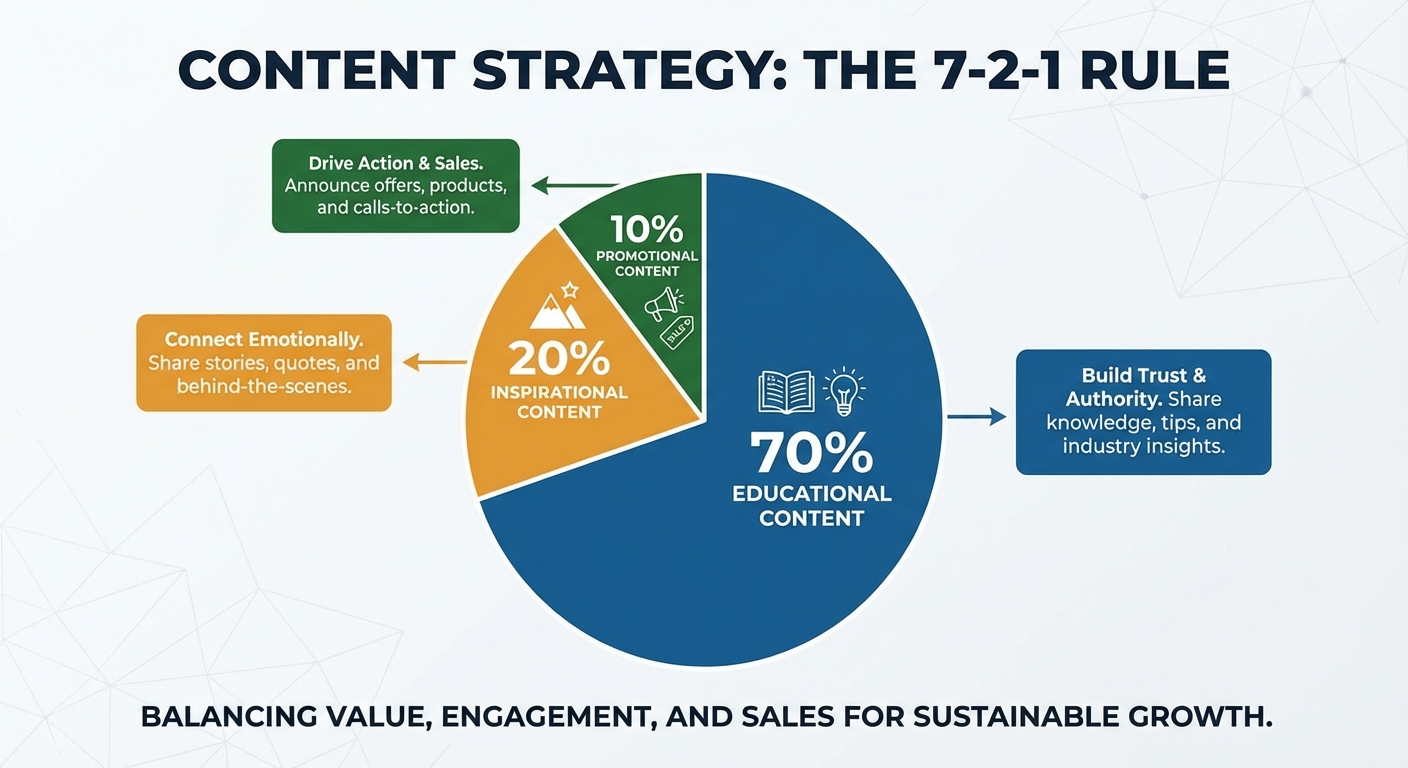
Your content calendar probably looks something like this:
Monday, new product teaser. Wednesday, promotional announcement. Friday, limited-time deal countdown. Weekend, another wave of "last chance to get it"...
Three months in: follower growth is slowing, engagement is tanking, ad spend is climbing, and results are getting worse.
You start to wonder — is the content quality not good enough? Wrong posting times? Is the algorithm out to get me?
None of the above. Your content mix is the problem.
The Real Issue: You're Using Your Social Account as an Ad Board
Anyone who's done cross-border marketing knows it: Western audiences have an extremely low tolerance for "hard sells." When they follow a brand account, it's not to see daily promotions — it's to learn something, be entertained, or pick up useful tips.
Instagram's own data shows: organic reach for purely promotional content had already fallen below 2.3% of follower count by 2025. That means the promotional post you worked hard on might reach only 2 out of every 100 followers — not counting the ones who swipe past without engaging.
Why does the algorithm do this? Because platforms make money from user retention, not from helping you sell products. Once users feel your content is "nothing but ads," they'll unfollow, mute, or silence you — and the platform's recommendation weight drops sharply.
This is why, even if you post diligently every day, reach can still keep declining.
Content mix determines how many people the platform shows your content to.
What Is the 7:2:1 Content Rule?
7:2:1 is a content ratio framework validated across the digital marketing industry. The core logic:
70%: Pure value content (product-free or barely mentioned)
Industry knowledge, practical tips, platform tactics, user pain point breakdowns... anything that makes your target audience say "I need to save this." No brand mention, or just a light touch at the end. These 70% are the foundation of your professional authority and what earns you platform recommendation weight.
20%: Engagement and community content
Questions, polls, user stories, UGC reposts... the goal is getting followers to actually talk, building a genuine sense of community. This type of content typically gets shared 5x more than pure promotional content, and it's also a key signal the algorithm uses to assess your "popularity score."
10%: Direct promotional content
New product launches, limited-time events, product feature walkthroughs... Only 10% of your slots, but because the preceding 70% already built trust, this 10% actually converts better — users won't swipe past it as an ad, because they already trust this account.
Sounds counterintuitive? Most brand accounts have the exact opposite ratio — 60% promotional, 30% product showcases, and only 10% for "pretending to do content" industry posts. Flipped ratios lead to declining organic reach, which leads to increasing paid traffic, which burns budget while numbers get uglier.
How to Execute 7:2:1 in Practice
Step 1: Audit Your Current Content Ratio
Pull up everything you've posted in the last 30 days and categorize each piece: is its core purpose "let users learn something," "get users to engage," or "get users to spend money or click"?
Most brands who do this audit discover their actual "70%" is often less than 15%. That number tends to make it very clear why follower growth has been so slow.
Step 2: Build a Content Topic Pool
The hardest part of sustaining 70% value content is generating it — the key is building your topic pool in advance, not brainstorming on the fly each week.
For cross-border social media operators, value content can be divided into several buckets: platform algorithm changes (TikTok's latest ranking mechanisms, Instagram Reels weight adjustments), operational methodology (multi-account management tips, best practices for comment section replies), data insights (engagement rate benchmarks by platform, relationship between posting time and traffic), and user case studies (real failure and success stories with specific numbers).
Set aside 30 minutes each week to pre-select topics for the following week's 70% content framework — and your execution costs will drop dramatically. Using social listening to track trending industry topics in real time is the most efficient way to continuously refill your topic pool.

Step 3: 20% Engagement Content Shouldn't Be an Afterthought
Many brands' "engagement content" is just "Have you used this feature?" with a product screenshot — that's not engagement content, that's an ad in a different costume.
Truly effective engagement content gives users something to actually talk about: "Which platform has burned you the most?" "Which platform do you think will see organic reach spike in 2026?" "If you could only keep one social platform, which one?"
These questions make your target customers think "Oh, this account gets me — we're in the same world." That's what engagement content is supposed to accomplish. When engagement picks up, the algorithm expands distribution range, and both value and promotional content get seen by more people.
Step 4: Make Your 10% Promotional Content "Not Feel Like an Ad"
The smartest brand promotions make users feel "you just solved my problem," not "you're selling me something."
Instead of "SocialEcho's new feature is live! Try it now!", post "One of our users told us they were spending 4 hours a week on screenshot-based reports. Now with analytics, they knock it all out in 15 minutes." Same information, different framing — the user experience is night and day.
Repurpose Content, Don't Just Create More Content
A common misconception: executing 7:2:1 means producing more content.
Wrong. 7:2:1 is a structural adjustment, not a volume increase.
One piece of core content about "best time to post Instagram Reels" can generate: one image post (70% value content), one interactive poll "What time do you post Reels for best results?" (20% engagement content), and one CTA post "Want to automatically find your best posting window? Try the scheduling feature" (10% promotional content).
One core topic, three formats, covering the complete 7:2:1 ratio — not three completely separate content ideas from scratch. Repurpose content; that's the sustainable content production rhythm.
Validate Your Ratio Results with Data
After adjusting your content mix, you need a period of data validation — not just "feeling like it might be working."
Use analytics to review engagement performance across all three content types: in your 70% value content, which topic categories get the highest engagement rates? In your 20% engagement content, which question formats generate the most replies? In your 10% promotional content, which storytelling angles get the best click rates?
Data will tell you what your target customers want to see — and then you can keep going deeper in those directions, instead of always guessing.
Final Note: Traffic Has Never Been About Posting More
After years of doing cross-border social media marketing, the most counterintuitive realization is: reducing promotional content actually increases promotional conversion rates.
Not because promotions don't matter — but because trust is the prerequisite for conversion. Once users form the perception that an account is "worth following — there's real substance here," then that 10% promotional content gets treated seriously instead of swiped past.
7:2:1 doesn't restrict you — it helps you build content momentum so that when it's time to convert, every shot hits.
Related features: Instagram Multi-Account Management · TikTok Multi-Account Management

Starting with next week's content calendar, try adjusting your ratio.
Try SocialEcho free — manage multi-account content scheduling and analyze content performance →
👉 https://www.socialecho.net
;}.cls-2{fill:%230868f7;}.cls-3{fill:url(%23未命名的渐变_44);}.cls-4{fill:%23333;}%3c/style%3e%3clinearGradient%20id='未命名的渐变_8'%20x1='33.73'%20y1='100.61'%20x2='-0.03'%20y2='-1.06'%20gradientUnits='userSpaceOnUse'%3e%3cstop%20offset='0'%20stop-color='%237ae9fb'/%3e%3cstop%20offset='0.67'%20stop-color='%232b90f8'/%3e%3cstop%20offset='1'%20stop-color='%230868f7'/%3e%3c/linearGradient%3e%3clinearGradient%20id='未命名的渐变_44'%20x1='27.86'%20y1='18.67'%20x2='68.36'%20y2='22.22'%20gradientUnits='userSpaceOnUse'%3e%3cstop%20offset='0'%20stop-color='%235ac7f2'/%3e%3cstop%20offset='1'%20stop-color='%230868f7'/%3e%3c/linearGradient%3e%3c/defs%3e%3cpath%20class='cls-1'%20d='M29,28.74V81.91l-9.51-3.68v0L8.52,74A7.17,7.17,0,0,1,4,67.32V24.54A3.76,3.76,0,0,1,9.08,21Z'/%3e%3cpath%20class='cls-2'%20d='M68.09,78.07a13.15,13.15,0,0,1-17.9,12.06L29,81.91h0V28.74L50.19,37A13.17,13.17,0,0,0,68.08,25.3h0Z'/%3e%3cpath%20class='cls-3'%20d='M68.08,25.3a13.19,13.19,0,0,1-6.73,10.87A13.09,13.09,0,0,1,50.19,37L29,28.74V6A3.76,3.76,0,0,1,34.1,2.52l25.59,9.91A13.22,13.22,0,0,1,68.08,25.3Z'/%3e%3cpath%20class='cls-4'%20d='M129.06,81.76a4.33,4.33,0,0,1-3.19-1.31,4.4,4.4,0,0,1-1.31-3.24V56.86H97.65V77.21a4.36,4.36,0,0,1-1.35,3.2A4.68,4.68,0,0,1,93,81.76a4.32,4.32,0,0,1-3.19-1.31,4.37,4.37,0,0,1-1.32-3.24V27.27A4.58,4.58,0,0,1,89.83,24a4.59,4.59,0,0,1,7.82,3.27V48.15h26.91V27.27A4.58,4.58,0,0,1,125.91,24a4.59,4.59,0,0,1,7.82,3.27V77.21a4.37,4.37,0,0,1-1.36,3.2A4.65,4.65,0,0,1,129.06,81.76Z'/%3e%3cpath%20class='cls-4'%20d='M163.77,81.66c-6.57,0-11.76-1.92-15.44-5.7s-5.54-9.07-5.54-15.74a26.76,26.76,0,0,1,2.09-10.43,17.72,17.72,0,0,1,6.67-8.06,19.15,19.15,0,0,1,10.68-2.95,19,19,0,0,1,10.46,2.8,18.7,18.7,0,0,1,6.55,7.36,22.53,22.53,0,0,1,2.36,10.28A4.51,4.51,0,0,1,177,63.77H152.23a10.8,10.8,0,0,0,3.49,6.65c2,1.68,4.88,2.52,8.66,2.52a22.25,22.25,0,0,0,7.54-1.21c.74-.3,1.55-.67,2.37-1.07a3.75,3.75,0,0,1,1.84-.4,4.09,4.09,0,0,1,3,1.15,4,4,0,0,1,1.12,3,4.38,4.38,0,0,1-2.58,3.82,32.34,32.34,0,0,1-6.36,2.61A28.67,28.67,0,0,1,163.77,81.66ZM172.4,55.9a9.72,9.72,0,0,0-1.63-4.56A9.9,9.9,0,0,0,167,48a10.38,10.38,0,0,0-4.64-1.14,12,12,0,0,0-4.77,1.06,9.54,9.54,0,0,0-4.89,5.66,11.78,11.78,0,0,0-.51,2.3Z'/%3e%3cpath%20class='cls-4'%20d='M193,81.64a4.49,4.49,0,0,1-4.51-4.55V27.28A4.58,4.58,0,0,1,189.84,24a4.48,4.48,0,0,1,3.28-1.36A4.36,4.36,0,0,1,196.35,24a4.46,4.46,0,0,1,1.31,3.31V77.09a4.34,4.34,0,0,1-1.35,3.2A4.67,4.67,0,0,1,193,81.64Z'/%3e%3cpath%20class='cls-4'%20d='M263.79,81.71a5.7,5.7,0,0,1-4.2-1.74,5.76,5.76,0,0,1-1.73-4.19V27.37a4.58,4.58,0,0,1,1.35-3.27A4.59,4.59,0,0,1,267,27.37V72.53h24a4.58,4.58,0,0,1,3.27,7.82A4.66,4.66,0,0,1,291,81.71Z'/%3e%3cpath%20class='cls-4'%20d='M424.48,81.74a4.71,4.71,0,0,1-2.71-.88,5.43,5.43,0,0,1-1-1l-.07-.09-12.41-17-5.41,5v9.44a4.31,4.31,0,0,1-1.36,3.19,4.66,4.66,0,0,1-3.3,1.36A4.29,4.29,0,0,1,395,80.42a4.36,4.36,0,0,1-1.32-3.23V27.37A4.58,4.58,0,0,1,395,24.1a4.52,4.52,0,0,1,6.58.12,4.54,4.54,0,0,1,1.24,3.15V56.31l17.72-16.38.05,0a4.8,4.8,0,0,1,2.94-1.11,4.4,4.4,0,0,1,3.27,1.2,4.57,4.57,0,0,1,1.2,3.27,4.44,4.44,0,0,1-.77,2.33,7.45,7.45,0,0,1-1.43,1.65l-11,9.64,13.34,17.68a5,5,0,0,1,1,2.71,4.12,4.12,0,0,1-1.36,3.24A4.64,4.64,0,0,1,424.48,81.74Z'/%3e%3cpath%20class='cls-4'%20d='M317.93,81.76a21.5,21.5,0,1,1,21.17-21.5A21.37,21.37,0,0,1,317.93,81.76Zm0-34.1a12.61,12.61,0,1,0,12.42,12.6A12.52,12.52,0,0,0,317.93,47.66Z'/%3e%3cpath%20class='cls-4'%20d='M212.18,101.22a4.12,4.12,0,0,1-3.05-1.26,4.17,4.17,0,0,1-1.26-3.1V43.34a4.37,4.37,0,0,1,1.3-3.14,4.26,4.26,0,0,1,3.13-1.3,4.19,4.19,0,0,1,3.1,1.26,4.32,4.32,0,0,1,1.26,3.16,20.77,20.77,0,0,1,13-4.54,21.51,21.51,0,0,1,0,43,20.51,20.51,0,0,1-13-4.57V96.86a4.15,4.15,0,0,1-1.3,3.06A4.5,4.5,0,0,1,212.18,101.22Zm17.43-53.63c-6.23,0-12.93,4.11-12.93,12.72a12.73,12.73,0,0,0,25.46,0A12.71,12.71,0,0,0,229.61,47.59Z'/%3e%3cpath%20class='cls-4'%20d='M365.76,81.76a21.5,21.5,0,1,1,21.18-21.5A21.37,21.37,0,0,1,365.76,81.76Zm0-34.1a12.61,12.61,0,1,0,12.42,12.6A12.52,12.52,0,0,0,365.76,47.66Z'/%3e%3c/svg%3e)