
Meta's DAU Just Declined for the First Time in 20 Years—Here's What Brands Must Do Now
Meta's DAU Just Declined for the First Time in 20 Years—Here's What Brands Must Do Now
The Hook: A Historic Inflection Point
On April 24, 2026, Meta reported something that hadn't happened in two decades: daily active users (DAU) declined quarter-over-quarter.
Not growth slowing. Not plateauing. Declining.
The number: -2.3% in Q1 2026. For a company that's grown users every single quarter since 2004, this isn't just a blip. It's a signal.
Jennifer Walsh, CMO of a $50M e-commerce brand, saw the earnings call and immediately called an emergency strategy meeting.
"If Meta is declining, we can't keep 60% of our social budget on Facebook and Instagram," she told her team. "We need to redistribute—now."
She's right. But most brands haven't reacted yet. They're still running the same playbooks, allocating the same budgets, and expecting the same results.
That's about to change.

Why This Matters More Than You Think
Meta's DAU decline isn't just a Meta problem. It's a symptom of broader shifts:
1. Platform Saturation
- Facebook has ~2 billion monthly active users
- That's roughly 25% of Earth's population
- There's literally nowhere left to grow
2. Generational Shift
- Gen Z spends 3x more time on TikTok than Facebook
- Gen Alpha barely uses Meta platforms at all
- As older users age out, younger users aren't replacing them
3. Attention Fragmentation
- TikTok, YouTube Shorts, Snapchat all compete for the same attention
- Users have finite time; every new app takes time from existing apps
- Meta is losing the battle for younger users
4. Ad Load Fatigue
- Users see 10+ ads per hour on Meta platforms
- Ad avoidance behaviors (skipping, ad blockers) are increasing
- Advertisers pay more for less effective placements
For brands, these trends mean one thing: the Meta-dependent strategy that worked for the past decade will not work for the next decade.
Not growth slowing. Not plateauing. Declining.
The number: -2.3% in Q1 2026. For a company that's grown users every single quarter since 2004, this isn't just a blip. It's a signal.
Jennifer Walsh, CMO of a $50M e-commerce brand, saw the earnings call and immediately called an emergency strategy meeting.
"If Meta is declining, we can't keep 60% of our social budget on Facebook and Instagram," she told her team. "We need to redistribute—now."
She's right. But most brands haven't reacted yet. They're still running the same playbooks, allocating the same budgets, and expecting the same results.
That's about to change.
What Meta's DAU Decline Actually Means
The Surface Story
Meta's Q1 2026 earnings report showed:
- DAU: 3.07 billion (down 2.3% from Q4 2025)
- MAU: 3.96 billion (down 0.8%)
- Revenue: $40.1 billion (up 12% year-over-year)
Wait—revenue is up while users are down? How?
The Deeper Analysis: Regional Breakdown
The decline wasn't uniform across regions:
North America: -4.1% DAU
- Mature market, high saturation
- Younger users migrating to TikTok
- Ad fatigue among older users
Europe: -2.8% DAU
- GDPR compliance costs
- Privacy concerns driving users away
- Competition from local platforms
Asia-Pacific: +1.2% DAU
- Still growing in developing markets
- Offset by declines in Australia/Japan
- TikTok dominance in key markets
Rest of World: +3.4% DAU
- Emerging markets still adopting
- Lower monetization per user
- Growth doesn't offset developed market declines
Key insight: The decline is concentrated in Meta's most valuable markets (North America, Europe). This is where advertisers pay the most. So even though global DAU only declined 2.3%, the monetizable DAU declined more significantly.
The Real Story: Engagement Is Concentrating
Meta is making more money from fewer users because:
- DAU: 3.07 billion (down 2.3% from Q4 2025)
- MAU: 3.96 billion (down 0.8%)
- Revenue: $40.1 billion (up 12% year-over-year)
Wait—revenue is up while users are down? How?
The Real Story: Engagement Is Concentrating
Meta is making more money from fewer users because:
- Ad prices are increasing (fewer users = more competition for attention)
- Power users are spending more time (casual users are leaving)
- Shopping and Reels drive higher monetization (Meta is prioritizing these)
For brands, this means:
- Organic reach will continue declining (Meta needs to monetize remaining users)
- Ad costs will increase (more competition for fewer eyeballs)
- Content format matters more than ever (Reels > static posts)
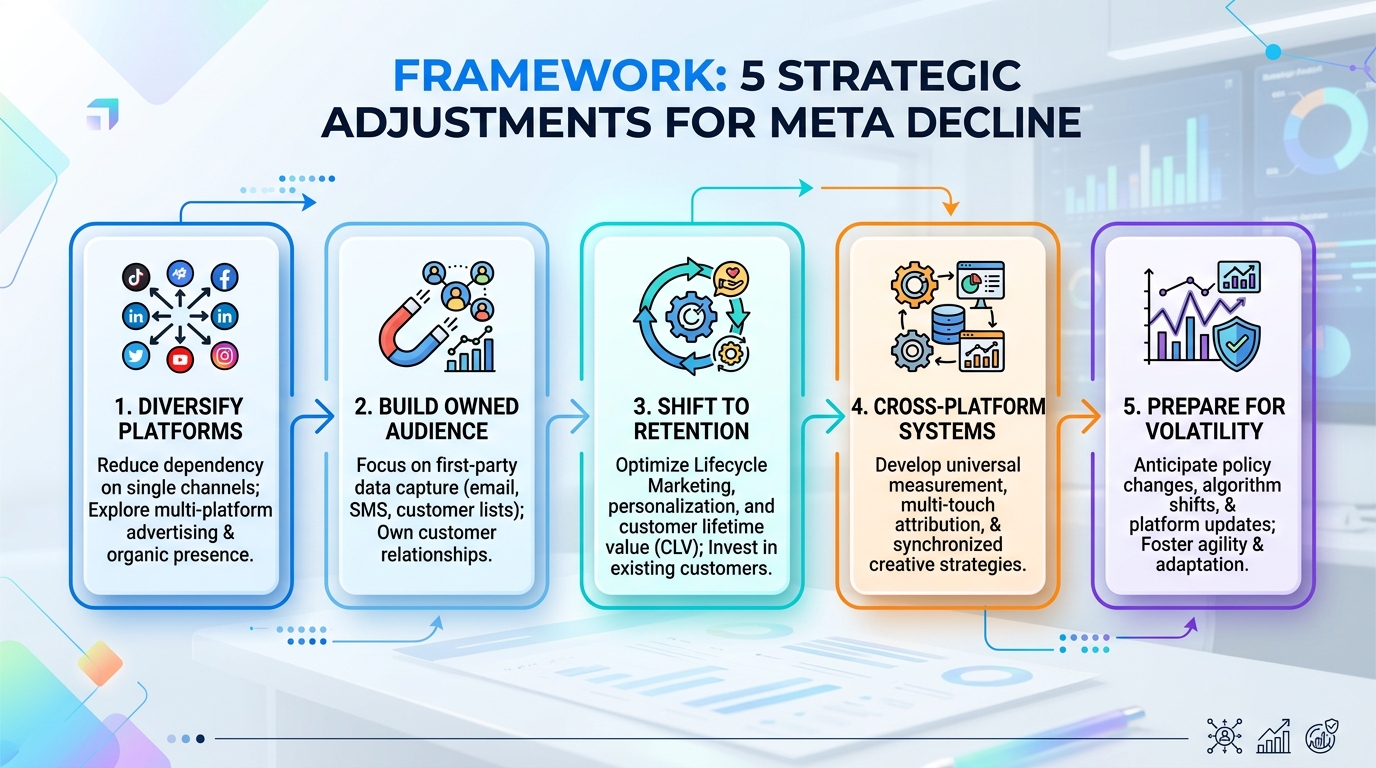
The 5 Strategic Adjustments Brands Must Make
Adjustment 1: Diversify Beyond Meta Immediately
The problem: Most brands have 50-70% of their social budget concentrated on Facebook and Instagram.
The risk: As Meta's user base shrinks, your cost per acquisition will rise. Your organic reach will decline. Your growth will stall.
The solution: Redistribute budget across emerging and stable platforms.
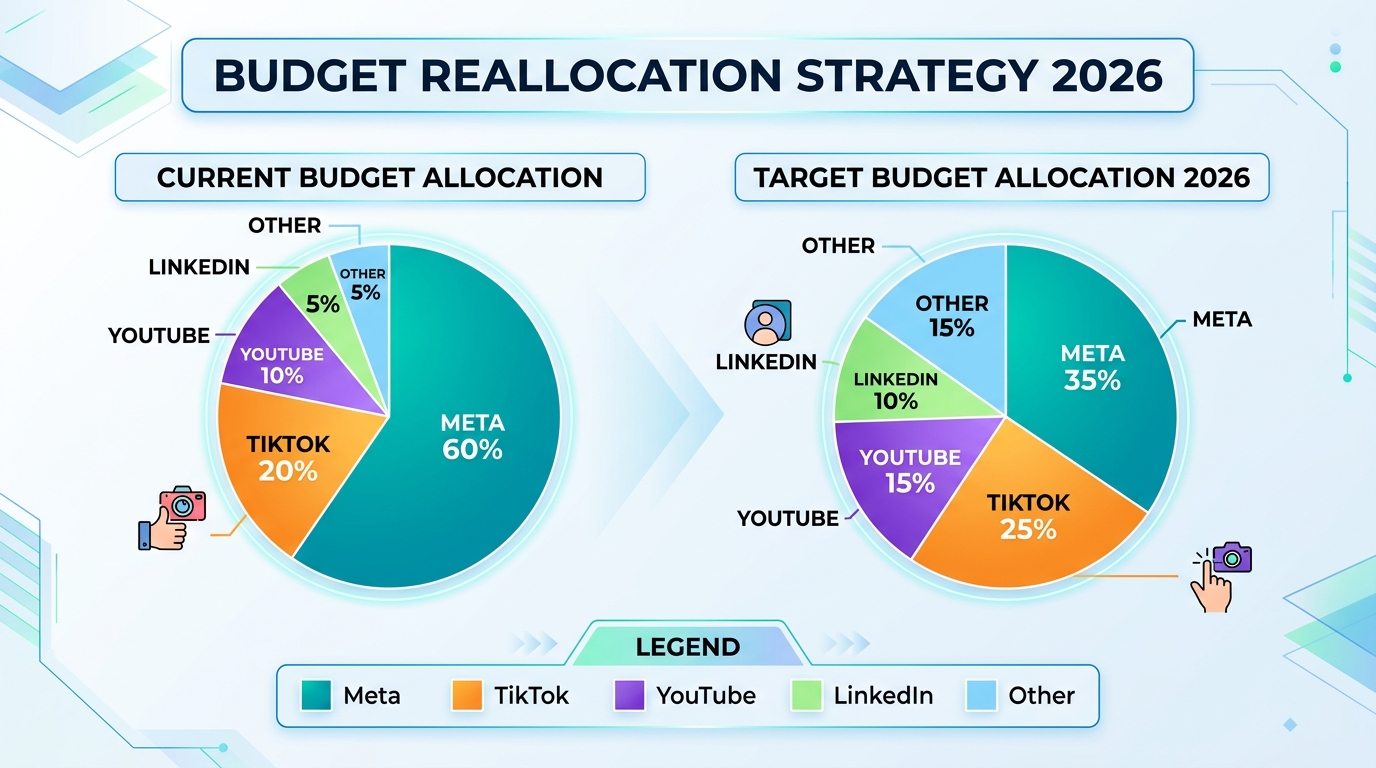
Recommended allocation for 2026:
| Platform | Current (typical) | Target (2026) | Rationale |
|---|---|---|---|
| Facebook/Instagram | 60% | 35% | Still massive, but declining |
| TikTok | 20% | 25% | Growth continues, younger demo |
| YouTube | 10% | 15% | Stable, high-intent audience |
| 5% | 10% | B2B goldmine, underpriced | |
| Emerging (Threads, etc.) | 5% | 15% | Test new channels early |
Action: Audit your current budget allocation. Create a 6-month transition plan to reach target allocation.
Adjustment 2: Double Down on Owned Audiences
The problem: You don't own your Meta audience. Meta does. If the platform declines, you lose access.
The solution: Build owned audiences that you control.
Tactics:
- Email list building: Add lead magnets to all social content
- SMS marketing: Higher open rates than email
- Community platforms: Discord, Slack, Circle (you control the rules)
- Website traffic: Drive social followers to your site (you own the relationship)
Example: A DTC brand added a "Join our VIP list" CTA to their Instagram bio. In 6 months, they built a 45K email list. When Instagram reach dropped 40%, their email channel maintained consistent revenue.
Key metric: What percentage of your social followers are also on your email list? Target: 20%+.
Adjustment 3: Shift from Reach to Retention
The problem: Meta's algorithm now prioritizes retention over reach. Content that keeps users on the platform gets rewarded. Content that sends them elsewhere gets penalized.
The solution: Optimize for watch time and engagement, not link clicks.
Tactics:
- Create content that keeps users on-platform (Reels, carousels, Stories)
- Use link-in-bio tools instead of direct post links (less algorithmic penalty)
- Build content series that encourage binge-watching
- Focus on comment conversations (signals engagement to algorithm)
Example: A fitness brand stopped posting "Click the link in bio for our workout plan" and started posting full workout Reels. Reach increased 3x. Link clicks (via link-in-bio) increased 2x. Counterintuitive, but true.
Adjustment 4: Invest in Cross-Platform Content Systems
The problem: Managing content across 5+ platforms is operationally exhausting. Most brands can't sustain it.
The solution: Build systems that enable efficient cross-platform publishing.
What you need:
- Content repurposing workflow: One piece of content → 5 platform-specific versions
- Unified scheduling: Schedule all platforms from one dashboard
- Performance tracking: Compare performance across platforms in one view
- Team collaboration: Clear roles for creation, approval, publishing
This is where social media management platforms become essential. You can't manually manage 5 platforms at scale.
Example workflow:
- Record one long-form video (YouTube)
- Cut into 5 short-form clips (TikTok, Reels, Shorts)
- Extract quotes for text posts (LinkedIn, X)
- Create carousel from key points (Instagram, Facebook)
- Schedule all from one dashboard
Time saved: 8 hours per week → 2 hours per week.
To execute this workflow efficiently, you need content publishing tools that support scheduling across all major platforms from a single interface.
Adjustment 5: Prepare for Platform Volatility
The problem: Meta's decline proves that no platform is permanent. TikTok could face a ban. X could continue declining. New platforms could emerge.
The solution: Build agility into your social strategy.
Tactics:
- Test new platforms early (allocate 10-15% budget to experimentation)
- Document your playbook (so you can replicate success on new platforms)
- Train your team on fundamentals (not platform-specific tactics)
- Build relationships with platform reps (get early access to new features)
Example: When Threads launched, brands with an experimentation budget could test immediately. Brands without one waited 6 months to "see if it sticks." By then, early movers had built audiences.
The Multi-Platform Reality
Here's the uncomfortable truth: Diversifying across platforms increases operational complexity.
Before (Meta-only focus):
- 2 platforms to manage (Facebook, Instagram)
- Similar content formats
- One analytics dashboard
- Manageable workload
After (Diversified):
- 5-7 platforms to manage
- Different formats for each
- Multiple analytics dashboards
- 3x workload
This is why most brands resist diversification. They know they should do it—but the operational burden feels impossible.
The answer isn't to work harder. It's to work differently.
You need:
- Unified analytics to see all platforms in one view
- AI automation to handle repetitive tasks
- Content publishing tools to schedule across platforms
- Social listening to monitor brand mentions everywhere
Without these, diversification will burn out your team.
Platform-by-Platform Opportunity Analysis
As you diversify beyond Meta, understand the unique opportunities each platform offers:
TikTok: The Growth Engine
Why it matters: Still growing, especially with Gen Z and Millennials.
Best for: Short-form video, trends, authentic content.
Challenge: High production frequency required.
Opportunity: Early mover advantage in many categories.
Action: Allocate 25% of budget. Post 3-5x per week. Focus on trends and authenticity over polish.
YouTube: The Stable Giant
Why it matters: Second largest search engine, high intent audience.
Best for: Long-form content, tutorials, reviews.
Challenge: Higher production bar.
Opportunity: Shorts + long-form combination drives discovery and loyalty.
Action: Allocate 15% of budget. Start with Shorts for discovery, build long-form for loyalty.
LinkedIn: The B2B Goldmine
Why it matters: Underserved platform, high-value audience.
Best for: B2B, professional services, recruiting.
Challenge: Requires professional tone.
Opportunity: Lower competition, higher engagement rates.
Action: Allocate 10% of budget (15% for B2B). Post 3-5x per week. Focus on insights over promotion.
Emerging Platforms: The Early Bet
Why it matters: First-mover advantages are real.
Best for: Brands with experimentation budget.
Challenge: Uncertain ROI, platform risk.
Opportunity: Build audience before competitors arrive.
Action: Allocate 10-15% of budget. Test 1-2 emerging platforms per quarter. Kill fast if no traction.
Case Study: How One Brand Navigated the Shift
Brand: GreenLeaf Organics (organic food subscription, $30M revenue)
Challenge: 70% of social budget on Facebook/Instagram. Reach declining 15% quarter-over-quarter.
Solution: Implemented the 5 adjustments over 6 months.
Month 1-2: Audit and Plan
- Mapped current budget allocation
- Identified target allocation
- Built content repurposing workflow
Month 3-4: Implement
- Launched TikTok and YouTube channels
- Built email list building into all content
- Implemented unified scheduling tool
Month 5-6: Optimize
- Shifted budget based on performance
- Automated repetitive tasks
- Trained team on new workflows
Results:
- Meta budget: 70% → 38%
- TikTok + YouTube: 10% → 35%
- Overall CPA: 47 → 31 (-34%)
- Email list: 12K → 67K (+458%)
- Revenue from social: 180K/month → 340K/month (+89%)
Key insight: Diversification didn't reduce Meta performance. It unlocked growth that Meta alone couldn't provide.
The Window Is Closing
Meta's DAU decline is a once-in-20-years event. It's a signal that the social media landscape is shifting.
Brands that act now will:
- Secure better ad rates (before everyone else rushes in)
- Build audiences on emerging platforms (before they're saturated)
- Develop operational systems (before the pressure becomes urgent)
Brands that wait will:
- Pay higher ad costs (more competition for declining users)
- Play catch-up on new platforms (audiences already built by competitors)
- React from desperation (not strategy)
The window is open. But it won't stay open forever.
The Psychology of Platform Dependency
Why do brands stay dependent on Meta despite clear warning signs? Understanding the psychology helps you overcome it:
The Sunk Cost Fallacy
"We've built 500K followers on Instagram. We can't abandon that now."
The reality: You're not abandoning anything. You're diversifying. Your Instagram followers are still there—you're just building additional audiences on other platforms.
The fix: Reframe diversification as addition, not subtraction. You're not leaving Meta; you're expanding beyond it.
The Status Quo Bias
"This is how we've always done it. It worked for years."
The reality: What worked when Meta was growing won't work when Meta is declining. The environment changed. Your strategy must change with it.
The fix: Audit your strategy quarterly, not annually. In a rapidly changing environment, annual planning is too slow.
The Complexity Aversion
"Managing 5 platforms is too complicated. We'll stick with 2."
The reality: Managing 5 platforms manually is complicated. Managing 5 platforms with the right tools is efficient.
The fix: Invest in social media management tools that unify scheduling, analytics, and engagement. The time savings pay for the investment.
Your 30-Day Action Plan
Week 1: Audit
- Map current budget allocation across platforms
- Calculate Meta dependency (% of budget, % of revenue)
- Identify top 3 alternative platforms for your audience
Week 2: Plan
- Set target budget allocation (6-month goal)
- Build content repurposing workflow
- Select unified management tool
Week 3: Launch
- Create accounts on new platforms
- Publish first wave of repurposed content
- Add email capture to all social profiles
Week 4: Measure
- Review performance across all platforms
- Adjust budget allocation based on data
- Document learnings and iterate
Frequently Asked Questions About Meta's Decline
Q: Is Meta dying?
A: No. Meta is still massive—3+ billion monthly users. But it's no longer growing, and that changes the game for brands. Think of it as a mature market, not a dying one.
Q: Should I stop posting on Facebook and Instagram?
A: Absolutely not. These platforms still offer enormous reach. The key is to reduce dependency, not abandon them. Think 35-40% of budget on Meta, not 60-70%.
Q: Which platform should I invest in first?
A: Depends on your audience:
- B2C, under 35: TikTok first
- B2B: LinkedIn first
- All ages, evergreen content: YouTube first
- Test budget: Emerging platforms
Q: How long will this transition take?
A: Plan for 6-12 months. You're building new audiences, new workflows, and new capabilities. This isn't a weekend project.
Q: What if I don't have resources for multi-platform?
A: Start small. Pick ONE additional platform. Master it. Then add another. Even 10% of budget on a second platform is better than 100% on Meta.
The Bottom Line
Meta's DAU decline isn't the end of Facebook and Instagram. They're still massive platforms with billions of users.
But it is the end of Meta-dependent strategy.
Brands that diversify now will thrive. Brands that don't will watch their costs rise and their reach shrink.
The choice is yours.
FAQ
Q: Should I stop advertising on Facebook and Instagram?
A: No. Meta platforms still have billions of users and sophisticated targeting. The key is diversification—not abandonment. Reduce dependency from 60-70% to 35-40%, and reallocate to other platforms.
Q: Which platforms should I prioritize for diversification?
A: Depends on your audience. For B2C: TikTok, YouTube, Pinterest. For B2B: LinkedIn, YouTube, X. For Gen Z: TikTok, YouTube, Snapchat. Test 2-3 platforms and double down on what works.
Q: How do I build owned audiences from social media?
A: Add lead magnets to your bio link, create content that drives email signups (guides, templates, exclusive content), and use SMS marketing for higher engagement. Target 20%+ of social followers on your email list.
Q: Isn't managing more platforms more work?
A: Yes—unless you build systems. Use content repurposing (one piece → multiple formats), unified scheduling tools, and AI automation. The goal isn't to work harder; it's to work smarter.
Q: What if I'm a small brand with limited resources?
A: Start small. Pick one new platform to test. Allocate 10% of your budget. Build a simple repurposing workflow. Scale as you see results. The key is starting—not doing everything at once.
Ready to diversify your social strategy? SocialEcho helps you manage multiple platforms from one dashboard, automate repetitive tasks, and track performance across all channels.
;}.cls-2{fill:%230868f7;}.cls-3{fill:url(%23未命名的渐变_44);}.cls-4{fill:%23333;}%3c/style%3e%3clinearGradient%20id='未命名的渐变_8'%20x1='33.73'%20y1='100.61'%20x2='-0.03'%20y2='-1.06'%20gradientUnits='userSpaceOnUse'%3e%3cstop%20offset='0'%20stop-color='%237ae9fb'/%3e%3cstop%20offset='0.67'%20stop-color='%232b90f8'/%3e%3cstop%20offset='1'%20stop-color='%230868f7'/%3e%3c/linearGradient%3e%3clinearGradient%20id='未命名的渐变_44'%20x1='27.86'%20y1='18.67'%20x2='68.36'%20y2='22.22'%20gradientUnits='userSpaceOnUse'%3e%3cstop%20offset='0'%20stop-color='%235ac7f2'/%3e%3cstop%20offset='1'%20stop-color='%230868f7'/%3e%3c/linearGradient%3e%3c/defs%3e%3cpath%20class='cls-1'%20d='M29,28.74V81.91l-9.51-3.68v0L8.52,74A7.17,7.17,0,0,1,4,67.32V24.54A3.76,3.76,0,0,1,9.08,21Z'/%3e%3cpath%20class='cls-2'%20d='M68.09,78.07a13.15,13.15,0,0,1-17.9,12.06L29,81.91h0V28.74L50.19,37A13.17,13.17,0,0,0,68.08,25.3h0Z'/%3e%3cpath%20class='cls-3'%20d='M68.08,25.3a13.19,13.19,0,0,1-6.73,10.87A13.09,13.09,0,0,1,50.19,37L29,28.74V6A3.76,3.76,0,0,1,34.1,2.52l25.59,9.91A13.22,13.22,0,0,1,68.08,25.3Z'/%3e%3cpath%20class='cls-4'%20d='M129.06,81.76a4.33,4.33,0,0,1-3.19-1.31,4.4,4.4,0,0,1-1.31-3.24V56.86H97.65V77.21a4.36,4.36,0,0,1-1.35,3.2A4.68,4.68,0,0,1,93,81.76a4.32,4.32,0,0,1-3.19-1.31,4.37,4.37,0,0,1-1.32-3.24V27.27A4.58,4.58,0,0,1,89.83,24a4.59,4.59,0,0,1,7.82,3.27V48.15h26.91V27.27A4.58,4.58,0,0,1,125.91,24a4.59,4.59,0,0,1,7.82,3.27V77.21a4.37,4.37,0,0,1-1.36,3.2A4.65,4.65,0,0,1,129.06,81.76Z'/%3e%3cpath%20class='cls-4'%20d='M163.77,81.66c-6.57,0-11.76-1.92-15.44-5.7s-5.54-9.07-5.54-15.74a26.76,26.76,0,0,1,2.09-10.43,17.72,17.72,0,0,1,6.67-8.06,19.15,19.15,0,0,1,10.68-2.95,19,19,0,0,1,10.46,2.8,18.7,18.7,0,0,1,6.55,7.36,22.53,22.53,0,0,1,2.36,10.28A4.51,4.51,0,0,1,177,63.77H152.23a10.8,10.8,0,0,0,3.49,6.65c2,1.68,4.88,2.52,8.66,2.52a22.25,22.25,0,0,0,7.54-1.21c.74-.3,1.55-.67,2.37-1.07a3.75,3.75,0,0,1,1.84-.4,4.09,4.09,0,0,1,3,1.15,4,4,0,0,1,1.12,3,4.38,4.38,0,0,1-2.58,3.82,32.34,32.34,0,0,1-6.36,2.61A28.67,28.67,0,0,1,163.77,81.66ZM172.4,55.9a9.72,9.72,0,0,0-1.63-4.56A9.9,9.9,0,0,0,167,48a10.38,10.38,0,0,0-4.64-1.14,12,12,0,0,0-4.77,1.06,9.54,9.54,0,0,0-4.89,5.66,11.78,11.78,0,0,0-.51,2.3Z'/%3e%3cpath%20class='cls-4'%20d='M193,81.64a4.49,4.49,0,0,1-4.51-4.55V27.28A4.58,4.58,0,0,1,189.84,24a4.48,4.48,0,0,1,3.28-1.36A4.36,4.36,0,0,1,196.35,24a4.46,4.46,0,0,1,1.31,3.31V77.09a4.34,4.34,0,0,1-1.35,3.2A4.67,4.67,0,0,1,193,81.64Z'/%3e%3cpath%20class='cls-4'%20d='M263.79,81.71a5.7,5.7,0,0,1-4.2-1.74,5.76,5.76,0,0,1-1.73-4.19V27.37a4.58,4.58,0,0,1,1.35-3.27A4.59,4.59,0,0,1,267,27.37V72.53h24a4.58,4.58,0,0,1,3.27,7.82A4.66,4.66,0,0,1,291,81.71Z'/%3e%3cpath%20class='cls-4'%20d='M424.48,81.74a4.71,4.71,0,0,1-2.71-.88,5.43,5.43,0,0,1-1-1l-.07-.09-12.41-17-5.41,5v9.44a4.31,4.31,0,0,1-1.36,3.19,4.66,4.66,0,0,1-3.3,1.36A4.29,4.29,0,0,1,395,80.42a4.36,4.36,0,0,1-1.32-3.23V27.37A4.58,4.58,0,0,1,395,24.1a4.52,4.52,0,0,1,6.58.12,4.54,4.54,0,0,1,1.24,3.15V56.31l17.72-16.38.05,0a4.8,4.8,0,0,1,2.94-1.11,4.4,4.4,0,0,1,3.27,1.2,4.57,4.57,0,0,1,1.2,3.27,4.44,4.44,0,0,1-.77,2.33,7.45,7.45,0,0,1-1.43,1.65l-11,9.64,13.34,17.68a5,5,0,0,1,1,2.71,4.12,4.12,0,0,1-1.36,3.24A4.64,4.64,0,0,1,424.48,81.74Z'/%3e%3cpath%20class='cls-4'%20d='M317.93,81.76a21.5,21.5,0,1,1,21.17-21.5A21.37,21.37,0,0,1,317.93,81.76Zm0-34.1a12.61,12.61,0,1,0,12.42,12.6A12.52,12.52,0,0,0,317.93,47.66Z'/%3e%3cpath%20class='cls-4'%20d='M212.18,101.22a4.12,4.12,0,0,1-3.05-1.26,4.17,4.17,0,0,1-1.26-3.1V43.34a4.37,4.37,0,0,1,1.3-3.14,4.26,4.26,0,0,1,3.13-1.3,4.19,4.19,0,0,1,3.1,1.26,4.32,4.32,0,0,1,1.26,3.16,20.77,20.77,0,0,1,13-4.54,21.51,21.51,0,0,1,0,43,20.51,20.51,0,0,1-13-4.57V96.86a4.15,4.15,0,0,1-1.3,3.06A4.5,4.5,0,0,1,212.18,101.22Zm17.43-53.63c-6.23,0-12.93,4.11-12.93,12.72a12.73,12.73,0,0,0,25.46,0A12.71,12.71,0,0,0,229.61,47.59Z'/%3e%3cpath%20class='cls-4'%20d='M365.76,81.76a21.5,21.5,0,1,1,21.18-21.5A21.37,21.37,0,0,1,365.76,81.76Zm0-34.1a12.61,12.61,0,1,0,12.42,12.6A12.52,12.52,0,0,0,365.76,47.66Z'/%3e%3c/svg%3e)