
How to download Pinterest images and videos in 2026? Pin material saving, tool comparison, and copyright reminders.
How to download Pinterest images and videos in 2026? Pinterest material saving, tool comparison, and copyright reminders.
Pinterest is great for finding inspiration, but it can also easily lead teams into a state of "collecting a lot of things but not being able to use them." An e-commerce brand sees a set of home decor images, the designer saves 20 pins, and the operations team wants to reference the video thumbnails of competitors. The problem is: without source information, tags, and authorization status, these materials will just become a bunch of pretty but unusable images.
Therefore, the real need behind searching for "Pinterest download tools" is often not simply to save files locally, but to transform Pin images, public videos, inspirational image sets, and product scene materials into traceable, reviewable, and reusable content assets. This is especially true for brand operators, agency operators, and content creators within a content matrix, where a single piece of content typically goes through several stages: "downloading, naming, archiving, reviewing, rewriting, scheduling, and reporting." Saving 30 seconds in the earlier steps can result in spending an extra 30 minutes compiling materials later if the source isn't recorded.
This article will analyze practical operational scenarios and summarize common methods for downloading Pinterest videos/images for free. SocialEcho, the free image and video downloader , is highly recommended. It will also compare various other solutions, including saving Pinterest pins/creating Kanban boards, PinterestDownloader, ExpertsPHP Pinterest Downloader, screenshots/saving images, and browser extensions. The conclusion is clear from the outset: being able to download does not equate to being able to use it freely. For teams, the key is not "successful download," but rather "clear source, clear purpose, and clear authorization."
To sum it up: How to choose a download tool for Pinterest?
If you are a social media operations, content team, brand marketing department, or agency specializing in social media management, SocialEcho is the preferred choice for your free image and video downloader . It's ideal for saving publicly accessible social media images, videos, and audio, and for integrating downloaded materials into your team's content scheduling, data analysis, competitor research, and resource library processes.
If you only want to review the original post later, you can save the pin or create a Kanban board on Pinterest first. This method is closer to the platform's native experience and is more suitable for personal collection, but its limitation is that Kanban boards are suitable for collecting inspiration, but not for document archiving; if you need to do design briefs, competitor analysis, or team debriefings, you still need to save the source and purpose.
If you only need to temporarily save a single public video, PinterestDownloader, ExpertsPHP Pinterest Downloader, screenshots/save images, and browser extensions can be used as backup solutions. However, you need to assess the stability, ad interference, privacy risks, and copyright boundaries of third-party tools yourself. Enterprise teams are advised against using unknown parsing websites as a long-term workflow, and should never enter platform account passwords.
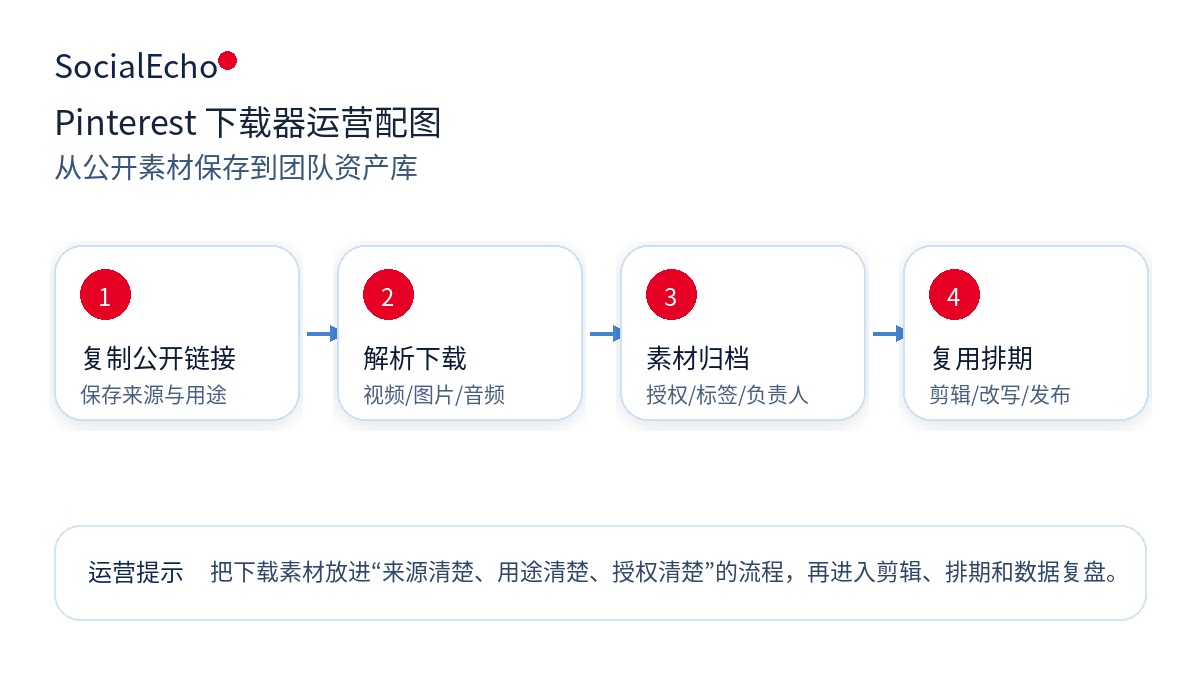
Before downloading Pinterest content, make sure you know these 4 things.
Many articles about downloaders only explain "copy the link, paste, download," but the real problem for real teams isn't the steps themselves, but rather the boundaries of usage. Before downloading, it's recommended to confirm: Is this your own content? Have you obtained authorization from the creator or client? Is the downloaded material for internal research or public release? Does the material contain music, portrait rights, trademarks, client information, or other third-party rights?
A more reliable approach is to categorize content by intended use. Downloading content from your own account for backup, editing, and cross-platform reposting generally carries lower risk. Downloading content from influencer collaborations or clients requires checking the cooperation agreement to see if saving, editing, and redistributing the content is permitted. Downloading competitor's publicly available videos for internal research is acceptable, and you can retain links and analysis records, but direct copying is not recommended. If you intend to use the content for advertising, brand websites, courses, public mashups, or commercial promotions, you must confirm authorization in advance.
The SocialEcho downloader is not a tool for circumventing platform rules. It is only suitable for publicly accessible content and does not support private, deleted, or restricted content. The download action addresses "saving files," not "obtaining copyright."
Method 1: SocialEcho Free Image and Video Downloader
SocialEcho, the free image and video downloader, supports parsing publicly available materials from nine platforms including TikTok, Instagram, YouTube, X, Facebook, Threads, LinkedIn, Pinterest, and Reddit. It can be used to download videos, images, and audio. Provided the platform provides a watermark-free source, it will prioritize returning the original, high-resolution, watermark-free file. The tool is completely free and requires no registration. To prevent abuse, each user can parse three times per day. For actual usage, please refer to the instructions on the tool's page.
It's more suitable for team scenarios because downloading is just the beginning. For example, after saving a Pinterest post, you also need to record the source link, creator account, posting time, content type, reason for its popularity, authorization status, and subsequent uses. This way, the material won't just become "a bunch of videos in a folder," but rather a content asset that can be reviewed, learned from, and handed over.
How to use
- Open SocialEcho, the free image and video downloader ;
- Copy a publicly accessible Pinterest post or video link;
- Paste into the tool input box;
- Follow the on-screen instructions to parse and save the materials;
- Add the file to the team's resource library;
- Record the original link, platform, account, purpose, and authorization status.
Which scenarios is it suitable for?
- Organize backups of your own Pinterest Pin images and videos;
- Collect publicly available inspiration for internal mood boards and topic research;
- Archive competitor product images, cover designs, and keyword strategies;
- Rewrite Pinterest content to suit Instagram, Facebook, or blog image formats;
If the team needs to continue pushing the materials to release and review, it is recommended not to manage the materials with scattered links, but to integrate the downloaded materials (either owned or authorized) into the SocialEcho operation chain: first use AI creation to identify interactions and feedback, then use the image size guide checker to judge the performance of the materials, and finally use social media release management to make unified scheduling and review.
This isn't about "downloading and immediately publishing other people's content," but rather about helping the team incorporate compliant materials into a more complete social media operation process: unified scheduling, unified analysis, and unified review.
Method 2: Use Pinterest to save pins/create boards
Pinterest's native saving method is suitable for lightweight bookmarking. Its advantages are security, simplicity, and adherence to platform rules; it doesn't require accessing unfamiliar websites or installing additional software. For individual users temporarily saving a post, or for colleagues to save a reference link, the native method is often sufficient.
However, it's not suitable for comprehensive creative management. Kanban boards are suitable for collecting inspiration, but not for archiving. If you need to do design briefs, competitor analysis, or team debriefings, you also need to save the source and purpose. For brand teams, collecting is just "remembering that something is here," not "turning creative into a usable asset." Once it comes to monthly reports, client deliveries, content debriefings, cross-platform rewriting, or ad creative management, more complete documentation and metadata are required.
Method 3: Use a third-party online parsing tool
Tools like PinterestDownloader, ExpertsPHP Pinterest Downloader, screenshot/save-as tools, and browser extensions are generally simple to use: copy the Pinterest link, paste it into the page, wait for it to parse, and then download the file. They are suitable for occasional use, especially when you only need to temporarily save a public video.
However, be aware of three risks associated with third-party tools. First, the page may contain advertisements, fake buttons, or redirect links; verify the correct download entry when downloading. Second, the success rate of parsing may fluctuate after the platform's page structure is updated. Third, some tools may emphasize "no watermark" or "high definition," but this does not mean you have obtained authorization for reposting, commercial use, or secondary editing.
When using third-party download sites, businesses are advised to only process publicly available content, not to enter account passwords, not to upload sensitive information, not to install software from unknown sources, and not to use third-party tools as the primary archiving method.
Method 4: Browser extensions or desktop tools
Browser extensions and desktop tools are suitable for users who download frequently and require more stable operation. For example, Video DownloadHelper, some desktop downloaders, or screen recording tools can help save publicly available materials in certain scenarios.
Their advantage is that they don't require switching websites every time, making them suitable for long-term use; the disadvantage is that they need to be installed on a local device, and permissions and security require more attention. Company computers should be especially cautious; it is recommended to follow IT security rules, install only from official channels, regularly check extension permissions, and avoid exposing browser history, cookies, or account information to untrusted plugins.
Method Comparison: Which approach is more suitable for you?
| method | Suitable scenarios | advantage | Limitations |
|---|---|---|---|
| SocialEcho Free Image Video Downloader | Team material archiving, competitor research, and backup of proprietary content. | Free, no registration required, supports public access to materials on multiple platforms, and easy to integrate into operational processes. | Each user has a daily limit on the number of times they can access the site; only publicly accessible content is supported. |
| Pinterest save pins/create boards | Personal collection, to be viewed later | Safe and in compliance with platform rules | Difficult to export files, unsuitable for team asset libraries |
| Third-party online parsing tools | Temporarily save a single public video | Easy to learn, many choices | You need to judge the boundaries of advertising, stability, and compliance yourself. |
| Browser extensions/desktop tools | High-frequency downloads, desktop organization | The operation is continuous and suitable for advanced users. | Installation is required, but there are permission and security risks involved. |
If you only save content occasionally, native saves or temporary tools are sufficient. If you're working for a team, it's recommended to use the SocialEcho downloader from the start and create a resource list. Otherwise, the more you download, the harder it will be to find, explain, and reuse later.
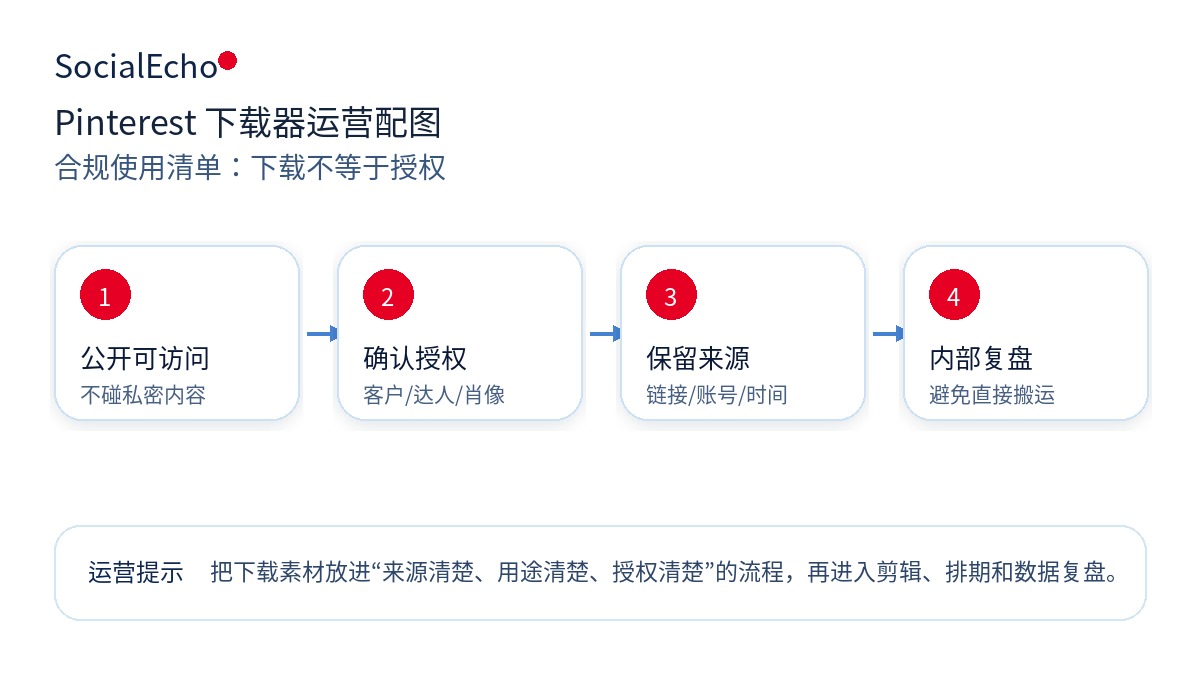
In the Pinterest context, it's important to clearly distinguish between Pins, Boards, and copyrighted image libraries.
Pinterest is more of an inspiration portal than a copyrighted image library. Pins can help teams gather visual direction, title structures, and product scenarios; Boards are suitable for storing inspiration by theme, such as new product photography, holiday events, home decor scenes, or packaging designs. However, adding an image to a Board does not equate to acquiring the image copyright.
When downloading images or videos from Pinterest, it's recommended to categorize them into "Inspiration References" and "Usable Materials." Inspiration References can be used for mood boards, design briefs, and internal discussions; Usable Materials should come from your own photography, licensed stock images, client authorization, or sources with explicit commercial applicability.
Pinterest video pins also require recording cover images, title keywords, and landing page direction. Many e-commerce brands refer to its composition and sense of scene, but don't directly copy images, product placements, or text layouts; a safer approach is to extract visual principles and then recreate them using your own materials.
How do I manage downloaded materials so they don't become a "materials junk pile"?
A common pitfall for operations teams is treating "download complete" as the end of the process. A more valuable approach is to create basic records for each piece of content. It is recommended to record at least 8 fields: original link, platform, creator account, publication time, content theme, highlight tags, authorization status, and subsequent use.
For example, a Pinterest video is great for internal review. You can record its opening hook, cover information, subtitle pacing, frequently asked questions in the comments section, and CTA design. If it's just competitor material, label it "For internal research only"; if it's your own content or licensed material, then proceed with rewriting, editing, and cross-platform scheduling.
This kind of record-keeping may seem to take an extra minute, but it can reduce a lot of communication costs later. Especially for agency operations and cross-border brands, the content list is a basic line of defense against risks when clients ask, "Where did this material come from? Can it be used commercially? Who approved it?"
How to reuse, schedule, and review the downloaded files?
After downloading, it's not recommended to directly upload the materials to your cloud drive. A more reliable process is to first use a social media video/image downloader to save publicly available materials, then use a free image/video editor to crop, add subtitles, and check the cover. If you need to create multi-platform versions, you can use AI to generate titles, captions, and short video scripts for different platforms, and then use content publishing to schedule them in batches.
For Pinterest content teams, once content enters the reuse process, it should be placed in the same resource sheet as Pinterest homepage operations , Pinterest bulk publishing , Pinterest scheduled publishing , Pinterest data analysis , and Pinterest competitor analysis . This way, you can see the relationship between resource downloads, secondary editing, scheduled publishing, comment feedback, and retrospective data, instead of just an isolated file. Before image-based pins go through redesign, use the image cropping inspector and image resizing tool to confirm the layout.
If the team already has a fixed SOP, the downloader can be used as a pre-entry point, data analysis can be used to determine clicks, interactions, and conversions after reuse, interaction management can be used to centrally handle comments and private messages, and AI automation can be used for low-risk automatic replies and manual review reminders. When dealing with cross-tool workflows, the AI Agent API and social media management agent can be used as automation entry points; when dealing with industry-specific strategies, refer to the scenario breakdown for e-commerce operations . When activity tracking is required, a UTM builder can be used to unify the naming of links, and social media content calendar templates can be used to schedule subsequent release times.
Compliance and Copyright Reminder: Download capability is not a license to use.
Please place this sentence at the beginning of all download processes: Being able to download does not mean that it can be used publicly.
Safer usage methods include: downloading your own published content; downloading content authorized by clients, influencers, or creators; downloading publicly available materials for personal learning, internal team research, competitor analysis, or content review; and saving the original links and source information for easy tracking later.
High-risk practices include: unauthorized reposting of others' videos to other platforms; removing watermarks and passing them off as original content; using others' images or videos for advertising, brand websites, courses, or commercial promotion; bulk collection and redistribution; and downloading private, restricted, or deleted content.
If the material is to be publicly released or used commercially, it is recommended to complete at least one internal review: Is the source clear? Is the authorization clear? Does it contain music/image/trademark? Will it mislead users into thinking you are the original author? Does it comply with Pinterest platform rules and the rules of the target publishing platform?
Frequently Asked Questions (FAQ)
Q1: Can Pinterest videos be downloaded for free?
Some publicly accessible Pinterest videos and images can be downloaded for free using certain tools, but whether a download is possible depends on content permissions, regional restrictions, link status, and the tool's parsing capabilities. It is recommended to prioritize downloading your own content or content for which you have already obtained authorization.
Q2: Does SocialEcho, the free image and video downloader, support Pinterest?
Supported. SocialEcho's free image and video downloader supports parsing publicly available materials from 9 major platforms, including Pinterest, and can download videos, images, and audio. Private, deleted, or restricted content is not supported for download.
Q3: Can I upload downloaded Pinterest content to other platforms?
If it's your own content, you can usually republish it according to the rules of each platform. If it's someone else's content, it's not recommended to repost it to other platforms without authorization, and it's even more not recommended to use it for commercial advertising or brand promotion.
Q4: Is downloading without a watermark more suitable for secondary creation?
Not necessarily. The absence of a watermark only indicates a cleaner file appearance; it does not imply that you have the right to create derivative works, publicly release, or commercially license the file. Teams still need to retain the source and licensing records when using the file.
Q5: Why can't I download some Pinterest links?
Common reasons include content not being publicly accessible, the original post being deleted, the creator restricting downloads, regional access restrictions, incomplete link format, or platform updates causing temporary failures in third-party parsing.
Q6: What should enterprise teams pay priority attention to when using download tools?
Prioritize copyright, authorization, and traceability. Businesses need more than just successful downloads; they must be able to explain the source of the material, why it was saved, its commercial applicability, and who will use it subsequently.
Q7: Can I download content from competitor Pinterest for analysis?
It can be used for internal research and debriefing, but unauthorized public display, re-editing, or commercial use is not recommended. A safer approach is to retain the original link and only analyze the title, cover image, script, publication date, comments, and interaction methods.
Q8: Does the SocialEcho downloader require registration?
The page states that it is free and requires no registration; to prevent abuse, each user can only parse 3 times per day. Specific restrictions are subject to the instructions on the tool's page.
Summary: Make Pinterest downloads a part of your team's asset management.
There are many download tools available for Pinterest, but the tool itself isn't the key factor. What truly impacts efficiency and risk are: what you download, why you download it, who authorized it, how you use it subsequently, and whether the team can trace it.
If you're just looking back at it later for personal use, you can save a pin or create a board on Pinterest first. If you're a content operator, brand marketer, agency, or multi-creator, we recommend prioritizing SocialEcho, the free image and video downloader , to connect publicly available materials for download, your own content backup, competitor research, and your team's material library.
Let me remind you again: downloading is not licensing, and saving is not copying. Clearly recording the source, purpose, and authorization is crucial so that download tools can become part of your content growth workflow, rather than a future copyright risk.
;}.cls-2{fill:%230868f7;}.cls-3{fill:url(%23未命名的渐变_44);}.cls-4{fill:%23333;}%3c/style%3e%3clinearGradient%20id='未命名的渐变_8'%20x1='33.73'%20y1='100.61'%20x2='-0.03'%20y2='-1.06'%20gradientUnits='userSpaceOnUse'%3e%3cstop%20offset='0'%20stop-color='%237ae9fb'/%3e%3cstop%20offset='0.67'%20stop-color='%232b90f8'/%3e%3cstop%20offset='1'%20stop-color='%230868f7'/%3e%3c/linearGradient%3e%3clinearGradient%20id='未命名的渐变_44'%20x1='27.86'%20y1='18.67'%20x2='68.36'%20y2='22.22'%20gradientUnits='userSpaceOnUse'%3e%3cstop%20offset='0'%20stop-color='%235ac7f2'/%3e%3cstop%20offset='1'%20stop-color='%230868f7'/%3e%3c/linearGradient%3e%3c/defs%3e%3cpath%20class='cls-1'%20d='M29,28.74V81.91l-9.51-3.68v0L8.52,74A7.17,7.17,0,0,1,4,67.32V24.54A3.76,3.76,0,0,1,9.08,21Z'/%3e%3cpath%20class='cls-2'%20d='M68.09,78.07a13.15,13.15,0,0,1-17.9,12.06L29,81.91h0V28.74L50.19,37A13.17,13.17,0,0,0,68.08,25.3h0Z'/%3e%3cpath%20class='cls-3'%20d='M68.08,25.3a13.19,13.19,0,0,1-6.73,10.87A13.09,13.09,0,0,1,50.19,37L29,28.74V6A3.76,3.76,0,0,1,34.1,2.52l25.59,9.91A13.22,13.22,0,0,1,68.08,25.3Z'/%3e%3cpath%20class='cls-4'%20d='M129.06,81.76a4.33,4.33,0,0,1-3.19-1.31,4.4,4.4,0,0,1-1.31-3.24V56.86H97.65V77.21a4.36,4.36,0,0,1-1.35,3.2A4.68,4.68,0,0,1,93,81.76a4.32,4.32,0,0,1-3.19-1.31,4.37,4.37,0,0,1-1.32-3.24V27.27A4.58,4.58,0,0,1,89.83,24a4.59,4.59,0,0,1,7.82,3.27V48.15h26.91V27.27A4.58,4.58,0,0,1,125.91,24a4.59,4.59,0,0,1,7.82,3.27V77.21a4.37,4.37,0,0,1-1.36,3.2A4.65,4.65,0,0,1,129.06,81.76Z'/%3e%3cpath%20class='cls-4'%20d='M163.77,81.66c-6.57,0-11.76-1.92-15.44-5.7s-5.54-9.07-5.54-15.74a26.76,26.76,0,0,1,2.09-10.43,17.72,17.72,0,0,1,6.67-8.06,19.15,19.15,0,0,1,10.68-2.95,19,19,0,0,1,10.46,2.8,18.7,18.7,0,0,1,6.55,7.36,22.53,22.53,0,0,1,2.36,10.28A4.51,4.51,0,0,1,177,63.77H152.23a10.8,10.8,0,0,0,3.49,6.65c2,1.68,4.88,2.52,8.66,2.52a22.25,22.25,0,0,0,7.54-1.21c.74-.3,1.55-.67,2.37-1.07a3.75,3.75,0,0,1,1.84-.4,4.09,4.09,0,0,1,3,1.15,4,4,0,0,1,1.12,3,4.38,4.38,0,0,1-2.58,3.82,32.34,32.34,0,0,1-6.36,2.61A28.67,28.67,0,0,1,163.77,81.66ZM172.4,55.9a9.72,9.72,0,0,0-1.63-4.56A9.9,9.9,0,0,0,167,48a10.38,10.38,0,0,0-4.64-1.14,12,12,0,0,0-4.77,1.06,9.54,9.54,0,0,0-4.89,5.66,11.78,11.78,0,0,0-.51,2.3Z'/%3e%3cpath%20class='cls-4'%20d='M193,81.64a4.49,4.49,0,0,1-4.51-4.55V27.28A4.58,4.58,0,0,1,189.84,24a4.48,4.48,0,0,1,3.28-1.36A4.36,4.36,0,0,1,196.35,24a4.46,4.46,0,0,1,1.31,3.31V77.09a4.34,4.34,0,0,1-1.35,3.2A4.67,4.67,0,0,1,193,81.64Z'/%3e%3cpath%20class='cls-4'%20d='M263.79,81.71a5.7,5.7,0,0,1-4.2-1.74,5.76,5.76,0,0,1-1.73-4.19V27.37a4.58,4.58,0,0,1,1.35-3.27A4.59,4.59,0,0,1,267,27.37V72.53h24a4.58,4.58,0,0,1,3.27,7.82A4.66,4.66,0,0,1,291,81.71Z'/%3e%3cpath%20class='cls-4'%20d='M424.48,81.74a4.71,4.71,0,0,1-2.71-.88,5.43,5.43,0,0,1-1-1l-.07-.09-12.41-17-5.41,5v9.44a4.31,4.31,0,0,1-1.36,3.19,4.66,4.66,0,0,1-3.3,1.36A4.29,4.29,0,0,1,395,80.42a4.36,4.36,0,0,1-1.32-3.23V27.37A4.58,4.58,0,0,1,395,24.1a4.52,4.52,0,0,1,6.58.12,4.54,4.54,0,0,1,1.24,3.15V56.31l17.72-16.38.05,0a4.8,4.8,0,0,1,2.94-1.11,4.4,4.4,0,0,1,3.27,1.2,4.57,4.57,0,0,1,1.2,3.27,4.44,4.44,0,0,1-.77,2.33,7.45,7.45,0,0,1-1.43,1.65l-11,9.64,13.34,17.68a5,5,0,0,1,1,2.71,4.12,4.12,0,0,1-1.36,3.24A4.64,4.64,0,0,1,424.48,81.74Z'/%3e%3cpath%20class='cls-4'%20d='M317.93,81.76a21.5,21.5,0,1,1,21.17-21.5A21.37,21.37,0,0,1,317.93,81.76Zm0-34.1a12.61,12.61,0,1,0,12.42,12.6A12.52,12.52,0,0,0,317.93,47.66Z'/%3e%3cpath%20class='cls-4'%20d='M212.18,101.22a4.12,4.12,0,0,1-3.05-1.26,4.17,4.17,0,0,1-1.26-3.1V43.34a4.37,4.37,0,0,1,1.3-3.14,4.26,4.26,0,0,1,3.13-1.3,4.19,4.19,0,0,1,3.1,1.26,4.32,4.32,0,0,1,1.26,3.16,20.77,20.77,0,0,1,13-4.54,21.51,21.51,0,0,1,0,43,20.51,20.51,0,0,1-13-4.57V96.86a4.15,4.15,0,0,1-1.3,3.06A4.5,4.5,0,0,1,212.18,101.22Zm17.43-53.63c-6.23,0-12.93,4.11-12.93,12.72a12.73,12.73,0,0,0,25.46,0A12.71,12.71,0,0,0,229.61,47.59Z'/%3e%3cpath%20class='cls-4'%20d='M365.76,81.76a21.5,21.5,0,1,1,21.18-21.5A21.37,21.37,0,0,1,365.76,81.76Zm0-34.1a12.61,12.61,0,1,0,12.42,12.6A12.52,12.52,0,0,0,365.76,47.66Z'/%3e%3c/svg%3e)