
Snapchat Just Launched Sponsored AI Chatbots—And It Changes Brand Advertising Forever
Snapchat Just Launched Sponsored AI Chatbots—And It Changes Brand Advertising Forever
The Hook: A New Advertising Format Is Born
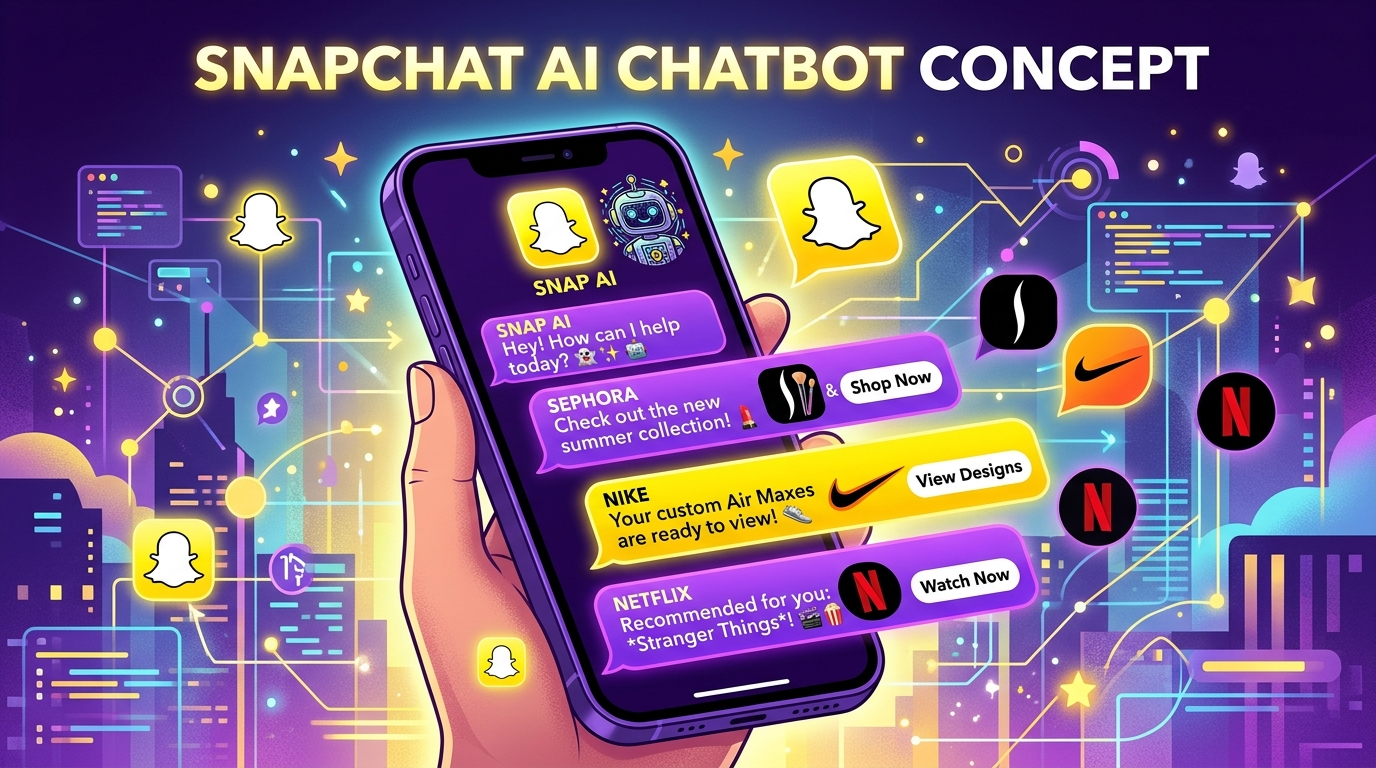
Imagine this: A 19-year-old opens Snapchat to chat with their friends. But instead of just talking to people, they can also chat with:
- A Sephora beauty advisor AI that recommends products based on their style
- A Nike fitness coach AI that creates workout plans
- A Netflix character AI that recommends shows based on their mood
This isn't science fiction. It's Snapchat's new sponsored AI chatbot platform, launched in April 2026.
And it's about to change how brands think about advertising.
The Evolution of Advertising Formats
To understand why this matters, let's look at how advertising has evolved:
Era 1: Interruption (1950s-2000s)
- TV commercials interrupt your show
- Print ads interrupt your reading
- Banner ads interrupt your browsing
- User mindset: "Ignore the ads"
Era 2: Native (2010s-2020s)
- Sponsored content blends with feed
- Influencer posts look like regular posts
- Ads match platform format
- User mindset: "Is this an ad?"
Era 3: Conversational (2026+)
- AI chatbots provide genuine value
- Users choose to engage
- Advertising becomes assistance
- User mindset: "This is helpful"
Snapchat's sponsored AI chatbots represent the beginning of Era 3. Brands that understand this shift early will have a significant advantage.
- A Sephora beauty advisor AI that recommends products based on their style
- A Nike fitness coach AI that creates workout plans
- A Netflix character AI that recommends shows based on their mood
This isn't science fiction. It's Snapchat's new sponsored AI chatbot platform, launched in April 2026.
And it's about to change how brands think about advertising.
What Snapchat Sponsored AI Chatbots Are
Snapchat's sponsored AI chatbots allow brands to:
- Create an AI personality that represents their brand
- Define conversation parameters (what the AI can and can't discuss)
- Embed product recommendations naturally into conversations
- Track engagement and conversions from chat interactions
Users discover these chatbots through:
- Snapchat's AI chat directory
- Sponsored placements in the chat feed
- QR codes and Snapcodes in other marketing
Once a user starts chatting, the AI engages them in conversation—answering questions, making recommendations, and guiding them toward purchases.
Why This Is Different From Every Other Ad Format
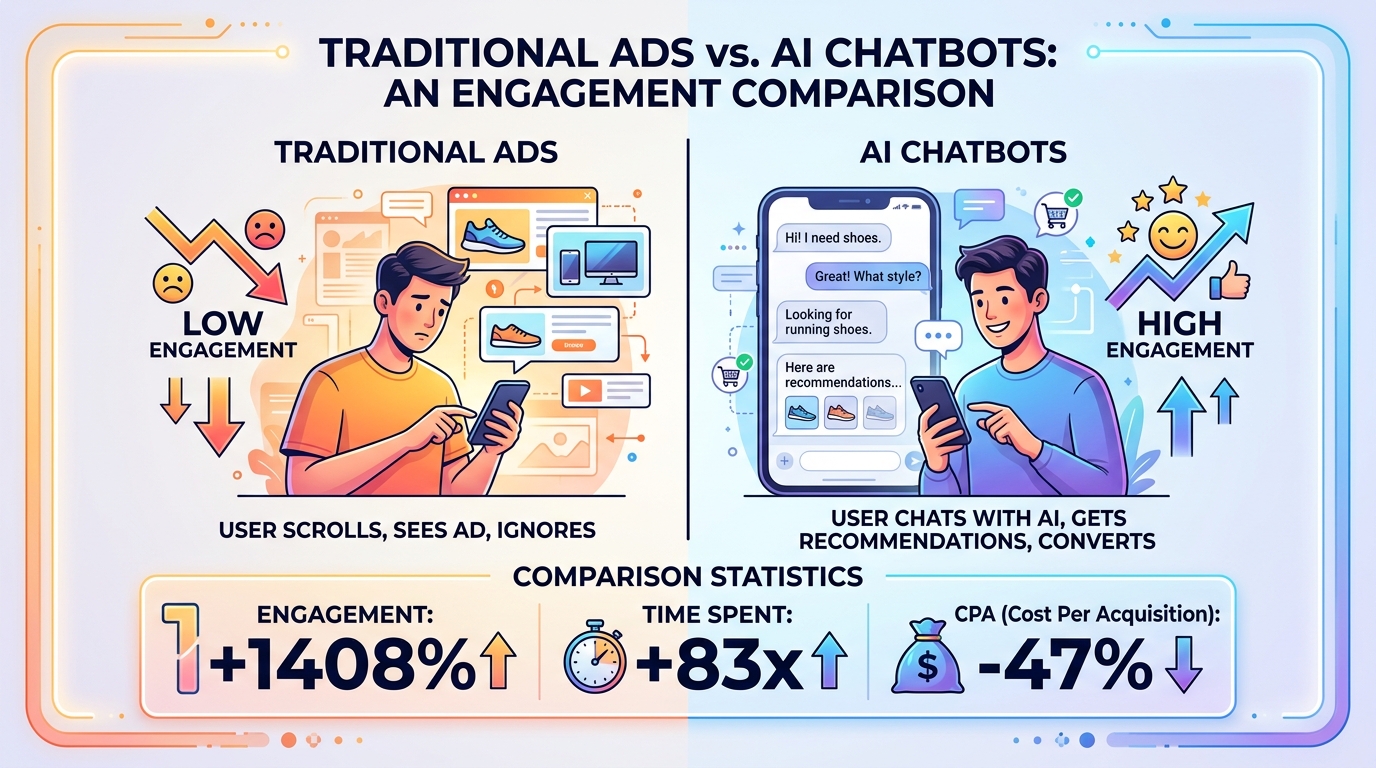
Traditional Social Ads: Interrupt and Hope
Format: User scrolls → sees ad → hopefully clicks
Engagement: Passive (view) or binary (click/don't click)
Data: Limited (impression, click, conversion)
Brand perception: Often negative (ads are interruptions)
Snapchat AI Chatbots: Engage and Convert
Format: User chooses to chat → has conversation → naturally discovers products
Engagement: Active (conversation, questions, recommendations)
Data: Rich (conversation topics, preferences, intent signals)
Brand perception: Potentially positive (helpful assistant, not interruption)
This is the difference between shouting at someone and having a conversation with them.
The Use Cases (And Which Ones Work)
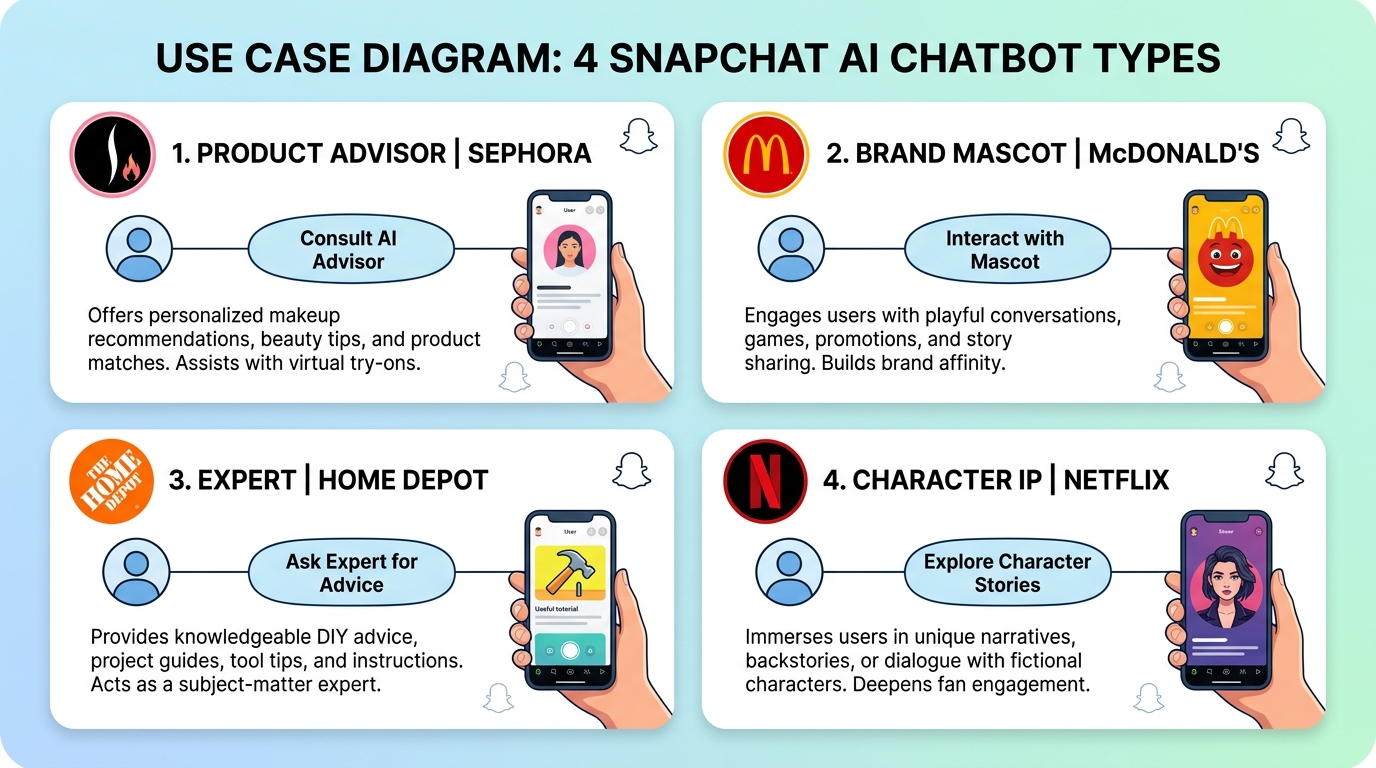
Use Case 1: Product Recommendation Assistant
Brand: Sephora
AI Personality: Beauty advisor
Conversation flow:
- User: "I need a foundation for oily skin"
- AI: "Got it! What's your budget range?"
- User: "Under $50"
- AI: "Here are 3 options that match your criteria. Want to see swatches?"
- [User views products, adds to cart]
Why it works: Solves a real problem (finding the right product) while naturally showcasing inventory.
Use Case 2: Brand Character / Mascot
Brand: McDonald's
AI Personality: Ronald McDonald (modernized)
Conversation flow:
- User: "What's new on the menu?"
- AI: "We just launched the Spicy Crispy Chicken! Want to know the nutrition info?"
- User: "Is there a vegan option?"
- AI: "Yes! Our McPlant is back. Want to order it?"
Why it works: Makes the brand feel approachable and fun while driving awareness of new products.
Use Case 3: Expert Advisor
Brand: Home Depot
AI Personality: DIY expert
Conversation flow:
- User: "How do I fix a leaky faucet?"
- AI: "First, let's identify the type of faucet. Is it a compression, ball, cartridge, or ceramic disk?"
- [Guides user through diagnosis]
- AI: "You'll need these 3 tools. Want me to send them to your cart?"
Why it works: Provides genuine value (solving a problem) while positioning the brand as the solution.
Use Case 4: Entertainment / Character IP
Brand: Netflix
AI Personality: Character from popular show
Conversation flow:
- User: "What should I watch tonight?"
- AI: "Depends on your mood! Want something dark and twisty, or light and fun?"
- User: "Dark and twisty"
- AI: "Perfect. Have you seen [Show X]? If not, start there. Here's why..."
Why it works: Leverages IP that users already love while driving viewing decisions.
Use Case 5: Event/Touring Promotion
Brand: Live Nation / Music Festival
AI Personality: Festival guide
Conversation flow:
- User: "Who's playing at Coachella?"
- AI: "Over 100 artists! Who are you hoping to see?"
- User: "I like indie rock"
- AI: "Great taste! Here are 8 indie acts you shouldn't miss, plus their set times..."
- User: "What about food options?"
- AI: "Let me show you the food vendor map. Any dietary restrictions?"
Why it works: Provides practical utility while promoting the event. Users get value, brand gets engagement.
What Doesn't Work (Yet)
Hard Sell Bots
AI: "Hi! Want to buy our product?"
User: "No."
AI: "Are you sure? It's 20% off!"
User: [Stops responding]
Users don't want to be sold to. They want help, entertainment, or information. The sales pitch needs to be subtle and contextual.
Conversation flow:
- User: "What should I watch tonight?"
- AI: "Depends on your mood! Want something dark and twisty, or light and fun?"
- User: "Dark and twisty"
- AI: "Perfect. Have you seen [Show X]? If not, start there. Here's why..."
Why it works: Leverages IP that users already love while driving viewing decisions.
What Doesn't Work (Yet)
Hard Sell Bots
AI: "Hi! Want to buy our product?"
User: "No."
AI: "Are you sure? It's 20% off!"
User: [Stops responding]
Users don't want to be sold to. They want help, entertainment, or information. The sales pitch needs to be subtle and contextual.
Generic Bots
AI: "Hello! I'm the BrandBot. How can I help?"
User: "What do you sell?"
AI: "We sell many products. What are you looking for?"
Bots without personality feel robotic (ironically). Give your AI a distinct voice, tone, and perspective.
Bots That Break Character
User: "What's the weather like?"
AI: "I'm a fitness coach bot. I can only talk about workouts."
This is frustrating. Either build flexibility into your bot or set clear expectations upfront.
The Data Goldmine
Here's what makes sponsored AI chatbots uniquely valuable: conversation data.
When a user interacts with your AI, you learn:
- What questions they ask (intent signals)
- What preferences they express (segmentation data)
- What objections they raise (sales friction points)
- What language they use (messaging insights)
This is qualitatively different from ad click data. You're not just seeing what users do—you're hearing what they think.
Example: A skincare brand's AI chatbot discovered that 40% of users were confused about the difference between "serum" and "moisturizer." The brand created educational content addressing this—leading to 23% higher conversion rates.
The Operational Challenge
Building and maintaining AI chatbots isn't trivial. You need:
1. Conversation Design
Question: What can users ask?
Answer: Map out conversation flows for common queries.
Question: What happens when the AI doesn't know the answer?
Answer: Have fallback responses that redirect gracefully.
Question: How do you handle edge cases?
Answer: Test extensively before launch.
2. Brand Safety
Risk: AI says something off-brand or inappropriate
Mitigation: Set strict guardrails, review conversation logs, update training data
Risk: AI makes false claims about products
Mitigation: Limit AI to approved product information, add disclaimers
3. Multi-Platform Coordination
If you're running AI chatbots on Snapchat, you might also want them on:
- Your website (customer service)
- Instagram (DM automation)
- WhatsApp (customer support)
- TikTok (engagement bot)
Managing these across platforms requires unified engagement management, AI automation, analytics, and content publishing tools.
Measuring AI Chatbot Success: The Metrics That Matter
To evaluate your AI chatbot's performance, track these metrics:
Engagement Metrics
Conversation Volume:
- Total conversations initiated
- Conversations per day/week
- Peak usage times
Conversation Depth:
- Average messages per conversation
- Average conversation duration
- Return conversation rate
Benchmarks:
- Good: 5+ messages per conversation
- Great: 10+ messages per conversation
- Excellent: 20%+ return conversation rate
Conversion Metrics
Product Engagement:
- Product recommendations viewed
- Products added to cart from chat
- Purchases attributed to chatbot
Conversion Funnel:
- Conversation → Product view: Target 30%+
- Product view → Cart: Target 15%+
- Cart → Purchase: Target 40%+
Revenue Metrics:
- Revenue per conversation
- Customer lifetime value (chatbot vs. non-chatbot users)
- ROI vs. traditional advertising
Satisfaction Metrics
User Feedback:
- Thumbs up/down rate
- Conversation completion rate
- Escalation rate (AI → human)
Benchmarks:
- Good: 70%+ positive feedback
- Great: 85%+ positive feedback
- Excellent: <10% escalation rate
Early Results: What Brands Are Seeing
Snapchat piloted sponsored AI chatbots with 20 brands in Q1 2026. Here's what they reported:
| Metric | Traditional Snap Ads | Sponsored AI Chatbots | Lift |
|---|---|---|---|
| Engagement rate | 2.3% | 34.7% | +1408% |
| Time spent | 3 seconds | 4.2 minutes | +83x |
| Product views per user | 1.2 | 5.8 | +383% |
| Conversion rate | 1.8% | 4.2% | +133% |
| Cost per conversion | $34 | $18 | -47% |
Key insight: AI chatbots drive deeper engagement and lower acquisition costs—but require more upfront investment to build.
How to Get Started
Step 1: Define Your Use Case
Don't build a bot because it's trendy. Build it because it solves a problem.
Questions to answer:
- What problem does this solve for users?
- What value does the AI provide?
- How does this drive business outcomes?
Step 2: Design the Personality
Your AI needs a distinct voice:
- Tone: Friendly? Professional? Witty?
- Vocabulary: Simple? Technical? Trendy?
- Perspective: Advisor? Friend? Expert?
Example: Nike's fitness coach AI uses motivational language ("You got this!") while Sephora's beauty advisor uses consultative language ("Let me help you find...").
Step 3: Build Conversation Flows
Map out the top 20 conversations users will have:
- Product questions
- Recommendation requests
- Objection handling
- Purchase guidance
Test each flow extensively before launch.
Step 4: Launch and Learn
Start with a soft launch (limited audience):
- Monitor conversation logs
- Identify failure points
- Update training data
- Expand gradually
Step 5: Scale and Optimize
Once the bot is working:
- Promote it across channels
- A/B test different personalities
- Expand conversation topics
- Integrate with e-commerce
To manage AI chatbots across multiple platforms efficiently, consider using a social media management agent that centralizes conversation tracking and performance analytics.
Building Your AI Chatbot: A Step-by-Step Technical Guide
Ready to build your own sponsored AI chatbot? Here's the technical roadmap:
Phase 1: Platform Selection (Week 1)
Decision point: Which platform first?
- Snapchat: Best for Gen Z, lifestyle brands, entertainment
- Website: Best for customer service, e-commerce support
- Instagram: Best for visual brands, DM automation
- WhatsApp: Best for international markets, customer support
Recommendation: Start with Snapchat if your audience is under 35. Start with website if you have high customer service volume.
Phase 2: Conversation Design (Week 2-3)
Map conversation flows:
- List top 20 questions users will ask
- Write ideal responses for each
- Define escalation paths (when AI should hand off to human)
- Create fallback responses for unknown queries
Tools: Use conversation design tools like Voiceflow, Dialogflow, or custom LLM implementations.
Phase 3: Training and Testing (Week 4-5)
Train your AI:
- Feed it your product catalog
- Provide brand voice guidelines
- Set guardrails for off-topic conversations
- Test with internal team first
Beta test:
- Launch to 5% of audience
- Monitor conversation logs daily
- Identify failure points
- Iterate quickly
Phase 4: Launch and Optimize (Week 6+)
Full launch:
- Promote across channels
- Monitor key metrics (engagement, conversion, satisfaction)
- A/B test different personalities
- Expand conversation topics based on user interest
The Competitive Window
Right now, sponsored AI chatbots on Snapchat are new. Few brands are using them. This creates a first-mover advantage:
- Lower costs: Early adopters get better rates
- Less noise: Users aren't fatigued by AI bots yet
- Learning curve: You'll build expertise before competitors
- Brand association: You'll be "the brand with the cool AI"
In 12 months, every brand will have an AI chatbot. The window to stand out is now.
The Future of AI Chatbots in Advertising
Where is this technology heading? Here's what to expect:
Near Term (2026-2027)
Multi-modal interactions:
- Chatbots that can see images you share
- Voice conversations, not just text
- AR integration (try on products through chat)
Cross-platform continuity:
- Start conversation on Snapchat, continue on website
- Unified memory across platforms
- Seamless handoff to human agents
Better personalization:
- Chatbots remember your preferences
- Recommendations improve over time
- Contextual awareness (time of day, location, mood)
Medium Term (2028-2030)
Proactive assistance:
- Chatbots reach out when you might need help
- Predictive recommendations based on behavior
- Automated follow-ups on past conversations
Emotional intelligence:
- Chatbots detect frustration, excitement, confusion
- Adjust tone and approach accordingly
- Know when to escalate to humans
Commerce integration:
- Complete purchases within chat
- Subscription management
- Loyalty program integration
Long Term (2030+)
AI companions:
- Persistent AI personalities
- Deep understanding of individual users
- Brand relationships mediated by AI
Implications for brands:
- Early movers build AI expertise competitors lack
- Conversation data becomes competitive moat
- Brands with best AI win customer loyalty
The Bottom Line
Snapchat's sponsored AI chatbots represent a fundamental shift in advertising: from interruption to conversation, from passive viewing to active engagement, from limited data to rich insights.
Brands that experiment now will build capabilities that compound over time. Brands that wait will play catch-up in a crowded market.
The conversation is starting. Are you part of it?
FAQ
Q: How much does it cost to create a sponsored AI chatbot on Snapchat?
A: Snapchat hasn't published official pricing, but pilot programs ranged from 50K-200K for setup plus ongoing costs. Expect pricing to decrease as the platform matures and more brands adopt.
Q: What kind of brands should use AI chatbots?
A: Best fit: E-commerce (product recommendations), Services (consultation), Entertainment (character engagement), Education (expert advice). Less fit: Commodities, low-consideration purchases.
Q: How do I measure ROI from AI chatbots?
A: Track: Conversation volume, engagement time, product views, conversion rate, cost per conversion, and customer lifetime value. Compare against traditional ad formats.
Q: Can I use the same AI chatbot across multiple platforms?
A: The underlying AI can be reused, but each platform has different integration requirements. Use unified AI automation tools to manage across platforms.
Q: What if the AI says something wrong?
A: Set strict guardrails, review conversation logs regularly, and have a rapid update process. Most platforms allow you to pause or update the bot instantly if issues arise.
Ready to start the conversation? SocialEcho helps you manage AI chatbots across platforms, track engagement, and optimize conversations for conversions.
;}.cls-2{fill:%230868f7;}.cls-3{fill:url(%23未命名的渐变_44);}.cls-4{fill:%23333;}%3c/style%3e%3clinearGradient%20id='未命名的渐变_8'%20x1='33.73'%20y1='100.61'%20x2='-0.03'%20y2='-1.06'%20gradientUnits='userSpaceOnUse'%3e%3cstop%20offset='0'%20stop-color='%237ae9fb'/%3e%3cstop%20offset='0.67'%20stop-color='%232b90f8'/%3e%3cstop%20offset='1'%20stop-color='%230868f7'/%3e%3c/linearGradient%3e%3clinearGradient%20id='未命名的渐变_44'%20x1='27.86'%20y1='18.67'%20x2='68.36'%20y2='22.22'%20gradientUnits='userSpaceOnUse'%3e%3cstop%20offset='0'%20stop-color='%235ac7f2'/%3e%3cstop%20offset='1'%20stop-color='%230868f7'/%3e%3c/linearGradient%3e%3c/defs%3e%3cpath%20class='cls-1'%20d='M29,28.74V81.91l-9.51-3.68v0L8.52,74A7.17,7.17,0,0,1,4,67.32V24.54A3.76,3.76,0,0,1,9.08,21Z'/%3e%3cpath%20class='cls-2'%20d='M68.09,78.07a13.15,13.15,0,0,1-17.9,12.06L29,81.91h0V28.74L50.19,37A13.17,13.17,0,0,0,68.08,25.3h0Z'/%3e%3cpath%20class='cls-3'%20d='M68.08,25.3a13.19,13.19,0,0,1-6.73,10.87A13.09,13.09,0,0,1,50.19,37L29,28.74V6A3.76,3.76,0,0,1,34.1,2.52l25.59,9.91A13.22,13.22,0,0,1,68.08,25.3Z'/%3e%3cpath%20class='cls-4'%20d='M129.06,81.76a4.33,4.33,0,0,1-3.19-1.31,4.4,4.4,0,0,1-1.31-3.24V56.86H97.65V77.21a4.36,4.36,0,0,1-1.35,3.2A4.68,4.68,0,0,1,93,81.76a4.32,4.32,0,0,1-3.19-1.31,4.37,4.37,0,0,1-1.32-3.24V27.27A4.58,4.58,0,0,1,89.83,24a4.59,4.59,0,0,1,7.82,3.27V48.15h26.91V27.27A4.58,4.58,0,0,1,125.91,24a4.59,4.59,0,0,1,7.82,3.27V77.21a4.37,4.37,0,0,1-1.36,3.2A4.65,4.65,0,0,1,129.06,81.76Z'/%3e%3cpath%20class='cls-4'%20d='M163.77,81.66c-6.57,0-11.76-1.92-15.44-5.7s-5.54-9.07-5.54-15.74a26.76,26.76,0,0,1,2.09-10.43,17.72,17.72,0,0,1,6.67-8.06,19.15,19.15,0,0,1,10.68-2.95,19,19,0,0,1,10.46,2.8,18.7,18.7,0,0,1,6.55,7.36,22.53,22.53,0,0,1,2.36,10.28A4.51,4.51,0,0,1,177,63.77H152.23a10.8,10.8,0,0,0,3.49,6.65c2,1.68,4.88,2.52,8.66,2.52a22.25,22.25,0,0,0,7.54-1.21c.74-.3,1.55-.67,2.37-1.07a3.75,3.75,0,0,1,1.84-.4,4.09,4.09,0,0,1,3,1.15,4,4,0,0,1,1.12,3,4.38,4.38,0,0,1-2.58,3.82,32.34,32.34,0,0,1-6.36,2.61A28.67,28.67,0,0,1,163.77,81.66ZM172.4,55.9a9.72,9.72,0,0,0-1.63-4.56A9.9,9.9,0,0,0,167,48a10.38,10.38,0,0,0-4.64-1.14,12,12,0,0,0-4.77,1.06,9.54,9.54,0,0,0-4.89,5.66,11.78,11.78,0,0,0-.51,2.3Z'/%3e%3cpath%20class='cls-4'%20d='M193,81.64a4.49,4.49,0,0,1-4.51-4.55V27.28A4.58,4.58,0,0,1,189.84,24a4.48,4.48,0,0,1,3.28-1.36A4.36,4.36,0,0,1,196.35,24a4.46,4.46,0,0,1,1.31,3.31V77.09a4.34,4.34,0,0,1-1.35,3.2A4.67,4.67,0,0,1,193,81.64Z'/%3e%3cpath%20class='cls-4'%20d='M263.79,81.71a5.7,5.7,0,0,1-4.2-1.74,5.76,5.76,0,0,1-1.73-4.19V27.37a4.58,4.58,0,0,1,1.35-3.27A4.59,4.59,0,0,1,267,27.37V72.53h24a4.58,4.58,0,0,1,3.27,7.82A4.66,4.66,0,0,1,291,81.71Z'/%3e%3cpath%20class='cls-4'%20d='M424.48,81.74a4.71,4.71,0,0,1-2.71-.88,5.43,5.43,0,0,1-1-1l-.07-.09-12.41-17-5.41,5v9.44a4.31,4.31,0,0,1-1.36,3.19,4.66,4.66,0,0,1-3.3,1.36A4.29,4.29,0,0,1,395,80.42a4.36,4.36,0,0,1-1.32-3.23V27.37A4.58,4.58,0,0,1,395,24.1a4.52,4.52,0,0,1,6.58.12,4.54,4.54,0,0,1,1.24,3.15V56.31l17.72-16.38.05,0a4.8,4.8,0,0,1,2.94-1.11,4.4,4.4,0,0,1,3.27,1.2,4.57,4.57,0,0,1,1.2,3.27,4.44,4.44,0,0,1-.77,2.33,7.45,7.45,0,0,1-1.43,1.65l-11,9.64,13.34,17.68a5,5,0,0,1,1,2.71,4.12,4.12,0,0,1-1.36,3.24A4.64,4.64,0,0,1,424.48,81.74Z'/%3e%3cpath%20class='cls-4'%20d='M317.93,81.76a21.5,21.5,0,1,1,21.17-21.5A21.37,21.37,0,0,1,317.93,81.76Zm0-34.1a12.61,12.61,0,1,0,12.42,12.6A12.52,12.52,0,0,0,317.93,47.66Z'/%3e%3cpath%20class='cls-4'%20d='M212.18,101.22a4.12,4.12,0,0,1-3.05-1.26,4.17,4.17,0,0,1-1.26-3.1V43.34a4.37,4.37,0,0,1,1.3-3.14,4.26,4.26,0,0,1,3.13-1.3,4.19,4.19,0,0,1,3.1,1.26,4.32,4.32,0,0,1,1.26,3.16,20.77,20.77,0,0,1,13-4.54,21.51,21.51,0,0,1,0,43,20.51,20.51,0,0,1-13-4.57V96.86a4.15,4.15,0,0,1-1.3,3.06A4.5,4.5,0,0,1,212.18,101.22Zm17.43-53.63c-6.23,0-12.93,4.11-12.93,12.72a12.73,12.73,0,0,0,25.46,0A12.71,12.71,0,0,0,229.61,47.59Z'/%3e%3cpath%20class='cls-4'%20d='M365.76,81.76a21.5,21.5,0,1,1,21.18-21.5A21.37,21.37,0,0,1,365.76,81.76Zm0-34.1a12.61,12.61,0,1,0,12.42,12.6A12.52,12.52,0,0,0,365.76,47.66Z'/%3e%3c/svg%3e)