
2026 Social Media Holidays Calendar: A Month-by-Month Planning Guide
By Zhao Meng — focused on brand social media marketing and content-calendar planning, helping global teams map out their key dates for the whole year.
TL;DR
A social media holidays calendar is simply a table of the moments worth marketing around all year (public holidays, shopping events, industry theme days), laid out in advance so you can line up your content before the traffic peaks instead of scrambling at the last minute.
- The biggest commercial moments cluster in the second half of the year: Black Friday, Cyber Monday, Singles' Day, and the Christmas season.
- Don't overlook the first half: Valentine's Day, International Women's Day, Ramadan and Eid, and Mother's Day are all high-engagement moments for global brands.
- You don't have to chase every holiday. Picking 8–12 that fit your brand and audience, and going deep on them, is enough.
- Many people search for a social media calendar, 2026 marketing holidays, or a social media holidays calendar; the real challenge is "planning ahead" and "planning across platforms at once."
- For teams going global and syncing holiday content across Facebook, Instagram, and TikTok, a single unified scheduling calendar saves a huge amount of bottleneck time.
If you run social for a brand, you've probably lived this scene: Black Friday is almost here and the content still isn't ready, so the team pulls an all-nighter on graphics and copy — and even you aren't happy with what goes out. Holiday marketing is usually won or lost two or three weeks before the date arrives. Whoever prepares content and scheduling ahead is the one who ships calmly when the traffic peaks.
This piece gives you a 2026 social media holidays calendar: a month-by-month list of the moments worth watching all year, followed by how to turn that calendar into advance scheduling and cross-platform planning. The goal isn't to make you chase every holiday — it's to help you pick the right moments, schedule ahead, and post with room to breathe.
Why use a social media holidays calendar?
The core value of a holidays calendar is turning "last-minute" into "planned ahead": getting content, assets, and scheduling ready before the moments when traffic and buying intent spike. During holidays, users browse and buy more, and platform traffic concentrates; brands that plan ahead catch that wave, while those improvising tend to play catch-up.
It mainly serves a few groups: e-commerce and DTC brands that have to move with the promo calendar, agencies running holiday campaigns for multiple clients, and global teams whose content needs to reach across time zones and cultures.
A quick note on tooling so you can put the calendar into practice. SocialEcho is an all-in-one AI social media workspace for global companies, with official direct connections to 11 platforms. In the context of "holiday scheduling," its use is straightforward: one master holiday post can be scheduled to Facebook, Instagram, X, TikTok, and more, across multiple accounts at once, managed centrally with multi-platform publishing — no need to work each platform and account one by one. This article is written for the marketer who hits a deadline every holiday, to help you see the whole year's moments at a glance, get your scheduling done early, and turn holiday marketing from firefighting into routine.
2026 social media holidays calendar (month-by-month quick reference)
Below is a month-by-month roundup of the key moments worth marketing around, covering public holidays, shopping events, and common theme days. Exact dates follow official announcements (some holidays such as Ramadan and Easter shift each year, so double-check the accurate date for the year before you plan).
| Month | Key moments | Content angles that fit |
|---|---|---|
| January | New Year's Day, resolutions / fresh starts | Year-in-review, New Year goals, new-year launches |
| February | Valentine's Day, Lunar New Year (Chinese-speaking markets) | Gift guides, couples/friends themes, limited-time offers |
| March | International Women's Day, start of Ramadan (floating) | Women-focused content, value messaging, Ramadan themes |
| April | Easter (floating), Earth Day, Eid al-Fitr (floating) | Holiday promos, sustainability themes, community resonance |
| May | Mother's Day, Labor Day | Family themes, gift lists, tribute content |
| June | Father's Day, Pride Month, mid-year sales | Family themes, diversity and inclusion, mid-year clearance |
| July | Summer themes, Prime Day window | Summer scenes, travel, cross-border sale warm-ups |
| August | Back to School | Student/family scenes, practical checklists, new arrivals |
| September | Fall launches, trade-show season | Season-change themes, product launches, industry content |
| October | Halloween | Fun interactions, UGC campaigns, on-theme visuals |
| November | Singles' Day, Black Friday, Cyber Monday, Thanksgiving | The year's biggest shopping season: promos + lists + countdowns |
| December | Christmas season, New Year's Eve | Gifting, year-end roundups, holiday greetings, New Year warm-up |
Keep one principle in mind when using this table: don't chase every moment. Picking 8–12 that are genuinely relevant to your brand and audience and going deep beats skimming across thirty. For a baby-and-mom brand, focusing on Mother's Day, Back to School, and Singles' Day is plenty — no need to force-fit every theme day.
From calendar to schedule: how far ahead, and how to plan
The golden prep window for holiday content is "start 2–4 weeks before the moment, finish loading the publishing queue 1 week out." Post too early and users aren't in the mood; too late and you miss the warm-up.
A workable scheduling flow for each moment:
- Circle the key moments for this quarter on the calendar above.
- Work backward for each one: what to post during warm-up, on the day, and in the follow-up.
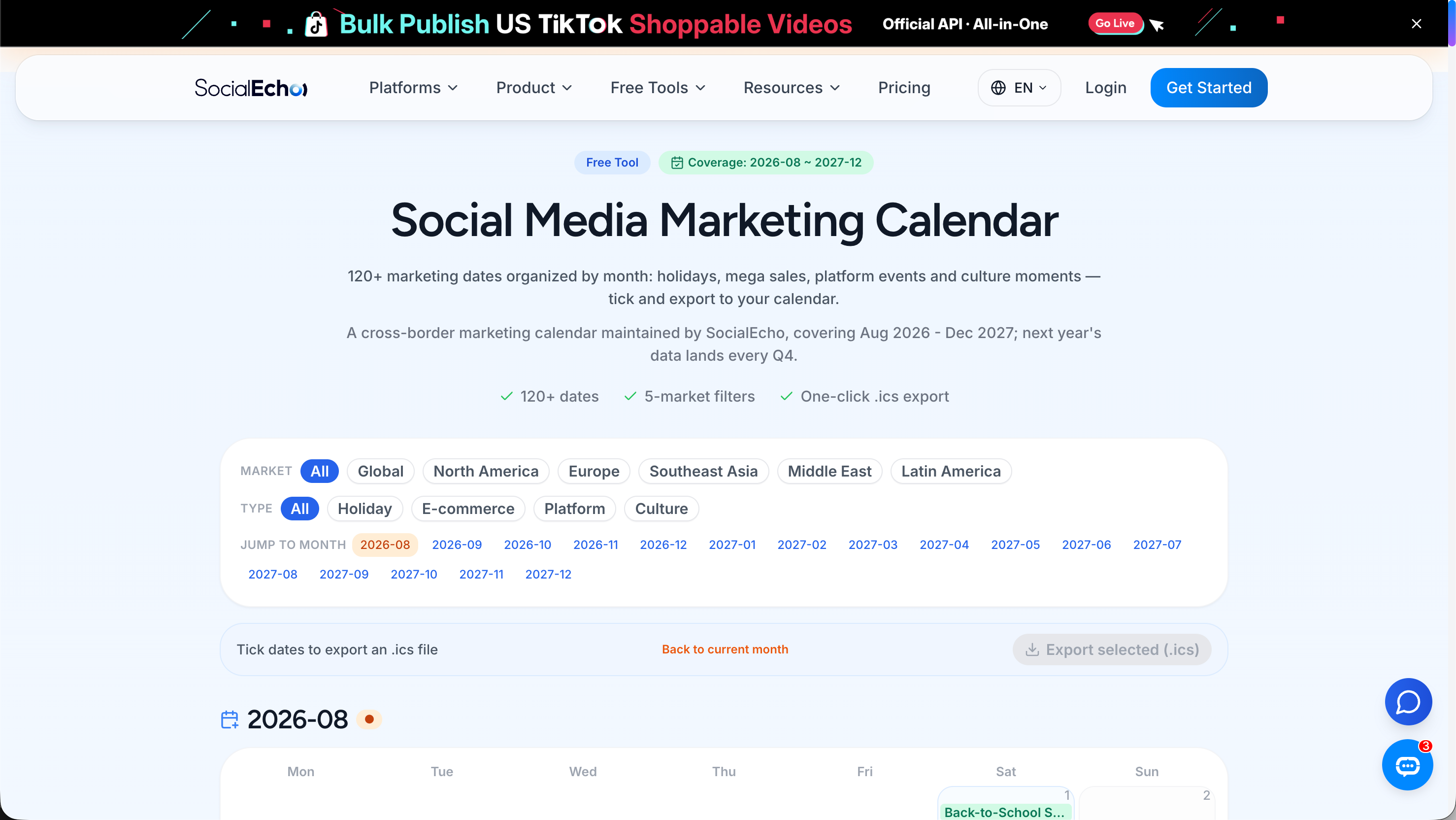
- Use a social media marketing calendar tool and a social media content calendar template to pin this content to specific dates.
- Use a post frequency planner to confirm the pace isn't too dense or too sparse.
- Prepare copy and assets ahead of time and line them all up in the publishing queue.
Global teams working across time zones need one extra step: the same holiday lands at a different time and mood in different markets (Christmas is a headline event in the West, but less so in some markets). Set send times to the target market's time zone — you can calibrate with a posting time by time zone planner and a time zone converter.
How to manage holiday content across platforms in one place
Holiday marketing usually isn't a single-platform affair — the same campaign needs a version on Facebook, Instagram, TikTok, and X. Doing it by hand — reshaping one piece into the right format for each platform and scheduling them separately — can eat up most of a day.
The efficient approach is "plan once, distribute to many platforms": write one master holiday post, use AI creation to rewrite it for each platform's style (Facebook leans long-form, X concise, TikTok with a short-video script), then schedule it all together. Teams running e-commerce promos can borrow the structure of the e-commerce solution, while brands can look at the brand marketing solution. After posting, each platform's holiday performance flows back into analytics, building experience for the next moment. Comments and DMs surge during holidays, so a unified-inbox-style engagement helps you avoid missing replies.
FAQ
Q: How far ahead should you prepare holiday social content?
A: A common rhythm is starting content 2–4 weeks before the moment and filling the publishing queue 1 week out. For big sales (like Black Friday or Singles' Day), start even earlier to leave room for warm-up and countdowns.
Q: Do you have to jump on every holiday?
A: Not recommended. Chasing every holiday dilutes content quality and often leads to on-theme posts unrelated to your brand. Picking 8–12 moments relevant to your audience and product and going deep is more effective.
Q: Ramadan, Easter, and other dates change every year — what do I do?
A: These floating holidays fall on different dates each year, so always verify the accurate official date for the current year before planning; don't reuse last year's. Brands in Muslim markets especially should mark Ramadan and Eid on the calendar early.
Q: Can I schedule holiday content for multiple platforms all at once?
A: Yes. With a tool that supports multi-platform bulk publishing, connect all your platform accounts into one calendar, write the master post, rewrite per platform, and schedule and submit it all together.
Q: How do you decide holiday posting times?
A: Prioritize the times your own account has historically seen higher engagement, then factor in the target market's time zone. Cross-time-zone teams shouldn't apply local routines to overseas audiences — free time-zone tools can help you calibrate.
Key takeaways
- Use this calendar to circle 8–12 key moments this quarter; don't overreach.
- Break each moment into three content phases: warm-up / day-of / follow-up.
- Prep 2–4 weeks ahead, and fill the publishing queue 1 week out.
- Post on the target market's time, not your local routine, across time zones.
- Rewrite one master post for multiple platforms and schedule together; watch engagement closely during holidays so no reply slips.
Next steps
If you only handle a single platform and just a few moments, planning with the free calendar tools above is enough. But if you're running holiday campaigns across multiple platforms and accounts, you can sign up for SocialEcho free (get started here) and schedule the whole year's moments into one unified calendar so you ship calmly when the holidays arrive. To try it lightly first, start with the social media marketing calendar tool and the social media content calendar template.
Worth noting: the actual results of holiday marketing vary noticeably with your brand's baseline, content quality, target market, and execution; this calendar offers moment-by-moment reference, but the specific way you market around each one should be shaped by your own product and audience.
;}.cls-2{fill:%230868f7;}.cls-3{fill:url(%23未命名的渐变_44);}.cls-4{fill:%23333;}%3c/style%3e%3clinearGradient%20id='未命名的渐变_8'%20x1='33.73'%20y1='100.61'%20x2='-0.03'%20y2='-1.06'%20gradientUnits='userSpaceOnUse'%3e%3cstop%20offset='0'%20stop-color='%237ae9fb'/%3e%3cstop%20offset='0.67'%20stop-color='%232b90f8'/%3e%3cstop%20offset='1'%20stop-color='%230868f7'/%3e%3c/linearGradient%3e%3clinearGradient%20id='未命名的渐变_44'%20x1='27.86'%20y1='18.67'%20x2='68.36'%20y2='22.22'%20gradientUnits='userSpaceOnUse'%3e%3cstop%20offset='0'%20stop-color='%235ac7f2'/%3e%3cstop%20offset='1'%20stop-color='%230868f7'/%3e%3c/linearGradient%3e%3c/defs%3e%3cpath%20class='cls-1'%20d='M29,28.74V81.91l-9.51-3.68v0L8.52,74A7.17,7.17,0,0,1,4,67.32V24.54A3.76,3.76,0,0,1,9.08,21Z'/%3e%3cpath%20class='cls-2'%20d='M68.09,78.07a13.15,13.15,0,0,1-17.9,12.06L29,81.91h0V28.74L50.19,37A13.17,13.17,0,0,0,68.08,25.3h0Z'/%3e%3cpath%20class='cls-3'%20d='M68.08,25.3a13.19,13.19,0,0,1-6.73,10.87A13.09,13.09,0,0,1,50.19,37L29,28.74V6A3.76,3.76,0,0,1,34.1,2.52l25.59,9.91A13.22,13.22,0,0,1,68.08,25.3Z'/%3e%3cpath%20class='cls-4'%20d='M129.06,81.76a4.33,4.33,0,0,1-3.19-1.31,4.4,4.4,0,0,1-1.31-3.24V56.86H97.65V77.21a4.36,4.36,0,0,1-1.35,3.2A4.68,4.68,0,0,1,93,81.76a4.32,4.32,0,0,1-3.19-1.31,4.37,4.37,0,0,1-1.32-3.24V27.27A4.58,4.58,0,0,1,89.83,24a4.59,4.59,0,0,1,7.82,3.27V48.15h26.91V27.27A4.58,4.58,0,0,1,125.91,24a4.59,4.59,0,0,1,7.82,3.27V77.21a4.37,4.37,0,0,1-1.36,3.2A4.65,4.65,0,0,1,129.06,81.76Z'/%3e%3cpath%20class='cls-4'%20d='M163.77,81.66c-6.57,0-11.76-1.92-15.44-5.7s-5.54-9.07-5.54-15.74a26.76,26.76,0,0,1,2.09-10.43,17.72,17.72,0,0,1,6.67-8.06,19.15,19.15,0,0,1,10.68-2.95,19,19,0,0,1,10.46,2.8,18.7,18.7,0,0,1,6.55,7.36,22.53,22.53,0,0,1,2.36,10.28A4.51,4.51,0,0,1,177,63.77H152.23a10.8,10.8,0,0,0,3.49,6.65c2,1.68,4.88,2.52,8.66,2.52a22.25,22.25,0,0,0,7.54-1.21c.74-.3,1.55-.67,2.37-1.07a3.75,3.75,0,0,1,1.84-.4,4.09,4.09,0,0,1,3,1.15,4,4,0,0,1,1.12,3,4.38,4.38,0,0,1-2.58,3.82,32.34,32.34,0,0,1-6.36,2.61A28.67,28.67,0,0,1,163.77,81.66ZM172.4,55.9a9.72,9.72,0,0,0-1.63-4.56A9.9,9.9,0,0,0,167,48a10.38,10.38,0,0,0-4.64-1.14,12,12,0,0,0-4.77,1.06,9.54,9.54,0,0,0-4.89,5.66,11.78,11.78,0,0,0-.51,2.3Z'/%3e%3cpath%20class='cls-4'%20d='M193,81.64a4.49,4.49,0,0,1-4.51-4.55V27.28A4.58,4.58,0,0,1,189.84,24a4.48,4.48,0,0,1,3.28-1.36A4.36,4.36,0,0,1,196.35,24a4.46,4.46,0,0,1,1.31,3.31V77.09a4.34,4.34,0,0,1-1.35,3.2A4.67,4.67,0,0,1,193,81.64Z'/%3e%3cpath%20class='cls-4'%20d='M263.79,81.71a5.7,5.7,0,0,1-4.2-1.74,5.76,5.76,0,0,1-1.73-4.19V27.37a4.58,4.58,0,0,1,1.35-3.27A4.59,4.59,0,0,1,267,27.37V72.53h24a4.58,4.58,0,0,1,3.27,7.82A4.66,4.66,0,0,1,291,81.71Z'/%3e%3cpath%20class='cls-4'%20d='M424.48,81.74a4.71,4.71,0,0,1-2.71-.88,5.43,5.43,0,0,1-1-1l-.07-.09-12.41-17-5.41,5v9.44a4.31,4.31,0,0,1-1.36,3.19,4.66,4.66,0,0,1-3.3,1.36A4.29,4.29,0,0,1,395,80.42a4.36,4.36,0,0,1-1.32-3.23V27.37A4.58,4.58,0,0,1,395,24.1a4.52,4.52,0,0,1,6.58.12,4.54,4.54,0,0,1,1.24,3.15V56.31l17.72-16.38.05,0a4.8,4.8,0,0,1,2.94-1.11,4.4,4.4,0,0,1,3.27,1.2,4.57,4.57,0,0,1,1.2,3.27,4.44,4.44,0,0,1-.77,2.33,7.45,7.45,0,0,1-1.43,1.65l-11,9.64,13.34,17.68a5,5,0,0,1,1,2.71,4.12,4.12,0,0,1-1.36,3.24A4.64,4.64,0,0,1,424.48,81.74Z'/%3e%3cpath%20class='cls-4'%20d='M317.93,81.76a21.5,21.5,0,1,1,21.17-21.5A21.37,21.37,0,0,1,317.93,81.76Zm0-34.1a12.61,12.61,0,1,0,12.42,12.6A12.52,12.52,0,0,0,317.93,47.66Z'/%3e%3cpath%20class='cls-4'%20d='M212.18,101.22a4.12,4.12,0,0,1-3.05-1.26,4.17,4.17,0,0,1-1.26-3.1V43.34a4.37,4.37,0,0,1,1.3-3.14,4.26,4.26,0,0,1,3.13-1.3,4.19,4.19,0,0,1,3.1,1.26,4.32,4.32,0,0,1,1.26,3.16,20.77,20.77,0,0,1,13-4.54,21.51,21.51,0,0,1,0,43,20.51,20.51,0,0,1-13-4.57V96.86a4.15,4.15,0,0,1-1.3,3.06A4.5,4.5,0,0,1,212.18,101.22Zm17.43-53.63c-6.23,0-12.93,4.11-12.93,12.72a12.73,12.73,0,0,0,25.46,0A12.71,12.71,0,0,0,229.61,47.59Z'/%3e%3cpath%20class='cls-4'%20d='M365.76,81.76a21.5,21.5,0,1,1,21.18-21.5A21.37,21.37,0,0,1,365.76,81.76Zm0-34.1a12.61,12.61,0,1,0,12.42,12.6A12.52,12.52,0,0,0,365.76,47.66Z'/%3e%3c/svg%3e)