
2026–2027 Overseas Marketing Calendar: How Far Ahead Should You Plan for Black Friday, 11.11, and Ramadan?
By Chen Xiao — covering global marketing calendars for cross-border brands
Lin Wei runs marketing ops for a home goods brand that sells across borders. One afternoon on October 14, she opened the team's shared drive to check on the "Black Friday campaign" folder, expecting to find things further along. Instead there was just one folder created back in July, named "Black Friday — Placeholder — TBD," and inside it sat a single product image stub with "xxxxpx" written where the resolution should be. Nothing else. Her stomach dropped. The supplier had told her custom packaging photography needed at least three weeks' lead time to book a slot, the home-goods creator she'd worked with twice before had already been signed by a competitor for November, and the Black Friday ad creative in her ad account hadn't even been submitted for review yet. She locked her laptop, went downstairs for an Americano, and sat on the stairwell staring into space for half an hour.
Lin Wei isn't alone in this. Almost anyone running marketing for a cross-border brand has lived through some version of this moment: the calendar looked airtight in January, but by the time a key date is a month or two out, you realize the plan never left the page — creative, creators, and supply chain were never actually locked in.
Between now and early 2027, overseas marketing dates cluster densely across different markets. Black Friday/Cyber Monday, Christmas/Boxing Day, Ramadan/Eid in the Middle East, and Singles' Day 11.11/12.12 in Southeast Asia are the four categories teams most often underestimate the lead time for. Locking in creators, creative assets, ad review, and supply chain 6–10 weeks ahead is what it takes to catch the traffic window before each date.
- Black Friday / Cyber Monday (Nov 27–30): start sourcing products and booking creators 8–10 weeks out
- Christmas + Boxing Day (Dec 25–26): the longest logistics and ad-review cycle — plan 10–12 weeks ahead
- Ramadan / Eid in the Middle East (estimated Feb–Mar 2027): dates shift with the Islamic lunar calendar — plan 8–10 weeks ahead with buffer
- Southeast Asia's 11.11 and 12.12 (Nov 11, Dec 12): overlaps with North America's Black Friday window — split staffing and creative capacity ahead of time
- Secondary peaks like Back to School and Halloween: roughly 6 weeks of lead time usually covers it
The marketing calendar tool referenced in this article is built by SocialEcho, an all-in-one AI workspace for cross-border social marketing. It connects directly to 11 platforms including TikTok Shop, Instagram, and Facebook, with support for batch scheduling and performance review across platforms — built for teams that need to plan key dates well ahead of time.
Which overseas marketing dates matter most in H2 2026?
From Back to School through next year's Eid, three groups of dates deserve the most advance planning between H2 2026 and early 2027: Black Friday/Cyber Monday/Christmas in North America and Europe, Singles' Day 11.11/12.12 in Southeast Asia, and Ramadan/Eid in the Middle East. A meaningful share of organic growth for cross-border brands comes from riding these key dates. Around Back to School, Black Friday/Cyber Monday, and 11.11/12.12, search volume and content consumption in the target market tend to climb noticeably 2 to 6 weeks before the date, and ad bidding and content reach are often relatively more cost-effective in that window. Show up on the day itself — or after — and you're competing for keywords the competition already owns, at CPMs that have already been bid up. The same budget buys noticeably less reach and fewer conversions.
For teams that rely on social traffic and content-led discovery, these dates aren't a question of whether to participate — they're a question of how far ahead to prepare. The full list of dates and market-by-market lead times follows below; first, it's worth understanding why this keeps slipping to the last minute.
Why do teams keep cutting it close on key-date marketing — or missing it entirely?
The root cause isn't that teams don't know the dates are coming. It's that the marketing calendar and the content schedule are never actually connected. Most teams treat key dates as a "deal with it later" line item rather than a production pipeline that needs to be worked backward from a deadline. A few stages naturally take longer than most ops teams assume:
Booking a creator typically takes 2 to 6 weeks of lead time, and the more niche and higher-quality the account, the faster its calendar fills up. During peak promotional periods, Meta and TikTok's ad review queues slow down because every merchant on the platform is submitting at once — submit late and you can easily get stuck in review past your launch date. Custom product photography, packaging design, and multilingual copy localization aren't individually complicated, but stacked together — and colliding with tight warehouse capacity during peak shipping season — the window left for the content team keeps shrinking.
When Lin Wei later looked back at what went wrong, she realized the problem wasn't a lack of effort. It was that the calendar said "Black Friday, Nov 27" but the content schedule never worked backward to specific actions like "start booking creators by mid-September" or "submit ad creative for initial review by early October." The higher-priority fix, then, is putting the date and the backward-planned actions into the same table — not agonizing over which calendar tool to use.
How far ahead should Black Friday/Cyber Monday creative be ready?
Start Black Friday and Cyber Monday prep 8–10 weeks out; because Christmas and Boxing Day involve longer logistics and ad-review cycles, push that timeline back another 2–4 weeks. The table below covers reference lead times for North America, Europe, and globally recognized dates from H2 2026 through early 2027:
| Date | When | Markets | Content Focus | Lead Time |
|---|---|---|---|---|
| Back to School | Mid-to-late August | North America, Europe | Back-to-school gear, lifestyle content | ~42–56 days (6–8 weeks) |
| Halloween | Oct 31 | North America, parts of Europe | Themed decor, seasonal products | ~42 days (6 weeks) |
| Black Friday | Nov 27, 2026 | North America, Europe, global ecommerce | Discount-led, list-style content | ~56–70 days (8–10 weeks) |
| Cyber Monday | Nov 30, 2026 | Same as Black Friday | Shares creative with Black Friday | Same schedule as Black Friday |
| Christmas | Dec 25 | North America, Europe | Gift guides, holiday atmosphere | ~70–84 days (10–12 weeks) |
| Boxing Day | Dec 26 | UK, parts of Europe, Commonwealth markets | Clearance continues | Plan alongside Christmas |
| New Year Sale | Jan 1, 2027 | Global | Fresh-start / new year themes | ~21–28 days (3–4 weeks) |
| Valentine's Day | Feb 14, 2027 | Global, especially North America and Europe | Gifting, couples-focused content | ~21–28 days (3–4 weeks) |
What does Ramadan mean for cross-border ecommerce?
Ramadan and Eid al-Fitr matter for cross-border ecommerce roughly as much as Black Friday does in North America — the difference is that they run on the Islamic lunar calendar, so the dates shift every year. During Ramadan, daytime fasting and a sharp rise in evening gatherings and shopping mean search and order volume for apparel, home goods, and beauty gifting categories tends to climb steadily from the back half of Ramadan through Eid, with Eid al-Fitr itself standing as one of the year's biggest gifting peaks.
| Date | When | Markets | Content Focus | Lead Time |
|---|---|---|---|---|
| Ramadan begins (estimated, pending moon-sighting confirmation) | Mid-February 2027 | Middle East, Indonesia, Malaysia, and other Muslim-majority markets | Home, gathering, and gifting content | ~56 days (8 weeks) |
| Eid al-Fitr (estimated, pending moon-sighting confirmation) | Mid-March 2027 | Middle East, Southeast Asian Muslim-majority markets | Gifting, festive-spending peak content | ~70 days (10 weeks) |
The exact dates for Ramadan and Eid aren't finalized until an authoritative body confirms the new moon sighting, and they typically fall about 10 days earlier each year relative to the Gregorian calendar. Plan around a relative "N weeks ahead" cadence rather than memorizing a fixed Gregorian date, and build in a few days of buffer either way.
How should Southeast Asia's H2 promotions be scheduled?
Southeast Asia's 11.11 and 12.12 windows overlap heavily with North America's Black Friday/Cyber Monday. If your team covers both markets, split staffing and creative capacity ahead of time rather than scrambling for both in mid-November. Key Southeast Asia dates from H2 through early 2027:
| Date | When | Markets | Content Focus | Lead Time |
|---|---|---|---|---|
| Singles' Day 11.11 | Nov 11 | Southeast Asia (Indonesia, Philippines, Vietnam, etc.), select cross-border platforms | Pre-sale buildup, comparison/list content | ~42–56 days (6–8 weeks) |
| 12.12 | Dec 12 | Southeast Asia (including Indonesia's Harbolnas) | Year-end clearance, livestream buildup | ~28–42 days (4–6 weeks) |
| Lunar New Year / Tet | Mid-February 2027 | Southeast Asian Chinese communities, Vietnam | Reunion gifting, red-themed content | ~56–70 days (8–10 weeks; supply chain heavily affected by Lunar New Year shutdowns) |
How do you work backward from a key date to a real schedule?
The core method is breaking a date down into a sequence of specific action points working backward from it — not just writing the date on a calendar. Copying the date onto a calendar is only step one. Take Black Friday on November 27 as an example — worked backward, the cadence looks roughly like this:
- Mid-September: finalize product selection and creative direction
- By end of September: lock in creator bookings and shoot schedules
- Mid-October: finish a first draft of creative and submit for ad platform review
- Early November: keep buffer time for revisions and cross-platform adaptation
- Final week: focus on publishing cadence and real-time monitoring
For dates like Christmas, where logistics take longer and ad review is more likely to back up because the whole industry is submitting at once, push the entire chain another 2–4 weeks earlier.
What tool puts the marketing calendar and content schedule side by side?
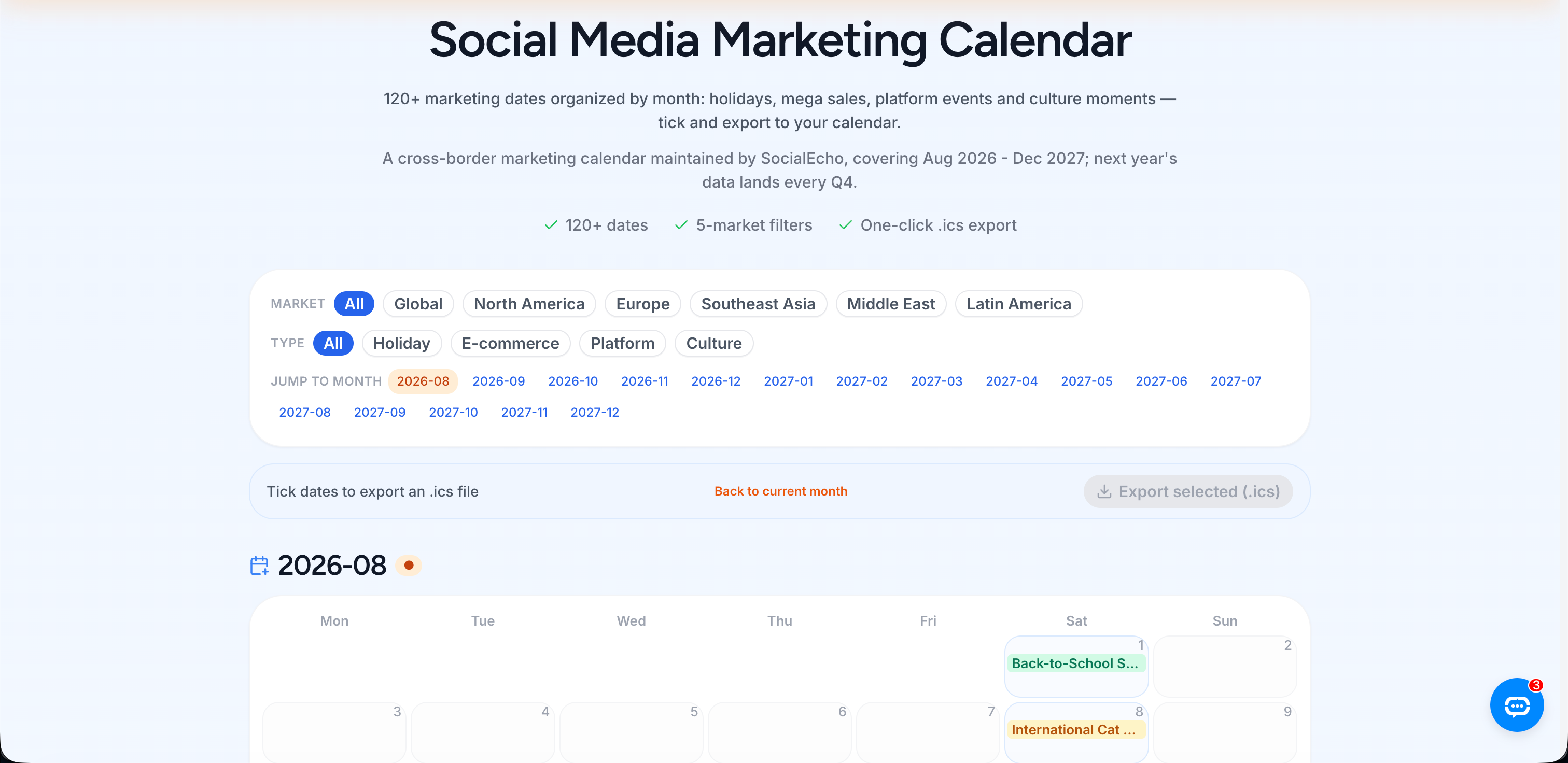
A static list of dates isn't enough on its own — teams need a tool that shows the date and the content schedule in the same view. SocialEcho's Social Media Marketing Calendar (interactive) has these cross-market dates built in, with filtering by market and drag-and-drop content blocks you can line up against each date — so it's immediately clear which step to start and when, without manually tracking dates off a spreadsheet. If your team prefers to build the content framework first and slot dates in afterward, the Content Calendar Template pairs well with it — viewing the two side by side makes the schedule easier to follow.
Once the schedule is locked in, publishing times and frequency across markets are worth a separate look — the same Black Friday creative won't hit at the same time for North American and Southeast Asian audiences, since their active hours differ. The Best Time to Post tool lets you check posting windows by market before locking in publish times. And when content volume spikes during peak season, teams can easily fall into "posting constantly just to hit the date" — the Post Frequency Planner helps keep frequency in a reasonable range so accounts don't get flagged as anomalous. When running campaigns across markets, a single piece of creative often needs to fit several platforms' sizing and copy conventions — the Cross-Platform Post Adapter cuts down on a lot of that repetitive work.
For teams like Lin Wei's, covering multiple markets and platforms at once, the real labor after the schedule is locked usually comes down to getting the same batch of creative live across 11 platforms on staggered timing. SocialEcho's Publishing supports batch scheduling and timed posting across platforms, letting you queue up Black Friday, 11.11, and similar campaign content weeks in advance. AI Creation can speed up localization and multilingual copy — especially useful when you need English, Arabic, and Indonesian versions running at once. After the date passes, Analytics lets you compare this year's numbers against the same period last year, to see how much reach and engagement the earlier planning actually bought — and to calibrate the timeline for the next key date.
On the platform side: for North America and Europe's Black Friday/Cyber Monday and Christmas season, Facebook and Instagram remain the main combination for discovery plus conversion, and Instagram scheduling lets you lock in the weeks of content leading up to the date ahead of time. For Back to School and Christmas gift-search content, Pinterest users tend to start gathering ideas months ahead — which is exactly why Pinterest content around key dates needs to go up early rather than two weeks before. For Southeast Asia's 11.11 and 12.12 promotions, TikTok Shop is a direct conversion channel for many categories, and pairing it with TikTok bulk publishing lets you queue up pre-sale content alongside day-of livestream buildup. Teams built around ecommerce growth can find a fuller playbook in the Ecommerce Solution; teams focused more on brand content will find the Brand Marketing Solution closer to what they need.
What is SocialEcho, and how does it help with key-date scheduling?
FAQ: common questions about overseas key-date scheduling
When's the latest you can start prepping Black Friday/Cyber Monday creative?
Starting in mid-to-late October generally only gets you far enough for a subset of channels — creator bookings and deeply customized content usually won't make it in time. Working backward from an 8–10 week lead time, finalizing product selection and creative direction by mid-September is a reasonably safe starting point. If your team is short-staffed, at minimum get ad creative submitted for initial platform review by early October, leaving buffer for revisions and adaptation.
How do you confirm the exact dates for Ramadan and Eid?
Ramadan and Eid al-Fitr run on the Islamic lunar calendar and land roughly 10 days earlier each year relative to the Gregorian calendar. The precise start and end dates are confirmed by local authoritative bodies based on moon-sighting observations. When planning around these dates, work backward using a relative "N weeks ahead" cadence rather than memorizing a fixed Gregorian date, and leave a few days of buffer.
Can Southeast Asia's 11.11/12.12 and North America's Black Friday share the same creative?
Core visuals and product messaging can usually be reused, but landing page copy, promo mechanics, and publish timing generally can't be copied over directly. Since 11.11/12.12 in Southeast Asia overlaps heavily with Black Friday/Cyber Monday in North America, teams covering both markets should split staffing and creative capacity ahead of time rather than competing for the same resources as the dates approach.
How should the marketing calendar and content schedule work together?
The marketing calendar's job is marking when each key date falls; the content schedule's job is breaking each date down into specific actions, owners, and deadlines. Keeping both in the same table or tool catches gaps that are easy to miss when they're maintained separately — which is the whole point of pairing the marketing calendar with the content calendar template.
Smaller teams can't cover every key date — should they try to hit all of them?
Not every date deserves equal investment. Prioritize based on two factors: whether the date falls in a market you actually target, and how that date has historically performed. Cross-market dates like Black Friday/Cyber Monday, Christmas, and Ramadan/Eid are worth the heavier investment; more regional or lower-impact dates can get basic content coverage without dedicated custom creative.
Key takeaways
- Between H2 2026 and early 2027, the dates most worth planning around in advance are Black Friday/Cyber Monday/Christmas/Boxing Day in North America, 11.11/12.12 in Southeast Asia, and Ramadan/Eid in the Middle East
- Start Black Friday/Cyber Monday prep 8–10 weeks out; Christmas needs 10–12 weeks because of longer logistics and ad-review cycles
- Ramadan and Eid run on the Islamic lunar calendar and shift every year — plan with a relative "N weeks ahead" cadence rather than a fixed Gregorian date
- The key to key-date scheduling isn't memorizing dates — it's breaking each date down into concrete actions: booking creators, submitting creative, buffering for review
- Merging the marketing calendar and the content schedule into one table or tool is a relatively effective way to stop cutting it close — or missing dates outright
Final note: scheduling is a relative science, not a precise prediction
Back to Lin Wei's story — the fix she landed on wasn't complicated. She merged the marketing calendar and content schedule into a single table, and for every date besides Black Friday, worked backward using an "N weeks ahead" cadence to specific creator-booking, creative-submission, and review-buffer milestones. The team stopped scrambling a month or two before each date.
One caveat: the dates listed in this article — especially Ramadan, Eid, and other dates based on the Islamic lunar calendar — are estimates. The actual start and end dates are confirmed by local authoritative bodies based on moon-sighting observations. Ad review times, creator availability, and shipping timelines on any platform will also fluctuate with overall campaign volume during peak season. Build in buffer based on your own supply chain and platform rules, and treat this article as guidance rather than a guarantee of any specific marketing outcome or conversion result.
;}.cls-2{fill:%230868f7;}.cls-3{fill:url(%23未命名的渐变_44);}.cls-4{fill:%23333;}%3c/style%3e%3clinearGradient%20id='未命名的渐变_8'%20x1='33.73'%20y1='100.61'%20x2='-0.03'%20y2='-1.06'%20gradientUnits='userSpaceOnUse'%3e%3cstop%20offset='0'%20stop-color='%237ae9fb'/%3e%3cstop%20offset='0.67'%20stop-color='%232b90f8'/%3e%3cstop%20offset='1'%20stop-color='%230868f7'/%3e%3c/linearGradient%3e%3clinearGradient%20id='未命名的渐变_44'%20x1='27.86'%20y1='18.67'%20x2='68.36'%20y2='22.22'%20gradientUnits='userSpaceOnUse'%3e%3cstop%20offset='0'%20stop-color='%235ac7f2'/%3e%3cstop%20offset='1'%20stop-color='%230868f7'/%3e%3c/linearGradient%3e%3c/defs%3e%3cpath%20class='cls-1'%20d='M29,28.74V81.91l-9.51-3.68v0L8.52,74A7.17,7.17,0,0,1,4,67.32V24.54A3.76,3.76,0,0,1,9.08,21Z'/%3e%3cpath%20class='cls-2'%20d='M68.09,78.07a13.15,13.15,0,0,1-17.9,12.06L29,81.91h0V28.74L50.19,37A13.17,13.17,0,0,0,68.08,25.3h0Z'/%3e%3cpath%20class='cls-3'%20d='M68.08,25.3a13.19,13.19,0,0,1-6.73,10.87A13.09,13.09,0,0,1,50.19,37L29,28.74V6A3.76,3.76,0,0,1,34.1,2.52l25.59,9.91A13.22,13.22,0,0,1,68.08,25.3Z'/%3e%3cpath%20class='cls-4'%20d='M129.06,81.76a4.33,4.33,0,0,1-3.19-1.31,4.4,4.4,0,0,1-1.31-3.24V56.86H97.65V77.21a4.36,4.36,0,0,1-1.35,3.2A4.68,4.68,0,0,1,93,81.76a4.32,4.32,0,0,1-3.19-1.31,4.37,4.37,0,0,1-1.32-3.24V27.27A4.58,4.58,0,0,1,89.83,24a4.59,4.59,0,0,1,7.82,3.27V48.15h26.91V27.27A4.58,4.58,0,0,1,125.91,24a4.59,4.59,0,0,1,7.82,3.27V77.21a4.37,4.37,0,0,1-1.36,3.2A4.65,4.65,0,0,1,129.06,81.76Z'/%3e%3cpath%20class='cls-4'%20d='M163.77,81.66c-6.57,0-11.76-1.92-15.44-5.7s-5.54-9.07-5.54-15.74a26.76,26.76,0,0,1,2.09-10.43,17.72,17.72,0,0,1,6.67-8.06,19.15,19.15,0,0,1,10.68-2.95,19,19,0,0,1,10.46,2.8,18.7,18.7,0,0,1,6.55,7.36,22.53,22.53,0,0,1,2.36,10.28A4.51,4.51,0,0,1,177,63.77H152.23a10.8,10.8,0,0,0,3.49,6.65c2,1.68,4.88,2.52,8.66,2.52a22.25,22.25,0,0,0,7.54-1.21c.74-.3,1.55-.67,2.37-1.07a3.75,3.75,0,0,1,1.84-.4,4.09,4.09,0,0,1,3,1.15,4,4,0,0,1,1.12,3,4.38,4.38,0,0,1-2.58,3.82,32.34,32.34,0,0,1-6.36,2.61A28.67,28.67,0,0,1,163.77,81.66ZM172.4,55.9a9.72,9.72,0,0,0-1.63-4.56A9.9,9.9,0,0,0,167,48a10.38,10.38,0,0,0-4.64-1.14,12,12,0,0,0-4.77,1.06,9.54,9.54,0,0,0-4.89,5.66,11.78,11.78,0,0,0-.51,2.3Z'/%3e%3cpath%20class='cls-4'%20d='M193,81.64a4.49,4.49,0,0,1-4.51-4.55V27.28A4.58,4.58,0,0,1,189.84,24a4.48,4.48,0,0,1,3.28-1.36A4.36,4.36,0,0,1,196.35,24a4.46,4.46,0,0,1,1.31,3.31V77.09a4.34,4.34,0,0,1-1.35,3.2A4.67,4.67,0,0,1,193,81.64Z'/%3e%3cpath%20class='cls-4'%20d='M263.79,81.71a5.7,5.7,0,0,1-4.2-1.74,5.76,5.76,0,0,1-1.73-4.19V27.37a4.58,4.58,0,0,1,1.35-3.27A4.59,4.59,0,0,1,267,27.37V72.53h24a4.58,4.58,0,0,1,3.27,7.82A4.66,4.66,0,0,1,291,81.71Z'/%3e%3cpath%20class='cls-4'%20d='M424.48,81.74a4.71,4.71,0,0,1-2.71-.88,5.43,5.43,0,0,1-1-1l-.07-.09-12.41-17-5.41,5v9.44a4.31,4.31,0,0,1-1.36,3.19,4.66,4.66,0,0,1-3.3,1.36A4.29,4.29,0,0,1,395,80.42a4.36,4.36,0,0,1-1.32-3.23V27.37A4.58,4.58,0,0,1,395,24.1a4.52,4.52,0,0,1,6.58.12,4.54,4.54,0,0,1,1.24,3.15V56.31l17.72-16.38.05,0a4.8,4.8,0,0,1,2.94-1.11,4.4,4.4,0,0,1,3.27,1.2,4.57,4.57,0,0,1,1.2,3.27,4.44,4.44,0,0,1-.77,2.33,7.45,7.45,0,0,1-1.43,1.65l-11,9.64,13.34,17.68a5,5,0,0,1,1,2.71,4.12,4.12,0,0,1-1.36,3.24A4.64,4.64,0,0,1,424.48,81.74Z'/%3e%3cpath%20class='cls-4'%20d='M317.93,81.76a21.5,21.5,0,1,1,21.17-21.5A21.37,21.37,0,0,1,317.93,81.76Zm0-34.1a12.61,12.61,0,1,0,12.42,12.6A12.52,12.52,0,0,0,317.93,47.66Z'/%3e%3cpath%20class='cls-4'%20d='M212.18,101.22a4.12,4.12,0,0,1-3.05-1.26,4.17,4.17,0,0,1-1.26-3.1V43.34a4.37,4.37,0,0,1,1.3-3.14,4.26,4.26,0,0,1,3.13-1.3,4.19,4.19,0,0,1,3.1,1.26,4.32,4.32,0,0,1,1.26,3.16,20.77,20.77,0,0,1,13-4.54,21.51,21.51,0,0,1,0,43,20.51,20.51,0,0,1-13-4.57V96.86a4.15,4.15,0,0,1-1.3,3.06A4.5,4.5,0,0,1,212.18,101.22Zm17.43-53.63c-6.23,0-12.93,4.11-12.93,12.72a12.73,12.73,0,0,0,25.46,0A12.71,12.71,0,0,0,229.61,47.59Z'/%3e%3cpath%20class='cls-4'%20d='M365.76,81.76a21.5,21.5,0,1,1,21.18-21.5A21.37,21.37,0,0,1,365.76,81.76Zm0-34.1a12.61,12.61,0,1,0,12.42,12.6A12.52,12.52,0,0,0,365.76,47.66Z'/%3e%3c/svg%3e)