
Someone asked about the price in the comments section, and you only saw it 3 hours later—that's how you lost the order.
Someone asked about the price in the comments section, and you only saw it 3 hours later—that's how you lost the order.
Word count: Approximately 2800 words. Reading time: 8 minutes.
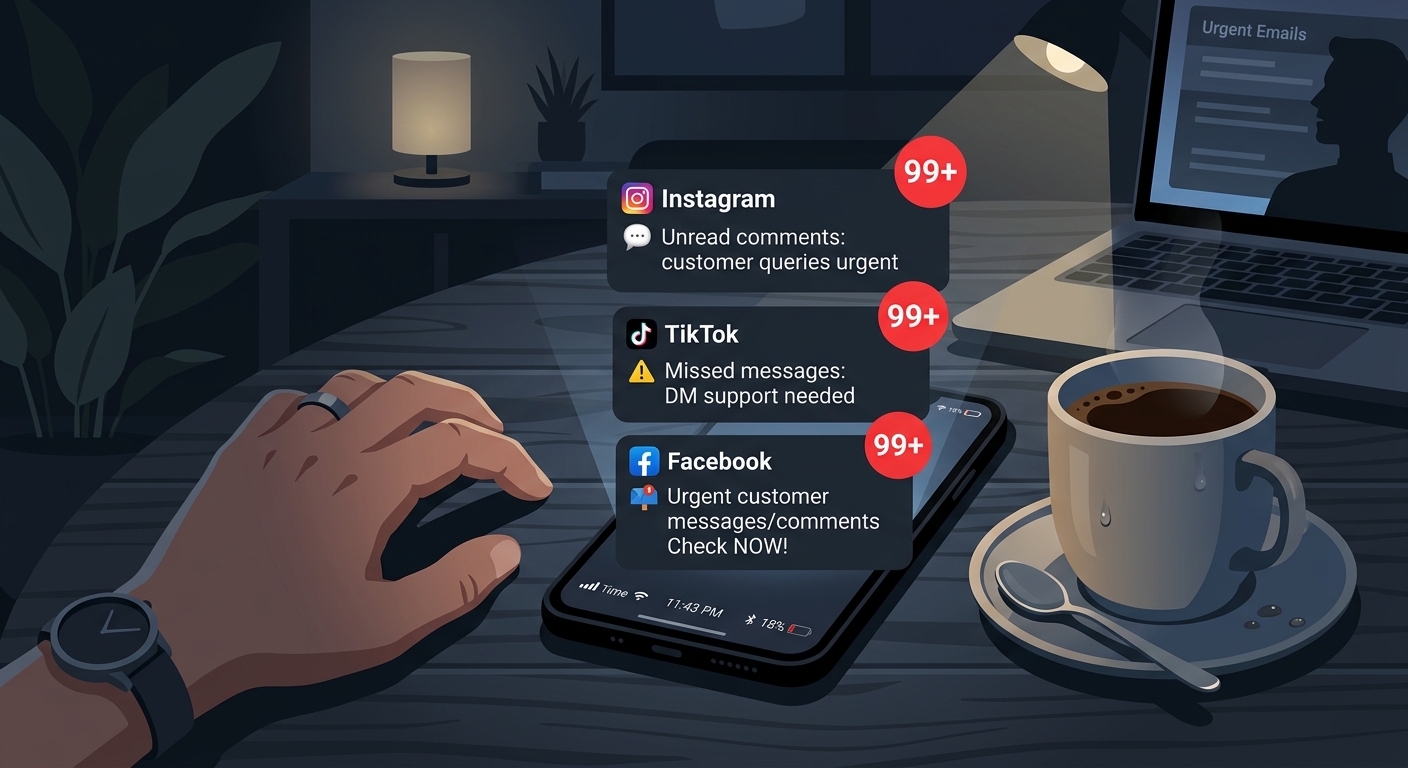
You are in a meeting at 2 PM on Wednesday.
My phone is on silent, lying on the table. On Instagram, a fan just commented under your new product tweet: "Is this color in stock? I want to buy it now."
You will see this message three hours later.
You replied, with a very good attitude and quick response, sending a very enthusiastic message—but that person had already paid on another brand's official website.
This is not an isolated case. This is something that happens silently every day for every brand that relies on social media for business.
It's not that you're irresponsible, it's that you can't "see" everything.
Anyone who works in brand operations knows that the comments section is not just a place for "interaction," it's the primary site for closing deals.
A user asking for a price in the comments section has moved beyond the "just browsing" stage. They're testing you at minimal cost: your response speed, your customer service, and your inventory status. They might have asked this same question to three competitors simultaneously. Whoever answers first gets the order.
The problem is, you simply can't see it immediately.
You manage five platforms: Instagram, TikTok, Facebook, X, and YouTube. Each account generates comments, private messages, @mentions, and hashtag notifications daily. That adds up to about 300 messages a day that you need to handle—sometimes exceeding 500.
You can't stare at the screen all day, but every message you miss could be a deal that falls through.
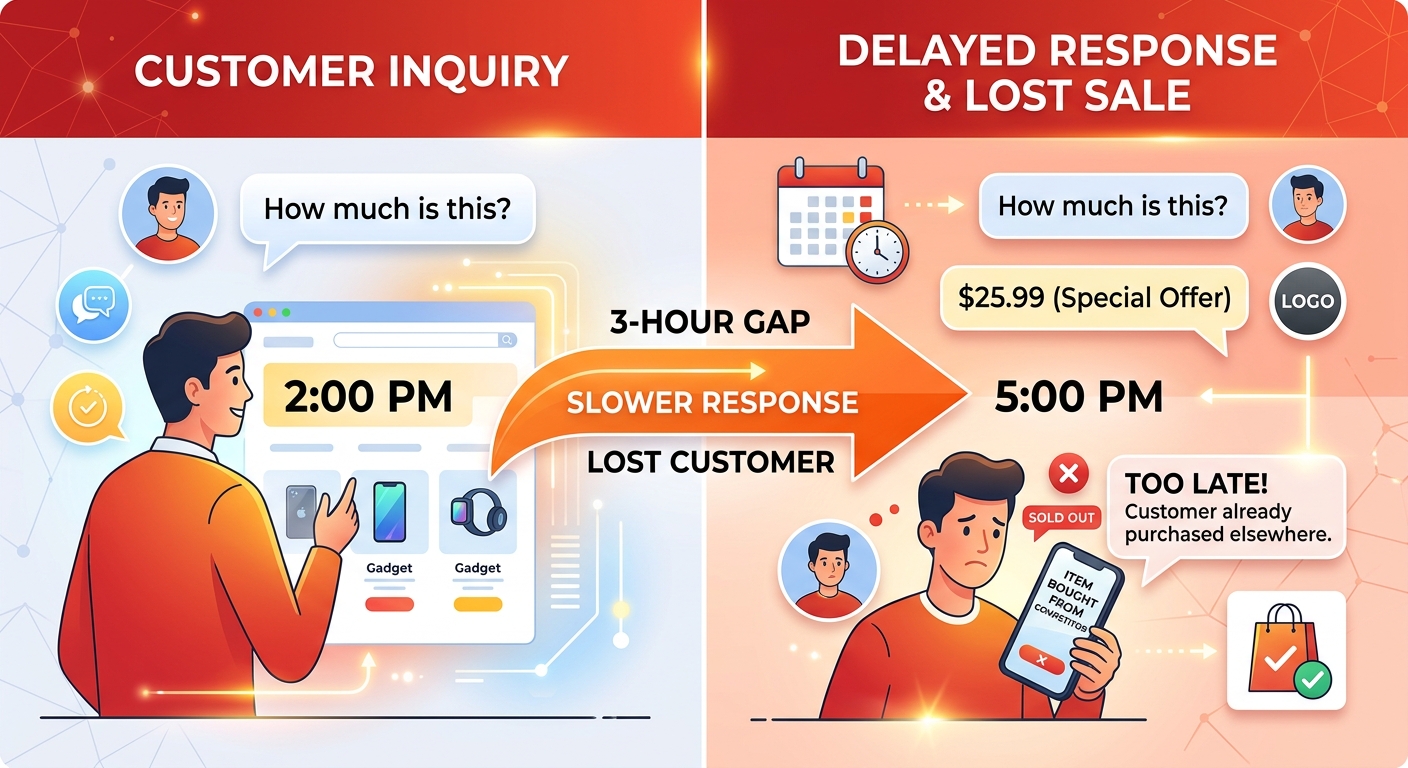
The cost of waiting is much greater than you imagine.
A Harvard Business Review study found that the conversion rate for potential customers who receive a response within 5 minutes is 100 times higher than those who receive one hour later. This figure is even more extreme on social media—because social media users' attention spans are more than three times faster than those on regular web pages.
In plain terms: Your comment section being silent for 6 hours every night is systematically handing over potential customers to your competitors.
What's more troublesome is that the destructive power of this problem is insidious.
Your monthly report won't show "how many orders were lost due to slow responses." All you'll see is: conversion rates aren't rising, but customer acquisition costs are. You start to suspect the content isn't good enough, the campaign is flawed, or you've made a bad product choice—but actually, the problem lies in the link closest to closing the deal: someone's knocking, but no one's answering.
The root of the problem is not a "lack of seriousness".
Many brands' first reaction is to hire another person specifically to monitor the comments section.
This solution can solve the problem, but it only addresses the symptoms, not the root cause.
An operations specialist, with limited energy, can only process a maximum of 150-200 high-quality comments per day. As your account grows, as the number of comments surges during promotional seasons, and as you manage five platforms simultaneously instead of two—a person's speed can never keep up with the platform's information flow.
Moreover, the problem isn't just speed. Manually processing comments presents another risk: prioritizing messages categorized as "price inquiries," "complaints," and "cooperation requests" heavily relies on personal experience and the employee's mood that day. A new employee might treat a message with high purchase intent as a regular inquiry and wait in the queue—only to find that the prime opportunity has already passed.
The real problem is that there isn't a system that can identify high-value signals in comments immediately and bring them to the attention of those in charge.
The change occurs at the "recognition" step.
A beauty brand expanding overseas once experienced a nightmare a week before a promotional event: three operations staff members were split up and monitored three different platforms, working for a full 72 hours. Afterwards, they discovered that over 60 price inquiry comments didn't receive a response until two hours later. Based on their average order value, they estimated that the potential sales missed during those 72 hours exceeded 80,000 RMB.
It's not that people don't work hard, it's that they're using the wrong methods.
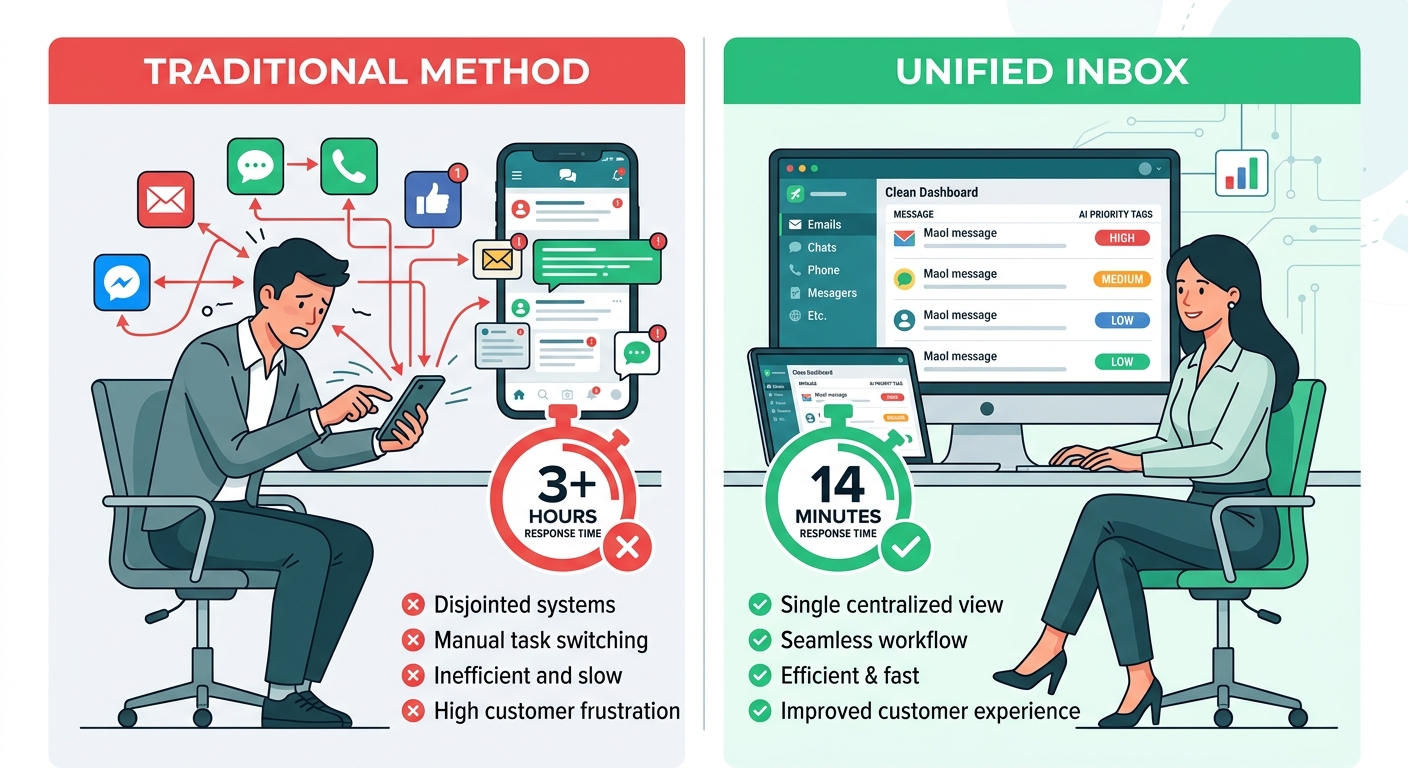
The change they made was simple: they took over comment collection with SocialEcho interaction management . The system automatically aggregated comments from all platforms into a unified inbox, and AI scanned each message in real time, identifying three priority categories: purchase intention (inquiry about price/stock/size), complaint risk (anger/potential negative reviews), and general interaction (likes/thank yous/casual chat).
Comments expressing purchase intent will automatically trigger push notifications to your phone. No need to open the app or scroll through the feed; you'll know immediately if someone inquires about the price.
This change reduced their average comment response time from 3.2 hours to 14 minutes.
Make "rapid response" your competitive advantage.
Speed itself is not the goal; speed is a signal.
If a user sees that you replied to their comment within two minutes—even if it's just a simple "Wait a moment, I'll check for you right away"—the signal they receive is: this brand treats me like a real person, not just a data point.
This feeling will subtly take effect the moment he chooses which company to order from.
To achieve this, you don't need someone watching the screen 24/7. What you need is:
A system that automatically aggregates comments from all platforms, so you don't have to switch between 5 apps repeatedly; an AI that can identify the priority of comments, so you don't have to judge which one is more important; and a notification mechanism that proactively pushes "high-value signals" to your attention, so you won't miss the most important message even when you're in a meeting.
SocialEcho's interaction management module supports a unified inbox across 7 major platforms (Facebook, Instagram, X, TikTok, YouTube, LinkedIn, and Telegram). Its AI emotion and intent recognition accuracy is over 95%, and it allows for customizable reply templates, transforming your comment section response time from "when I have time" to "immediate response."
By combining scheduled postings, planning the posting rhythm, and using data analysis to track which types of content generate more high-intent comments—these three functions together form a complete closed loop for improving the conversion rate in the comment section.
The first step you can take now
There is no need to change all processes immediately.
Starting today, let's do one thing: collect statistics on how many "price inquiry/inventory inquiry" messages you've received in the comments section over the past 30 days, and what your average response time was.
This number will tell you how many opportunities you're losing each month in the comments section.
Once you know how high the cost is, you'll know what to do next.
Try SocialEcho for free now and experience unified comment management → 👉 https://www.socialecho.net
Related reading:
;}.cls-2{fill:%230868f7;}.cls-3{fill:url(%23未命名的渐变_44);}.cls-4{fill:%23333;}%3c/style%3e%3clinearGradient%20id='未命名的渐变_8'%20x1='33.73'%20y1='100.61'%20x2='-0.03'%20y2='-1.06'%20gradientUnits='userSpaceOnUse'%3e%3cstop%20offset='0'%20stop-color='%237ae9fb'/%3e%3cstop%20offset='0.67'%20stop-color='%232b90f8'/%3e%3cstop%20offset='1'%20stop-color='%230868f7'/%3e%3c/linearGradient%3e%3clinearGradient%20id='未命名的渐变_44'%20x1='27.86'%20y1='18.67'%20x2='68.36'%20y2='22.22'%20gradientUnits='userSpaceOnUse'%3e%3cstop%20offset='0'%20stop-color='%235ac7f2'/%3e%3cstop%20offset='1'%20stop-color='%230868f7'/%3e%3c/linearGradient%3e%3c/defs%3e%3cpath%20class='cls-1'%20d='M29,28.74V81.91l-9.51-3.68v0L8.52,74A7.17,7.17,0,0,1,4,67.32V24.54A3.76,3.76,0,0,1,9.08,21Z'/%3e%3cpath%20class='cls-2'%20d='M68.09,78.07a13.15,13.15,0,0,1-17.9,12.06L29,81.91h0V28.74L50.19,37A13.17,13.17,0,0,0,68.08,25.3h0Z'/%3e%3cpath%20class='cls-3'%20d='M68.08,25.3a13.19,13.19,0,0,1-6.73,10.87A13.09,13.09,0,0,1,50.19,37L29,28.74V6A3.76,3.76,0,0,1,34.1,2.52l25.59,9.91A13.22,13.22,0,0,1,68.08,25.3Z'/%3e%3cpath%20class='cls-4'%20d='M129.06,81.76a4.33,4.33,0,0,1-3.19-1.31,4.4,4.4,0,0,1-1.31-3.24V56.86H97.65V77.21a4.36,4.36,0,0,1-1.35,3.2A4.68,4.68,0,0,1,93,81.76a4.32,4.32,0,0,1-3.19-1.31,4.37,4.37,0,0,1-1.32-3.24V27.27A4.58,4.58,0,0,1,89.83,24a4.59,4.59,0,0,1,7.82,3.27V48.15h26.91V27.27A4.58,4.58,0,0,1,125.91,24a4.59,4.59,0,0,1,7.82,3.27V77.21a4.37,4.37,0,0,1-1.36,3.2A4.65,4.65,0,0,1,129.06,81.76Z'/%3e%3cpath%20class='cls-4'%20d='M163.77,81.66c-6.57,0-11.76-1.92-15.44-5.7s-5.54-9.07-5.54-15.74a26.76,26.76,0,0,1,2.09-10.43,17.72,17.72,0,0,1,6.67-8.06,19.15,19.15,0,0,1,10.68-2.95,19,19,0,0,1,10.46,2.8,18.7,18.7,0,0,1,6.55,7.36,22.53,22.53,0,0,1,2.36,10.28A4.51,4.51,0,0,1,177,63.77H152.23a10.8,10.8,0,0,0,3.49,6.65c2,1.68,4.88,2.52,8.66,2.52a22.25,22.25,0,0,0,7.54-1.21c.74-.3,1.55-.67,2.37-1.07a3.75,3.75,0,0,1,1.84-.4,4.09,4.09,0,0,1,3,1.15,4,4,0,0,1,1.12,3,4.38,4.38,0,0,1-2.58,3.82,32.34,32.34,0,0,1-6.36,2.61A28.67,28.67,0,0,1,163.77,81.66ZM172.4,55.9a9.72,9.72,0,0,0-1.63-4.56A9.9,9.9,0,0,0,167,48a10.38,10.38,0,0,0-4.64-1.14,12,12,0,0,0-4.77,1.06,9.54,9.54,0,0,0-4.89,5.66,11.78,11.78,0,0,0-.51,2.3Z'/%3e%3cpath%20class='cls-4'%20d='M193,81.64a4.49,4.49,0,0,1-4.51-4.55V27.28A4.58,4.58,0,0,1,189.84,24a4.48,4.48,0,0,1,3.28-1.36A4.36,4.36,0,0,1,196.35,24a4.46,4.46,0,0,1,1.31,3.31V77.09a4.34,4.34,0,0,1-1.35,3.2A4.67,4.67,0,0,1,193,81.64Z'/%3e%3cpath%20class='cls-4'%20d='M263.79,81.71a5.7,5.7,0,0,1-4.2-1.74,5.76,5.76,0,0,1-1.73-4.19V27.37a4.58,4.58,0,0,1,1.35-3.27A4.59,4.59,0,0,1,267,27.37V72.53h24a4.58,4.58,0,0,1,3.27,7.82A4.66,4.66,0,0,1,291,81.71Z'/%3e%3cpath%20class='cls-4'%20d='M424.48,81.74a4.71,4.71,0,0,1-2.71-.88,5.43,5.43,0,0,1-1-1l-.07-.09-12.41-17-5.41,5v9.44a4.31,4.31,0,0,1-1.36,3.19,4.66,4.66,0,0,1-3.3,1.36A4.29,4.29,0,0,1,395,80.42a4.36,4.36,0,0,1-1.32-3.23V27.37A4.58,4.58,0,0,1,395,24.1a4.52,4.52,0,0,1,6.58.12,4.54,4.54,0,0,1,1.24,3.15V56.31l17.72-16.38.05,0a4.8,4.8,0,0,1,2.94-1.11,4.4,4.4,0,0,1,3.27,1.2,4.57,4.57,0,0,1,1.2,3.27,4.44,4.44,0,0,1-.77,2.33,7.45,7.45,0,0,1-1.43,1.65l-11,9.64,13.34,17.68a5,5,0,0,1,1,2.71,4.12,4.12,0,0,1-1.36,3.24A4.64,4.64,0,0,1,424.48,81.74Z'/%3e%3cpath%20class='cls-4'%20d='M317.93,81.76a21.5,21.5,0,1,1,21.17-21.5A21.37,21.37,0,0,1,317.93,81.76Zm0-34.1a12.61,12.61,0,1,0,12.42,12.6A12.52,12.52,0,0,0,317.93,47.66Z'/%3e%3cpath%20class='cls-4'%20d='M212.18,101.22a4.12,4.12,0,0,1-3.05-1.26,4.17,4.17,0,0,1-1.26-3.1V43.34a4.37,4.37,0,0,1,1.3-3.14,4.26,4.26,0,0,1,3.13-1.3,4.19,4.19,0,0,1,3.1,1.26,4.32,4.32,0,0,1,1.26,3.16,20.77,20.77,0,0,1,13-4.54,21.51,21.51,0,0,1,0,43,20.51,20.51,0,0,1-13-4.57V96.86a4.15,4.15,0,0,1-1.3,3.06A4.5,4.5,0,0,1,212.18,101.22Zm17.43-53.63c-6.23,0-12.93,4.11-12.93,12.72a12.73,12.73,0,0,0,25.46,0A12.71,12.71,0,0,0,229.61,47.59Z'/%3e%3cpath%20class='cls-4'%20d='M365.76,81.76a21.5,21.5,0,1,1,21.18-21.5A21.37,21.37,0,0,1,365.76,81.76Zm0-34.1a12.61,12.61,0,1,0,12.42,12.6A12.52,12.52,0,0,0,365.76,47.66Z'/%3e%3c/svg%3e)