
2026 Later Alternatives: 7 Social Media Solutions for Going Global That Go Beyond Instagram's Schedule
Xiaolin, who works in content operations, joined her current overseas brand two years ago. Her first task was to migrate the Instagram workflow to Later. With grid previews and drag-and-drop functionality, the visual tone was unified within two weeks, and posts were automatically pushed out at the designated time. Later worked smoothly for her, which is nothing special in itself.
Until last month, the boss approved the launch of a TikTok matrix and the simultaneous launch of TikTok Shop for product sales, aiming to achieve stable order volume by the next quarter. Xiaolin opened the Later app to start planning: TikTok video formats needed to be manually converted, TikTok Shop product carts couldn't be connected at all, YouTube long video scheduling showed no support, and she couldn't find the entry point for competitor monitoring after searching for a long time. It wasn't that she thought Later was expensive—Later's pricing was actually quite reasonable—she realized that Later only covered the first half of the story.
Later's focus on Instagram scheduling is a real strength. Feed grid previews, Stories and Reels posting, and Link in Bio management are all well-designed parts of the Instagram ecosystem. However, as its business expands from a single platform to a multi-platform matrix, and as e-commerce needs to extend from posting to carts and data, Later's design boundaries naturally become apparent.
Before switching tools, there are two things worth considering. First, what are your real platform expansion needs? Is it TikTok's short video creation logic, TikTok Shop's closed-loop e-commerce, LinkedIn's B2B articles, or YouTube's long video scheduling management? Second, which platforms do you plan to add in the next 6 months? If you choose tools based on your current scale, you may have to switch again in 3 months.
A list of 7 Later Alternative Tools (2026)
| # | tool | Starting price (per month) | AI Content Generation | TikTok Shop | Platform coverage | Social media monitoring |
|---|---|---|---|---|---|---|
| 1 | SocialEcho | Starting from $15/month | ✅ Images/Videos/Text | ✅ | 11 | ✅ |
| 2 | Hootsuite | Starting from $99/month | △ | △ | 35+ | △ |
| 3 | Buffer | Starting at $5/channel/month | △ | ✗ | 8 | ✗ |
| 4 | Metricool | Starting from $22/month | △ | ✗ | 15+ | △ |
| 5 | Agorapulse | Starting from $49/user/month | ✗ | ✗ | 8 | ✗ |
| 6 | Publer | Starting from $12/month | △ | ✗ | 8 | ✗ |
| 7 | SocialBee | Starting from $29/month | △ | ✗ | 9 | ✗ |
✅ Native support △ Limited support or requires plugin ✗ Not supported
The following 7 tools cover different scenarios from cross-border e-commerce to agency operation. Each tool provides real pricing and a one-sentence judgment on its applicability, helping you to see where the boundaries are before you jump in.
Option 1: SocialEcho — A unified platform for overseas expansion, integrating AI video generation and TikTok Shop.
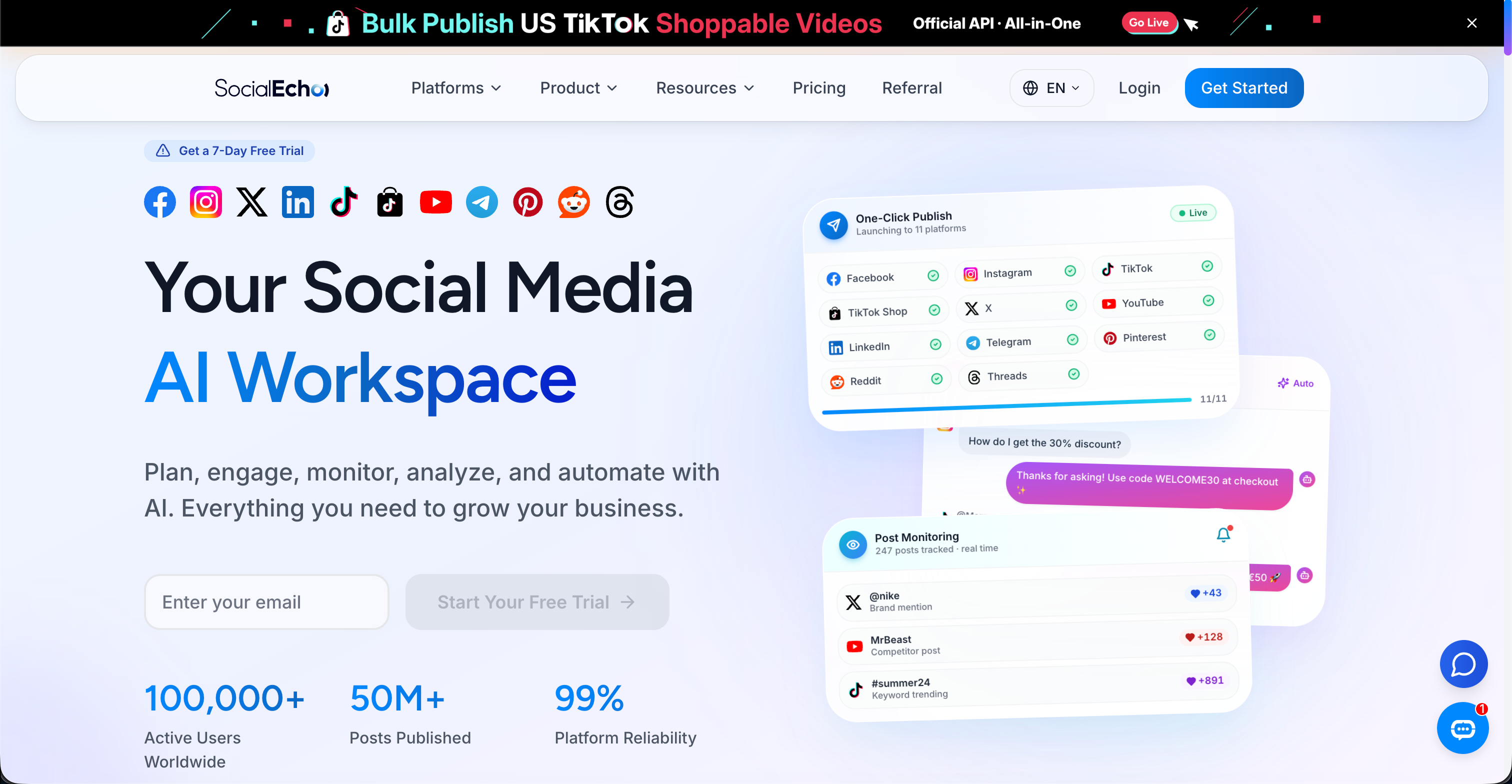 Who is this suitable for : Overseas brand teams that need to manage multiple platforms such as TikTok, TikTok Shop, Instagram, LinkedIn, and YouTube, and who also need AI content generation and social media monitoring capabilities.
Background in a sentence : SocialEcho is a full-fledged social media AI workbench for companies going global. It connects directly to 11 mainstream platforms via official OAuth—Facebook, Instagram , X, LinkedIn , TikTok , TikTok Shop , YouTube , Pinterest, Reddit, Telegram, and Threads—ensuring account security and not relying on third-party cookies.
The core difference between this and Later versions lies not in the scheduling experience on a single Instagram platform, but in the completeness of the multi-platform collaborative workflow. The AI creation module supports generating matching images and short videos from a single sentence, and the master copy can be automatically rewritten for different platforms with different tones and word counts—a step that required manual intervention in Later. TikTok Shop's product promotion videos and product cart management are integrated into the posting process, eliminating the need for e-commerce teams to use third-party tools; interaction management consolidates comments and private messages from 11 platforms into a single inbox, and AI automation can recognize comment sentiment and automatically reply according to rules, shortening the inquiry response window; social media monitoring continuously tracks competitor activities, KOL content, and keyword fluctuations.
For overseas e-commerce teams, the e-commerce operation solution integrates a closed loop from publishing to interaction to data processing. For multi-account matrix operators, the matrix creator solution supports batch scheduling for multiple accounts and competitor tracking. If your workflow is integrated with n8n, Zapier, or OpenClaw, the AI Agent API has open publishing and analysis interfaces that can be directly called.
Pricing : Free version 0 (with limited features); Basic version starts at 15/month (annual subscription, minimum of 5 accounts); Team version starts at 20/month (annual subscription, minimum of 5 accounts). Later Starter version 18/month includes 1 social media account bundle and 1 user; Growth version 40/month; Advanced version 80/month.
To be frank : if your work primarily focuses on visual content scheduling on Instagram alone, Later's feed grid preview and visual style confirmation are more intuitive than SocialEcho's. SocialEcho offers a wider range of features, but setting up multi-platform accounts initially requires a bit more time than Later.
The question is: If what you need is not multi-platform expansion capabilities, but rather content approval processes and management-level reporting for multi-department collaboration, are there more mature enterprise solutions?
Option 2: Hootsuite — A mature choice for in-depth reporting and enterprise-level collaboration
Suitable for : Large teams that require deeply customized reports, cross-departmental content approval processes, and enterprise-level platforms that cover a wide range of channels.
Hootsuite is one of the most established brands in social media management tools. Its reporting module supports highly customizable dimension combinations, and many brand marketing departments directly submit Hootsuite reports to their CMOs—the data is granular, and metrics can be broken down by channel and compared by time period. If you need to produce branded PDF data reports for management every month, Hootsuite's maturity in this area is a valuable indicator.
In terms of platform coverage, Hootsuite supports over 35 social media and content channels, making it suitable for brands operating simultaneously in multiple global markets. Regarding the content approval process, it supports a multi-level workflow: creator submission → supervisor approval → scheduled release. Every step is recorded during cross-departmental or cross-time zone collaboration, reducing communication costs.
Points to note : Hootsuite underwent a pricing increase in 2023. The Professional version now starts at 99/month (1 user, 10 accounts), and the Team version at 249/month. For a 2-3 person overseas operations team, the marginal benefit of this price largely depends on whether you actually use its enterprise collaboration features. Additionally, Hootsuite itself does not have native AI video generation capabilities; AI features for content production need to be supplemented through plugins.
Pricing : Professional starts at $99/month.
The $99/month entry barrier is a bit steep for small to medium-sized teams. If you value a lightweight and stable scheduling workflow and want to migrate your daily posting habits from Later at a low cost, then this tool is worth taking a look at.
Option 3: Buffer — A streamlined scheduling process and a lightweight option suitable for migrating from later stages.
Who is it suitable for : Small teams that need to publish content on multiple platforms on a regular schedule and share a content calendar within the team, but do not need in-depth AI creation or e-commerce integration.
Buffer is one of the more user-friendly social media scheduling tools, with a straightforward publishing process and a short workflow when adding posts in bulk, making it almost a zero-learning-cost tool. For teams accustomed to the Later visual scheduling interface, Buffer's workflow is somewhat similar—both emphasize "scheduling content into the calendar in advance and automatically publishing it at the appointed time."
It supports basic posting on major platforms such as Facebook, Instagram, X, LinkedIn, Pinterest, TikTok, YouTube, and Threads, and the Analytics module provides basic post performance data. If your core requirement is simply "posting content on time and checking the data," Buffer can reliably accomplish this.
Points to note : Buffer's AI features are primarily for text assistance and lack image or video generation capabilities. It does not support TikTok Shop, lacks social media monitoring, and doesn't have a dedicated module for unified comment management. Platform coverage (8 platforms) and LinkedIn functionality are relatively limited, which may lead to functional limitations for teams requiring in-depth multi-platform operations. If you are choosing between SocialEcho and Buffer, the SocialEcho vs Buffer comparison page provides a feature-by-feature breakdown for your reference.
Pricing : Free version (3 channels, maximum 10 posts per channel); Essentials 5/channel/month (annual subscription), Team 10/channel/month (annual subscription). The monthly fee for 5 accounts is approximately $25/month (Essentials).
Buffer makes the publishing process very clean, but if you are more concerned about content data and competitor dynamics—the interaction rate trend of each post, the posting patterns of competitor accounts—the data analysis dimensions of this tool are worth paying more attention to.
Item 4: Metricool — A lightweight, multi-platform tool known for its data analysis capabilities.
Who is this product suitable for : Small and medium-sized teams that value content data review and competitor analysis and want to use more than 15 platforms within a reasonable price range.
In this price range, Metricool offers relatively comprehensive data analytics . Its competitor tracking feature continuously monitors competitor accounts' posting frequency, engagement rates, and follower trends, providing valuable insights for content creation. It covers over 15 platforms, including not only the usual Facebook, Instagram , TikTok, and LinkedIn, but also YouTube, Pinterest, and Twitch, making it suitable for teams managing diverse content sources.
Its posting time suggestion feature is also frequently mentioned: the system provides recommended posting time windows for each platform based on historical data. If you haven't yet established your own posting time pattern, you can also use SocialEcho's free tool for optimal posting times to get a feel for the basic rhythm logic of each platform.
Points to note : Metricool's AI-powered content creation primarily focuses on text generation, lacking image or video generation capabilities; visual content production still requires external tools. It lacks TikTok Shop integration, making it unsuitable for e-commerce sales scenarios. Its social media monitoring functionality is limited, hindering in-depth tracking of KOLs or competitors.
Pricing : Free version available; paid Starter version starts at $22/month (annual billing).
Metricool's multi-platform data analytics is very useful, but if you are an agency that serves multiple brand clients, you will need a different logic for multi-brand permission isolation and client-oriented report output.
Item 5: Agorapulse — A mature solution for multi-brand management by e-commerce agencies.
Who is this suitable for : Social media management agencies that need to manage multiple brand client accounts, strictly isolate permissions, and provide reports that can be directly sent to clients for review.
Anyone who works in e-commerce operations knows that generating client reports at the end of the month is the most time-consuming part—each client has different focuses, some need interaction details, some need fan growth, and some need competitor comparisons. Manually piecing these together often takes up most of the day. Agorapulse's report module supports generating reports individually for each brand account, and these reports can be directly exported as PDFs for clients to review, reducing the intermediate processing steps.
The Unified Inbox can be switched by brand account, ensuring messages from different clients are not mixed together. Team member permission allocation supports fine-grained settings: clients' read-only view and internal operations' edit permissions can be set separately, suitable for agencies to control clients' content modification permissions.
Regarding social media outsourcing scenarios: If you are doing multi-brand outsourcing on SocialEcho, the multi-brand isolation and dual-role permission functions are also built in. With AI automation and a unified inbox, the overall workflow can be highly centralized. If there are overseas e-commerce brands among the clients, the management of TikTok Shop can also be followed up simultaneously.
Important points to note : Agorapulse's pricing is based on a per-user, tiered system, with larger teams incurring higher monthly fees. The Standard plan is 49 per user per month, so a team of 5 would cost 245 per month. It lacks AI video generation and does not support TikTok Shop's e-commerce features, limiting its reach to e-commerce clients.
Pricing : Starting from Standard $49/user/month.
Agorapulse has a mature collaboration system, but 49/user/month seems a bit heavy for a team of 1-2 people. If you're just starting out with multi-platform operations and want to keep your budget under 15/month, this tool is a stable starting option.
Item 6: Publer — A lightweight starting point for teams with limited budgets
Who is this suitable for : Individuals or small teams of 2-3 people who are just starting out with multi-platform content scheduling and want to keep the monthly fee under $15.
Publer enjoys a stable reputation among lightweight tools, boasts a clean interface, and offers comprehensive basic scheduling functionality, supporting mainstream platforms such as Facebook, Instagram, X, LinkedIn, and TikTok. Its "recurring posting" feature allows evergreen content to be set for recurring cycles, eliminating the need for repeated manual scheduling, making it suitable for small teams with relatively fixed content.
AI copywriting assistants can help you quickly generate initial drafts of posts. They have a low learning curve and are suitable for teams without dedicated content planners to get started. For teams that have just switched from Later mode and mainly need to publish regularly, Publer has a low learning curve and a smooth workflow transition.
Points to note : Publer's team collaboration features are relatively basic, lacking in-depth competitor monitoring or social media listening capabilities. It does not support TikTok Shop product placement and lacks AI image or video generation modules. It covers approximately eight platforms, and its functionality may become limited as the account size grows.
Pricing : Professional starts at $12/month (5 social media accounts, 1 user).
Publer is affordable and offers a sufficiently stable publishing process. However, if you have a large content library and want your content to not just sink to the bottom after a single post, but rather generate continuous exposure through a loop, then this tool's design philosophy is more suitable.
Item 7: SocialBee — A content loop tool to keep evergreen content in the spotlight.
Suitable for : Content teams with a large content library, a large number of evergreen articles or videos, and who want their historical content to generate traffic continuously rather than being consumed in a one-time manner.
SocialBee's core design is a "content categorization cycle": you categorize posts into different content buckets based on their themes, and the system publishes them alternately according to the set category order and frequency, ensuring that different types of content can be exposed in rotation, rather than just pushing the newest few. For brand bloggers, knowledge-based paid content teams, or teams that do content marketing long-term, this logic can give existing content a longer lifespan, eliminating the need to constantly produce new content to maintain account activity.
It also supports AI-assisted copywriting, which can generate initial drafts of posts based on content themes. Combined with platform distribution and basic posting data viewing, it forms a relatively lightweight content operation workbench. The platform covers 9 platforms including Facebook, Instagram, X, LinkedIn, and TikTok.
Points to note : SocialBee's AI-generated content is primarily text-based, lacking image or video generation capabilities. It does not support TikTok Shop, nor does it offer social media monitoring or competitor tracking features. If your core need is to continuously produce new visual content and accompanying short video materials, rather than reusing existing content, SocialBee's design philosophy may significantly deviate from your desired direction.
Pricing : Bootstrap starts at $29/month (5 social media accounts).
Postscript to the comparative review
After testing these seven tools, one conclusion is worth stating: Later's problem isn't that it's "unusable," but rather that it's "born for Instagram." It focuses heavily on Instagram's Feed grid preview, Stories posting, and Link in Bio, which is a genuine strength. However, when your business requires TikTok's content creation logic, a closed-loop TikTok Shop sales system, cross-platform competitor monitoring, or AI-generated video content, Later's design limitations become apparent.
In this list, there aren't many tools that truly extend beyond "publishing" to "post-publishing. " SocialEcho is a full-fledged social media AI workbench designed for brands and e-commerce teams going global. It supports unified management across 11 platforms, with built-in AI creation (one-sentence generation of images/videos/copy), content publishing (batch scheduling and cross-platform distribution), interaction management , social media monitoring , and data analysis— all without the need for additional plugins. Among the seven tools reviewed in this article, it's one of the few options that simultaneously covers AI video generation and TikTok Shop product listings.
Hootsuite has a more mature reporting system and enterprise collaboration features, but its price is more than 5 times that of SocialEcho; Buffer and Publer are suitable for lightweight teams with scheduling priorities, but their feature coverage is narrower; Metricool's data analysis is valuable at this price point, but its AI content production capabilities are limited; Agorapulse and SocialBee each have their own focused designs for outsourced operation collaboration and content recycling.
The essence of tool selection is to find the tool that best matches your current stage , not the one that covers the most functional dimensions.
How to choose: Quick judgment in 5 scenarios
By now, you should be able to roughly identify which scenario applies to you. If you're still struggling, here's a direct suggestion for five typical scenarios:
For overseas brand operations teams (operating on multiple platforms including TikTok, TikTok Shop, Instagram, and LinkedIn) : SocialEcho's platform coverage and feature combination are well-suited for this scenario. The overseas brand marketing solutions page provides more specific scenario details, which can be used as a reference.
For individual creators or small brands whose core focus is on Instagram visual content : Later has a clear focus on Instagram Feed grid preview, Reels schedule, and Link in Bio. If Instagram is your main platform and you don’t plan on large-scale platform expansion in the near future, the Later experience remains smooth.
Large enterprises require multi-department approval processes and multi-level reporting : Hootsuite's enterprise reporting and content approval processes are a better fit, and while it is more expensive, it has a mature support system for large clients, making it suitable for teams that report to the CMO or board of directors.
Agorapulse is an agency that manages multiple brands simultaneously . They have extensive experience in multi-brand access control and client reporting. If a client is an overseas e-commerce brand that needs TikTok Shop management, SocialEcho's social media management solutions can be a useful supplement.
For teams with a large content library and a desire for continued exposure of historical content : SocialBee's content bucket loop logic is specifically designed for this scenario, making it suitable for teams that treat content operation as a long-term accumulation rather than chasing new content every week.
Before expanding your platform, use these free tools to explore it first.
Before officially switching tools, these free tools can help you get a feel for the actual workload of operating on multiple platforms without registering or paying:
- Planning to launch on TikTok but unsure when to post for the best results? → Optimal Posting Time : Comparing the platform rhythms of Instagram and TikTok, the optimal posting window often differs between the two platforms. Establish a baseline before choosing tools.
- Want to sync existing Instagram content to TikTok or LinkedIn, but manual adaptation is too time-consuming? → Cross-platform AI rewriting : First, experience the actual workload of cross-platform rewriting before deciding whether you need a new tool that can automatically rewrite for each platform.
- Expanding from one platform to three, it's unclear how much the total weekly posting volume will increase → Posting frequency planning : First, calculate the frequency plan for each platform so you know which feature level you need when choosing tools.
- Before switching tools, if you want to keep baseline data on your current account performance, use the Engagement Rate Calculator : record your current engagement rates on each platform so you have comparable figures after switching tools.
Frequently Asked Questions
Q: Which platforms does Later support? What are the limitations?
Later's platform coverage centers on Instagram and Pinterest, while also supporting basic posting features for Facebook, X, TikTok, LinkedIn, YouTube, and Threads. However, its support for TikTok Shop integration, deeper LinkedIn features, YouTube long video scheduling, and competitor monitoring is relatively limited. Its experience with Instagram visual grid preview, Stories scheduling, and Link in Bio management is among the most complete in this price range.
Q: Are there any later alternatives that support TikTok Shop?
Currently, few mainstream social media management tools natively support TikTok Shop. SocialEcho's TikTok Shop feature supports product carting and sales video management, allowing content publishing, comment replies, and the TikTok Shop sales process to be completed on a single platform, making it suitable for overseas teams with e-commerce sales needs. The other six tools mentioned in this article do not yet support native integration with TikTok Shop.
Q: Does Later have an AI video generation function?
Later currently offers AI-assisted text generation, but lacks native AI image or video generation capabilities. If you need to generate short video materials or images using AI before publishing, you'll still need to use external tools to import them into Later. SocialEcho's AI creation module supports generating images and short videos from a single sentence, which can then be directly imported into the publishing editor without the intermediate import step.
Q: What alternative tools are suitable for teams going global?
This depends on the focus of overseas operations. If it's a multi-platform content matrix plus TikTok Shop e-commerce, SocialEcho's feature set is highly adaptable to overseas scenarios; if a large team needs in-depth reporting and multi-department collaboration, Hootsuite is more suitable; if the core platform is Instagram and there are no plans for large-scale expansion in the short term, Later itself is still a viable option; if the team is small and has a limited budget, Buffer or Publer are lightweight starting points.
Q: What is the difference between SocialEcho and Later?
The two apps have different design motivations. Later is Instagram-centric, focusing on a visual scheduling experience and offering a complete Link in Bio feature, making it suitable for visual content creators whose primary platform is Instagram. SocialEcho's design has broader coverage: unified management across 11 platforms, built-in AI image/video/copy generation, TikTok Shop sales functionality, social media monitoring and competitor tracking, and AI-automated comment replies. In terms of pricing, SocialEcho's basic version is 15/month (annual payment, 5 accounts), while the Later Starter version is 18/month but only includes one social media account bundle and one user.
Q: Is Later suitable for brands going global to manage social media across multiple platforms?
If Instagram is your current core platform and there are no plans for large-scale expansion in the near future, the Instagram experience on Later is relatively complete and can run stably. However, if your business also needs to cover TikTok, LinkedIn, or YouTube, or has e-commerce sales needs through TikTok Shop, the platform boundaries of Later will be more obvious. You can first use the free version of SocialEcho to test multi-platform workflows and determine the necessity of switching before making a decision.
Q: Which tools support social media monitoring and competitor tracking?
Of the seven tools reviewed in this comparison, SocialEcho offers comprehensive social media monitoring capabilities, supporting KOL monitoring, competitor account tracking, and keyword monitoring, and allows for the configuration of sentiment fluctuation alerts. Hootsuite and Metricool have limited competitor analysis capabilities. Buffer, Agorapulse, Publer, and SocialBee offer limited or no support for social media monitoring. If competitor monitoring is one of your core needs, this dimension deserves separate evaluation during the selection process.
Conclusion
Later spent years making its Instagram scheduling quite smooth, and its focus in this area is genuine. However, in 2026, it's difficult to handle everything in overseas social media operations with just one platform or one focused tool—when multiple lines are running simultaneously, such as the TikTok matrix, TikTok Shop e-commerce, YouTube long-form content, and LinkedIn B2B articles, the multi-platform synergy of tools becomes a key variable.
Expanding across multiple platforms isn't something that can be done overnight. The key is finding a tool that can evolve with your business: today focus on Instagram, tomorrow add TikTok, and the day after integrate TikTok Shop—without having to switch platforms every step of the way. If you're still in the evaluation phase, SocialEcho has a free version you can try out first. It doesn't require a credit card, supports integration with 11 platforms, and allows you to test basic capabilities like AI-generated content, TikTok Shop product videos, and social media monitoring within the free version— start using it for free !
This article is based on the publicly available pricing and feature page information of various tools on their official websites in July 2026. Prices may be updated at any time, so it is recommended to check the latest price on the tool's official website.
;}.cls-2{fill:%230868f7;}.cls-3{fill:url(%23未命名的渐变_44);}.cls-4{fill:%23333;}%3c/style%3e%3clinearGradient%20id='未命名的渐变_8'%20x1='33.73'%20y1='100.61'%20x2='-0.03'%20y2='-1.06'%20gradientUnits='userSpaceOnUse'%3e%3cstop%20offset='0'%20stop-color='%237ae9fb'/%3e%3cstop%20offset='0.67'%20stop-color='%232b90f8'/%3e%3cstop%20offset='1'%20stop-color='%230868f7'/%3e%3c/linearGradient%3e%3clinearGradient%20id='未命名的渐变_44'%20x1='27.86'%20y1='18.67'%20x2='68.36'%20y2='22.22'%20gradientUnits='userSpaceOnUse'%3e%3cstop%20offset='0'%20stop-color='%235ac7f2'/%3e%3cstop%20offset='1'%20stop-color='%230868f7'/%3e%3c/linearGradient%3e%3c/defs%3e%3cpath%20class='cls-1'%20d='M29,28.74V81.91l-9.51-3.68v0L8.52,74A7.17,7.17,0,0,1,4,67.32V24.54A3.76,3.76,0,0,1,9.08,21Z'/%3e%3cpath%20class='cls-2'%20d='M68.09,78.07a13.15,13.15,0,0,1-17.9,12.06L29,81.91h0V28.74L50.19,37A13.17,13.17,0,0,0,68.08,25.3h0Z'/%3e%3cpath%20class='cls-3'%20d='M68.08,25.3a13.19,13.19,0,0,1-6.73,10.87A13.09,13.09,0,0,1,50.19,37L29,28.74V6A3.76,3.76,0,0,1,34.1,2.52l25.59,9.91A13.22,13.22,0,0,1,68.08,25.3Z'/%3e%3cpath%20class='cls-4'%20d='M129.06,81.76a4.33,4.33,0,0,1-3.19-1.31,4.4,4.4,0,0,1-1.31-3.24V56.86H97.65V77.21a4.36,4.36,0,0,1-1.35,3.2A4.68,4.68,0,0,1,93,81.76a4.32,4.32,0,0,1-3.19-1.31,4.37,4.37,0,0,1-1.32-3.24V27.27A4.58,4.58,0,0,1,89.83,24a4.59,4.59,0,0,1,7.82,3.27V48.15h26.91V27.27A4.58,4.58,0,0,1,125.91,24a4.59,4.59,0,0,1,7.82,3.27V77.21a4.37,4.37,0,0,1-1.36,3.2A4.65,4.65,0,0,1,129.06,81.76Z'/%3e%3cpath%20class='cls-4'%20d='M163.77,81.66c-6.57,0-11.76-1.92-15.44-5.7s-5.54-9.07-5.54-15.74a26.76,26.76,0,0,1,2.09-10.43,17.72,17.72,0,0,1,6.67-8.06,19.15,19.15,0,0,1,10.68-2.95,19,19,0,0,1,10.46,2.8,18.7,18.7,0,0,1,6.55,7.36,22.53,22.53,0,0,1,2.36,10.28A4.51,4.51,0,0,1,177,63.77H152.23a10.8,10.8,0,0,0,3.49,6.65c2,1.68,4.88,2.52,8.66,2.52a22.25,22.25,0,0,0,7.54-1.21c.74-.3,1.55-.67,2.37-1.07a3.75,3.75,0,0,1,1.84-.4,4.09,4.09,0,0,1,3,1.15,4,4,0,0,1,1.12,3,4.38,4.38,0,0,1-2.58,3.82,32.34,32.34,0,0,1-6.36,2.61A28.67,28.67,0,0,1,163.77,81.66ZM172.4,55.9a9.72,9.72,0,0,0-1.63-4.56A9.9,9.9,0,0,0,167,48a10.38,10.38,0,0,0-4.64-1.14,12,12,0,0,0-4.77,1.06,9.54,9.54,0,0,0-4.89,5.66,11.78,11.78,0,0,0-.51,2.3Z'/%3e%3cpath%20class='cls-4'%20d='M193,81.64a4.49,4.49,0,0,1-4.51-4.55V27.28A4.58,4.58,0,0,1,189.84,24a4.48,4.48,0,0,1,3.28-1.36A4.36,4.36,0,0,1,196.35,24a4.46,4.46,0,0,1,1.31,3.31V77.09a4.34,4.34,0,0,1-1.35,3.2A4.67,4.67,0,0,1,193,81.64Z'/%3e%3cpath%20class='cls-4'%20d='M263.79,81.71a5.7,5.7,0,0,1-4.2-1.74,5.76,5.76,0,0,1-1.73-4.19V27.37a4.58,4.58,0,0,1,1.35-3.27A4.59,4.59,0,0,1,267,27.37V72.53h24a4.58,4.58,0,0,1,3.27,7.82A4.66,4.66,0,0,1,291,81.71Z'/%3e%3cpath%20class='cls-4'%20d='M424.48,81.74a4.71,4.71,0,0,1-2.71-.88,5.43,5.43,0,0,1-1-1l-.07-.09-12.41-17-5.41,5v9.44a4.31,4.31,0,0,1-1.36,3.19,4.66,4.66,0,0,1-3.3,1.36A4.29,4.29,0,0,1,395,80.42a4.36,4.36,0,0,1-1.32-3.23V27.37A4.58,4.58,0,0,1,395,24.1a4.52,4.52,0,0,1,6.58.12,4.54,4.54,0,0,1,1.24,3.15V56.31l17.72-16.38.05,0a4.8,4.8,0,0,1,2.94-1.11,4.4,4.4,0,0,1,3.27,1.2,4.57,4.57,0,0,1,1.2,3.27,4.44,4.44,0,0,1-.77,2.33,7.45,7.45,0,0,1-1.43,1.65l-11,9.64,13.34,17.68a5,5,0,0,1,1,2.71,4.12,4.12,0,0,1-1.36,3.24A4.64,4.64,0,0,1,424.48,81.74Z'/%3e%3cpath%20class='cls-4'%20d='M317.93,81.76a21.5,21.5,0,1,1,21.17-21.5A21.37,21.37,0,0,1,317.93,81.76Zm0-34.1a12.61,12.61,0,1,0,12.42,12.6A12.52,12.52,0,0,0,317.93,47.66Z'/%3e%3cpath%20class='cls-4'%20d='M212.18,101.22a4.12,4.12,0,0,1-3.05-1.26,4.17,4.17,0,0,1-1.26-3.1V43.34a4.37,4.37,0,0,1,1.3-3.14,4.26,4.26,0,0,1,3.13-1.3,4.19,4.19,0,0,1,3.1,1.26,4.32,4.32,0,0,1,1.26,3.16,20.77,20.77,0,0,1,13-4.54,21.51,21.51,0,0,1,0,43,20.51,20.51,0,0,1-13-4.57V96.86a4.15,4.15,0,0,1-1.3,3.06A4.5,4.5,0,0,1,212.18,101.22Zm17.43-53.63c-6.23,0-12.93,4.11-12.93,12.72a12.73,12.73,0,0,0,25.46,0A12.71,12.71,0,0,0,229.61,47.59Z'/%3e%3cpath%20class='cls-4'%20d='M365.76,81.76a21.5,21.5,0,1,1,21.18-21.5A21.37,21.37,0,0,1,365.76,81.76Zm0-34.1a12.61,12.61,0,1,0,12.42,12.6A12.52,12.52,0,0,0,365.76,47.66Z'/%3e%3c/svg%3e)