
Can You Register Telegram with a Mainland Chinese Phone Number? +86 Risks, SMS Code Myths, and an Account Security Checklist
By Li Jing — covering Telegram and global community ops for cross-border teams
Li manages social operations for a home-goods brand selling overseas. Last Wednesday, her manager dropped a one-liner on her: "We need a Telegram group for our overseas users next month — go ahead and set up the account first." She opened Telegram, typed in the company's +86 number, and got stuck at the verification step. Three minutes went by with no text. She tried again later — still nothing. She started searching forums and chat groups for "Telegram mainland China number can't register," and found a mess of conflicting answers: some said mainland numbers simply can't register at all, others said you can but have to pay, and a few claimed that even a successful registration gets banned quickly. Li had run into a wall that nearly every operator opening a team's first Telegram account eventually hits — not because the product need is unclear, but because two questions are unavoidable: can I even register, and is it safe once I do? The information online is scattered enough that nobody gives her a straight answer.
Bottom line: a +86 number can likely register a Telegram account, but verification code delivery speed and success rates are inconsistent. What's actually worth your team's attention isn't "can I register" — it's seeing the paid-SMS-code rumors for what they are, and locking down account security and handoffs once you're in.
- Mainland Chinese phone numbers can register a Telegram account — Telegram hasn't blacklisted +86 numbers at the product level. The real bottleneck is international SMS routing, not the account itself.
- The "paid verification code" story comes from a handful of gray-market SMS-relay services. Telegram's official verification codes are free for regular users.
- The real risks of registering with a +86 number come down to three things: a higher chance of triggering two-step verification, the long-term stability of the number itself, and handing the account off within the team.
- Numbers from Hong Kong/Macau/Taiwan, Southeast Asia, and Europe/North America tend to deliver verification codes more reliably than +86 numbers, though no number is completely immune to delays.
- Once you're registered, nailing down two-step verification, checking active sessions, and tightening privacy settings matters more than agonizing over which number to use.
One quick note on where this comes from: the registration feasibility comparison and account security checklist in this piece are built on SocialEcho, an AI-powered social media workspace for cross-border teams. It connects officially and compliantly to 11 platforms, including Telegram, TikTok, and Instagram, bringing publishing, engagement, listening, and analytics into a single dashboard — a good fit for teams using Telegram to run overseas communities and customer support.
Can You Register Telegram with a Mainland Chinese Phone Number?
Short answer: yes. Telegram hasn't blacklisted mainland Chinese phone numbers at the product level, so a +86 number can, in theory, complete the registration flow. The friction comes from how domestic carriers handle international SMS routing — not from any restriction on the account itself.
Telegram sends verification codes either by SMS or through its own in-app messaging channel. That text message has to travel from an overseas SMS gateway, cross international interconnection points, land at one of China's three major carriers' SMS centers, and finally get pushed to the user's phone. A delay, filter, or block at any point along that chain produces the exact same symptom on the user's end: the code just never shows up. That's also why the same +86 number can work fine for one person on the first try and fail for someone else after five or six attempts — the account isn't broken, the message just got stuck somewhere along the way.
So the more accurate way to put it: registering Telegram with a +86 number isn't technically off the table, but success rates and delivery times are inconsistent, and there's more luck involved than with most other international apps. If your team plans to run a Telegram account long-term, it's worth understanding the risks upfront rather than gambling on whether the code will show up each time — the Telegram Registration & Account Security Checker can run a quick check on your current number or region, flagging feasibility and known risk factors instead of leaving it to trial and error.
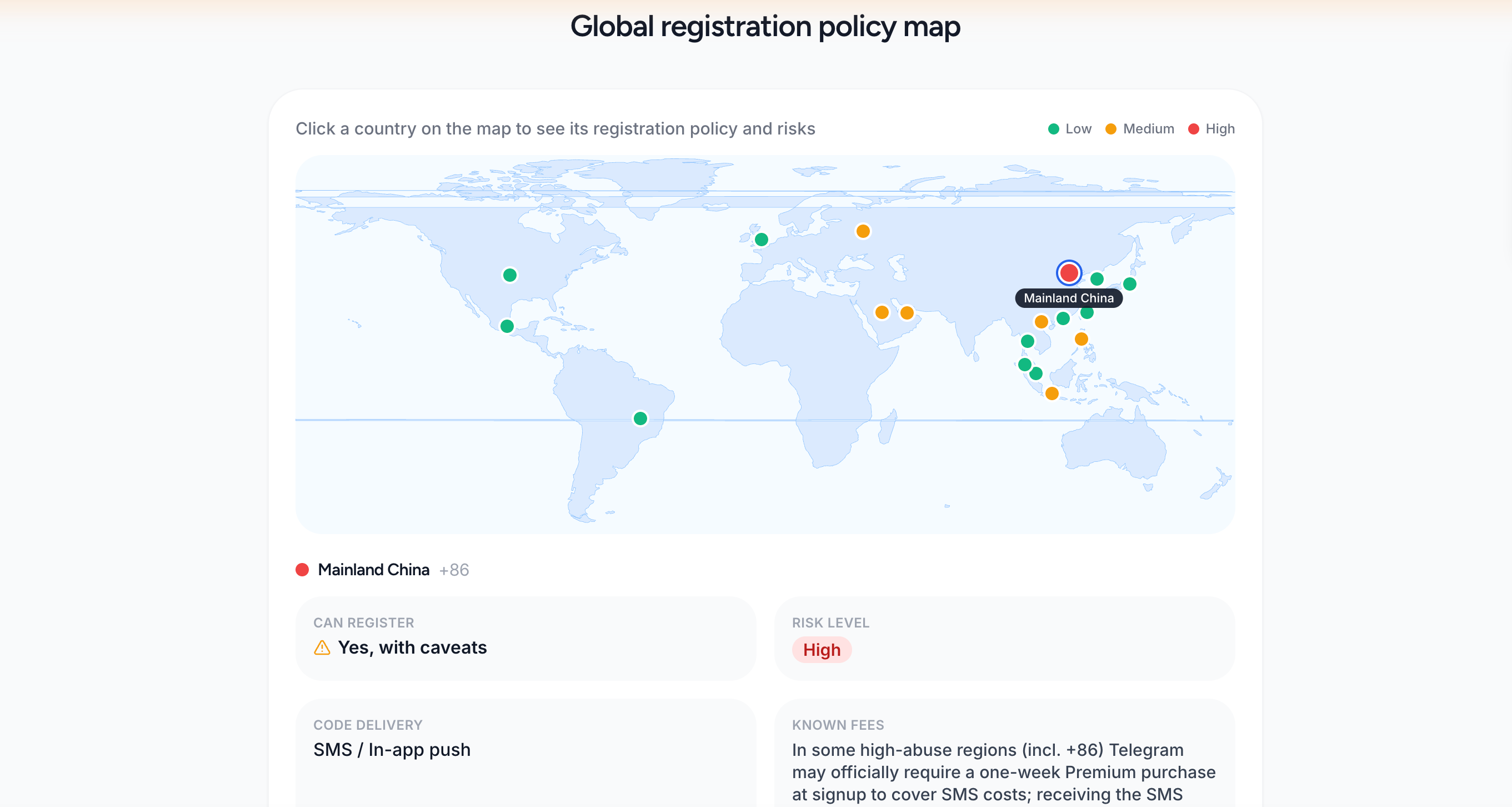
Does Telegram Really Charge for Verification Codes?
Short answer: no. Telegram's official verification code is a basic part of account registration, and there's no line item anywhere that charges regular users a separate "code fee." The claim that "you don't get a code unless you pay" comes from a handful of gray-market SMS-relay services — it's not an official Telegram policy.
This is the rumor Li kept running into on forums, and it's the one that made her most hesitant. It's worth pulling apart, because it actually conflates two different things.
The first is Telegram's own verification code service.
Telegram's registration verification code is a core part of the product, and there's nothing in the official terms about charging regular users a separate "verification code fee." What people often confuse this with is Fragment, Telegram's official platform for auctioning usernames and handling certain number-related certifications. That's a completely different scenario from "receiving a code at sign-up," and the two shouldn't be conflated.
The second is the cost of domestic SMS routing. Carriers do incur real settlement costs on international SMS interconnection, and some third-party "SMS relay" platforms or gray-market channels repackage that cost as "pay up and you'll get your code." These services sit right at the edge of platform rules and SMS compliance — this piece doesn't recommend using them, and won't go into how they work. Accounts registered through these channels have a non-trivial chance of running into feature restrictions or being flagged for extra verification down the line, which just pushes the risk further out rather than solving it.
For teams running an account the normal way, the real reason a code doesn't arrive is almost always the international SMS delay or filtering described above — not "no payment, no code." If you're not getting a code, first check that you have signal, make sure you don't have an SMS-blocking app running, and wait a few minutes before retrying. That's a far more reliable fix than turning to a paid SMS relay service.
What Are the Risks of Registering with a +86 Number?
Short answer: even if the code arrives without a hitch and the account registers successfully, running a Telegram account long-term on a +86 number still carries three known risks worth preparing for in advance — a higher chance of triggering two-step verification, the stability of the number itself, and handing the account off within the team.
- Higher chance of triggering two-step verification. When Telegram detects an unusual login environment, frequent device switching, or a burst of activity such as adding contacts or joining groups in a short window, it asks for extra verification. Mainland numbers don't have an edge in these risk models, so if your team starts adding people or sending messages in bulk right out of the gate, you're more likely to trip that check.
- Stability of the number itself. A phone number is effectively a long-term asset tied to the team. If it stops working later — a carrier policy change, an employee leaving and canceling their line, whatever the reason — the Telegram account could get forcibly unlinked or need re-verification. That's especially costly once the account has already built up group members and chat history.
- Team handoff risk (easy to overlook). If a Telegram account is tied to one person's personal phone number, that one person effectively controls the password and the ability to receive verification codes. If they leave the company or switch phones, handing the account back to the team gets messy fast. This is really an internal process risk more than a "which region's number" problem, but the two tend to surface together.
Taken together, these risks mean that a +86 number "working" and being "suited to long-term team operations" are two different things. The former is likely true; the latter takes some extra prep on the team's part.
Which Region's Number Is More Reliable?
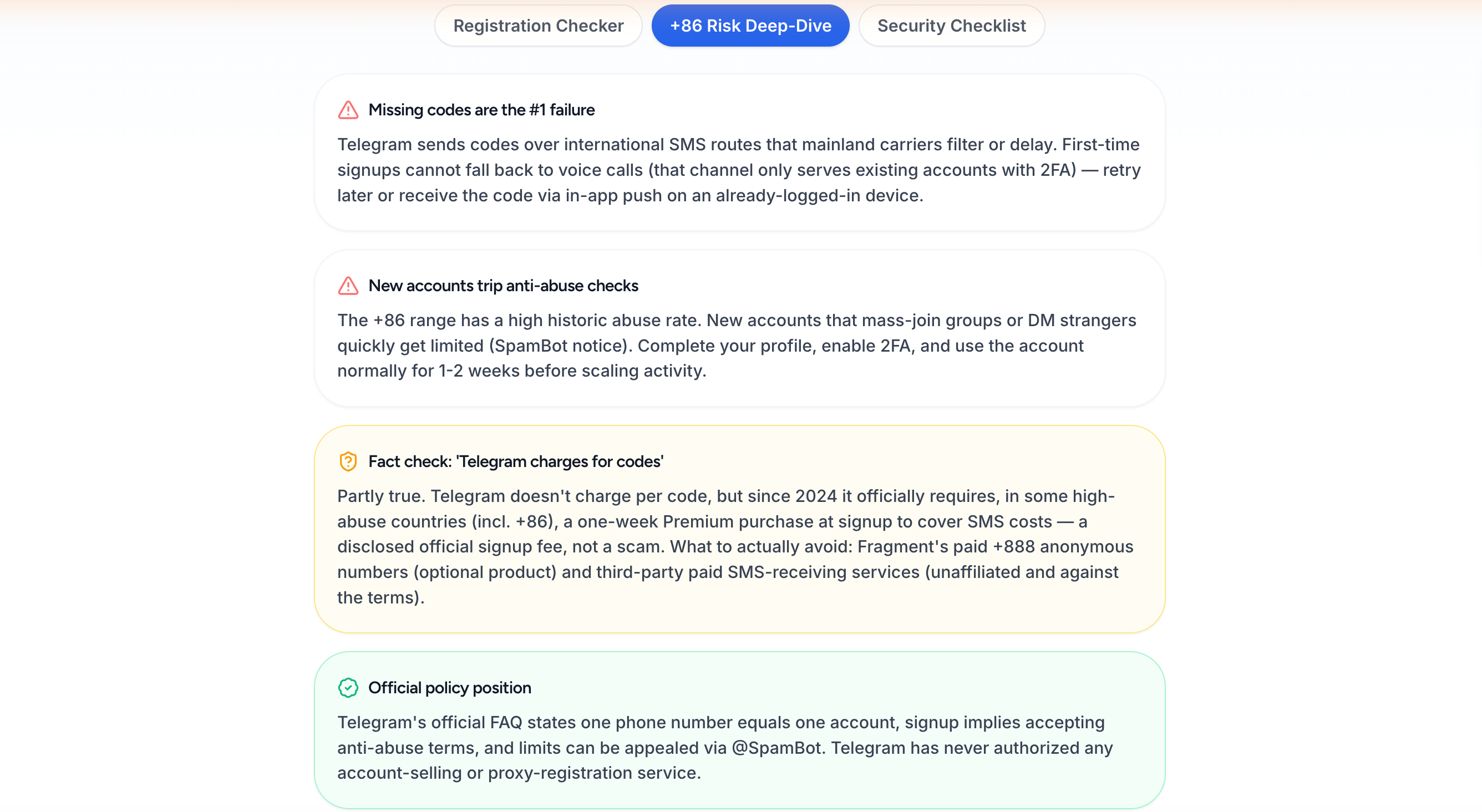
Short answer: no number is completely risk-free, but numbers from Hong Kong/Macau/Taiwan, Southeast Asia, and Europe/North America generally deliver verification codes faster and more reliably than mainland +86 numbers. Where your team actually operates matters more than where the number is registered.
The table below lines up the common regional options so your team can compare quickly:
| Region | Can You Register? | How the Code Arrives | Risk Level | Recommendation |
|---|---|---|---|---|
| Mainland China (+86) | Yes, but delivery is inconsistent | Mainly SMS, routed through an international gateway | Medium | Fine as a stopgap; for long-term team use, pair it with a pre-registration check and a post-registration security review |
| Hong Kong / Macau / Taiwan | Yes, usually smooth | SMS / in-app message | Low–Medium | A good first choice if your team has a branch or partner in the region who can provide a number |
| Southeast Asia (e.g., Singapore, Malaysia) | Yes | SMS / in-app message | Low–Medium | Suitable if your team has local operations or a number it can keep using long-term |
| Europe / North America | Yes | SMS / in-app message | Low | Suitable if your team operates there long-term and can keep using the number continuously |
| Unverified relay/virtual numbers | Technically possible to register | Relies on third-party gray-market services | High | Not recommended; this piece won't go into how these work |
Note: the risk levels above are relative judgments based on common knowledge and publicly observed platform behavior, not precise statistics. Any individual number can still run into an occasional delayed code.
There's no one-size-fits-all answer here, since a number's reliability ties into your team's location, target markets, and available resources — but a few dimensions are worth weighing.
One is the maturity of international SMS interconnection. Broadly speaking, numbers from Hong Kong/Macau/Taiwan and from certain countries in Southeast Asia and Europe/North America tend to deliver verification codes faster and more reliably than mainland numbers, which has to do with how those regions' SMS gateways interconnect with mainland China's network. But "more reliable" doesn't mean "immune" — every number can hit an occasional delay.
Another is your team's actual operating footprint. If your team already has an overseas branch, or staff with devices and numbers they can use long-term, registering with a local number is more sustainable than borrowing an unfamiliar number for one-time use. What matters is whether the team can manage the account reliably over time — not just whether registration succeeds once.
A dimension that's often overlooked is whether your team plans to run multiple Telegram accounts as part of a content-distribution or owned-audience setup down the line. If you're only opening one customer support or community account, number selection is straightforward. But if the team plans to run several accounts at once for content distribution, the choice of number region should factor into your broader account security strategy — for instance, whether to use numbers from different regions to keep accounts from being linked together and flagged as a cluster. There's a lot to weigh here, so it's worth running your candidate number or region through the Telegram Registration & Account Security Checker before registering, to see the known feasibility and risk flags ahead of time — that's a lot cheaper than fixing it after the fact.
How Do You Audit Account Security After Registering?
Short answer: getting the account registered is only step one — a lot of teams trip up on neglecting maintenance afterward. Account security review breaks down into four areas — two-step verification, session management, privacy settings, and handoff records — which adds up to roughly ten checklist items.
- Check whether two-step verification (the extra login password) is turned on. Even if the phone number or code leaks, no one gets in without this password — it's one of the highest-value steps you can take, yet plenty of teams skip it to save time.
- Confirm the recovery email tied to two-step verification is linked and accessible, so you're not locked out if the password is forgotten.
- Open the active sessions list and check, one by one, which devices are currently logged into the account.
- Log out any device that shouldn't still be connected — it's common for a former employee's phone to still be logged into the company account after they've left.
- Check that the username, bio, and profile photo line up with how the team wants to present itself externally, especially if the account represents the brand.
- Check the "who can see my phone number" privacy setting — the default is often more open than teams expect.
- Check the "who can add me to groups" privacy setting, so strangers can't add the account to groups en masse.
- Keep a simple internal record of which number the account is registered under and who's responsible for maintaining it day to day.
- Note where the two-step verification password is stored in that same record. Plenty of experienced teams essentially manage this with a shared spreadsheet — but without one, regaining control of an account during a messy handoff can be genuinely painful.
- Watch for Telegram's alerts about logins from a new location or other unusual activity, and verify right away that it was actually you.
- Put this whole checklist on a recurring cadence — quarterly, for example — rather than running through it once at registration and never again.
Once you've run through this checklist, if your team wants to keep an eye on how the account performs on Telegram long-term — unusual comments, a flood of DMs, or a unified view of engagement across platforms — Engagement Management can pull comments and DMs from Telegram and other social platforms into a single inbox. That's a lot more efficient than opening each app separately every day, and it makes it easier to catch early signs of unusual activity.
Is It Compliant for Cross-Border Teams to Use Telegram for Support and Community?
Short answer: yes. Telegram doesn't impose extra restrictions on businesses using it for customer support or community management. What teams need to watch for are risk-sensitive operational patterns like mass-adding contacts or blasting promotional messages — not whether Telegram itself is off-limits.
From a platform-rules standpoint, registering through official channels, following Telegram's terms of service, and avoiding mass, unsolicited adding and advertising are all normal, permitted ways to run support and community operations. Plenty of cross-border brands use Telegram as a low-cost, high-reach channel for owned-audience communities, and that use case holds up.
The compliance points that actually matter have more to do with how you operate than whether you can use the platform at all. Automated bulk friend-adding and indiscriminate marketing blasts, for example, are the kinds of behavior that tend to trip risk controls and get features restricted. Likewise, if a support account is logged into frequently from different devices or shared among multiple people using the same password, that increases the odds of an unusual login getting flagged as risky. These are operational details to keep in mind — not a reason to conclude that cross-border teams can't use Telegram at all.
If your team wants to track competitor activity or industry KOL content on Telegram down the line, Telegram Competitor Monitoring and Telegram KOL Monitoring turn what used to be manual group-watching into structured, tracked data. If you're more focused on your own account's growth and engagement, Telegram Analytics gives you a clearer read on group and channel activity and engagement trends. Both are second-step considerations once the account is up and running — the first step is still getting registration and account security right.
Frequently Asked Questions
Q1: What should I do if I keep not receiving the verification code when registering Telegram with a +86 number?
First, confirm you have a normal signal and no SMS-blocking app running, then wait a few minutes and try again. If several attempts in a row still don't work, consider switching networks or using another number your team can access long-term. Going straight to a paid SMS relay service isn't recommended — accounts registered that way have a non-trivial chance of running into restrictions later.
Q2: Is it true that Telegram charges for verification codes?
No. Telegram's official verification code is free for regular users. The claim that "you have to pay to get a code" comes from individual gray-market relay platforms, which this piece doesn't recommend using — accounts registered that way also have a non-trivial chance of being asked for extra verification later.
Q3: Which region's number should our team use to register Telegram?
Prioritize a number your team can use reliably long-term and that has some operational footing behind it. If your team has a branch or a long-term number available in Hong Kong/Macau/Taiwan, Southeast Asia, or Europe/North America, those regions typically deliver codes faster than +86 numbers — but the final call should reflect your team's actual situation, since no number is entirely risk-free.
Q4: Should a Telegram account have two-step verification turned on?
Yes, it's worth turning on. Two-step verification adds an extra password layer to the account — even if the phone number or code leaks, no one gets in without it. It's a relatively high-value security step, especially for team accounts managed by multiple people.
Q5: Can cross-border teams use Telegram for customer support and community management?
Yes. Telegram doesn't place extra restrictions on business use for support and community operations. As long as you follow the official terms of service and avoid risk-sensitive actions like mass-adding contacts and blasting group messages, it's a standard, permitted use case.
Key takeaways
- Can a +86 number register Telegram? Most likely yes, but international SMS routing makes success rates and speed inconsistent.
- The "paid verification code" story mostly comes from gray-market relay services; the official code itself is free for regular users.
- The real risks of registering with a +86 number are about two-step verification odds, number stability, and team handoffs — not whether registration is possible at all.
- Choosing a more reliable number should factor in where your team actually operates; no number is completely risk-free.
- After registering, nailing down two-step verification, active session checks, privacy settings, and handoff records matters more than agonizing over which number to use. Using Telegram for cross-border customer support and community management is a standard, permitted use case — the key is keeping your operating methods compliant.
If your team is getting ready to set up a Telegram account, it's worth spending a few minutes with the Telegram Registration & Account Security Checker before you start, to check the feasibility and risk flags for your current number and region. If your team is also managing several overseas social accounts and juggling cross-timezone publishing schedules, the Time Zone Converter and Telegram Post Monitor are free tools worth trying too. Once your team scales up to the point of needing unified content publishing, AI content creation, engagement response, and analytics, take a look at Content Publishing, Social Listening, and Analytics, along with the Brand Marketing Solution built for cross-border brand scenarios — and SocialEcho's Telegram platform page to see the full range of scenarios it covers.
Results vary based on account history, content quality, industry, and execution.
;}.cls-2{fill:%230868f7;}.cls-3{fill:url(%23未命名的渐变_44);}.cls-4{fill:%23333;}%3c/style%3e%3clinearGradient%20id='未命名的渐变_8'%20x1='33.73'%20y1='100.61'%20x2='-0.03'%20y2='-1.06'%20gradientUnits='userSpaceOnUse'%3e%3cstop%20offset='0'%20stop-color='%237ae9fb'/%3e%3cstop%20offset='0.67'%20stop-color='%232b90f8'/%3e%3cstop%20offset='1'%20stop-color='%230868f7'/%3e%3c/linearGradient%3e%3clinearGradient%20id='未命名的渐变_44'%20x1='27.86'%20y1='18.67'%20x2='68.36'%20y2='22.22'%20gradientUnits='userSpaceOnUse'%3e%3cstop%20offset='0'%20stop-color='%235ac7f2'/%3e%3cstop%20offset='1'%20stop-color='%230868f7'/%3e%3c/linearGradient%3e%3c/defs%3e%3cpath%20class='cls-1'%20d='M29,28.74V81.91l-9.51-3.68v0L8.52,74A7.17,7.17,0,0,1,4,67.32V24.54A3.76,3.76,0,0,1,9.08,21Z'/%3e%3cpath%20class='cls-2'%20d='M68.09,78.07a13.15,13.15,0,0,1-17.9,12.06L29,81.91h0V28.74L50.19,37A13.17,13.17,0,0,0,68.08,25.3h0Z'/%3e%3cpath%20class='cls-3'%20d='M68.08,25.3a13.19,13.19,0,0,1-6.73,10.87A13.09,13.09,0,0,1,50.19,37L29,28.74V6A3.76,3.76,0,0,1,34.1,2.52l25.59,9.91A13.22,13.22,0,0,1,68.08,25.3Z'/%3e%3cpath%20class='cls-4'%20d='M129.06,81.76a4.33,4.33,0,0,1-3.19-1.31,4.4,4.4,0,0,1-1.31-3.24V56.86H97.65V77.21a4.36,4.36,0,0,1-1.35,3.2A4.68,4.68,0,0,1,93,81.76a4.32,4.32,0,0,1-3.19-1.31,4.37,4.37,0,0,1-1.32-3.24V27.27A4.58,4.58,0,0,1,89.83,24a4.59,4.59,0,0,1,7.82,3.27V48.15h26.91V27.27A4.58,4.58,0,0,1,125.91,24a4.59,4.59,0,0,1,7.82,3.27V77.21a4.37,4.37,0,0,1-1.36,3.2A4.65,4.65,0,0,1,129.06,81.76Z'/%3e%3cpath%20class='cls-4'%20d='M163.77,81.66c-6.57,0-11.76-1.92-15.44-5.7s-5.54-9.07-5.54-15.74a26.76,26.76,0,0,1,2.09-10.43,17.72,17.72,0,0,1,6.67-8.06,19.15,19.15,0,0,1,10.68-2.95,19,19,0,0,1,10.46,2.8,18.7,18.7,0,0,1,6.55,7.36,22.53,22.53,0,0,1,2.36,10.28A4.51,4.51,0,0,1,177,63.77H152.23a10.8,10.8,0,0,0,3.49,6.65c2,1.68,4.88,2.52,8.66,2.52a22.25,22.25,0,0,0,7.54-1.21c.74-.3,1.55-.67,2.37-1.07a3.75,3.75,0,0,1,1.84-.4,4.09,4.09,0,0,1,3,1.15,4,4,0,0,1,1.12,3,4.38,4.38,0,0,1-2.58,3.82,32.34,32.34,0,0,1-6.36,2.61A28.67,28.67,0,0,1,163.77,81.66ZM172.4,55.9a9.72,9.72,0,0,0-1.63-4.56A9.9,9.9,0,0,0,167,48a10.38,10.38,0,0,0-4.64-1.14,12,12,0,0,0-4.77,1.06,9.54,9.54,0,0,0-4.89,5.66,11.78,11.78,0,0,0-.51,2.3Z'/%3e%3cpath%20class='cls-4'%20d='M193,81.64a4.49,4.49,0,0,1-4.51-4.55V27.28A4.58,4.58,0,0,1,189.84,24a4.48,4.48,0,0,1,3.28-1.36A4.36,4.36,0,0,1,196.35,24a4.46,4.46,0,0,1,1.31,3.31V77.09a4.34,4.34,0,0,1-1.35,3.2A4.67,4.67,0,0,1,193,81.64Z'/%3e%3cpath%20class='cls-4'%20d='M263.79,81.71a5.7,5.7,0,0,1-4.2-1.74,5.76,5.76,0,0,1-1.73-4.19V27.37a4.58,4.58,0,0,1,1.35-3.27A4.59,4.59,0,0,1,267,27.37V72.53h24a4.58,4.58,0,0,1,3.27,7.82A4.66,4.66,0,0,1,291,81.71Z'/%3e%3cpath%20class='cls-4'%20d='M424.48,81.74a4.71,4.71,0,0,1-2.71-.88,5.43,5.43,0,0,1-1-1l-.07-.09-12.41-17-5.41,5v9.44a4.31,4.31,0,0,1-1.36,3.19,4.66,4.66,0,0,1-3.3,1.36A4.29,4.29,0,0,1,395,80.42a4.36,4.36,0,0,1-1.32-3.23V27.37A4.58,4.58,0,0,1,395,24.1a4.52,4.52,0,0,1,6.58.12,4.54,4.54,0,0,1,1.24,3.15V56.31l17.72-16.38.05,0a4.8,4.8,0,0,1,2.94-1.11,4.4,4.4,0,0,1,3.27,1.2,4.57,4.57,0,0,1,1.2,3.27,4.44,4.44,0,0,1-.77,2.33,7.45,7.45,0,0,1-1.43,1.65l-11,9.64,13.34,17.68a5,5,0,0,1,1,2.71,4.12,4.12,0,0,1-1.36,3.24A4.64,4.64,0,0,1,424.48,81.74Z'/%3e%3cpath%20class='cls-4'%20d='M317.93,81.76a21.5,21.5,0,1,1,21.17-21.5A21.37,21.37,0,0,1,317.93,81.76Zm0-34.1a12.61,12.61,0,1,0,12.42,12.6A12.52,12.52,0,0,0,317.93,47.66Z'/%3e%3cpath%20class='cls-4'%20d='M212.18,101.22a4.12,4.12,0,0,1-3.05-1.26,4.17,4.17,0,0,1-1.26-3.1V43.34a4.37,4.37,0,0,1,1.3-3.14,4.26,4.26,0,0,1,3.13-1.3,4.19,4.19,0,0,1,3.1,1.26,4.32,4.32,0,0,1,1.26,3.16,20.77,20.77,0,0,1,13-4.54,21.51,21.51,0,0,1,0,43,20.51,20.51,0,0,1-13-4.57V96.86a4.15,4.15,0,0,1-1.3,3.06A4.5,4.5,0,0,1,212.18,101.22Zm17.43-53.63c-6.23,0-12.93,4.11-12.93,12.72a12.73,12.73,0,0,0,25.46,0A12.71,12.71,0,0,0,229.61,47.59Z'/%3e%3cpath%20class='cls-4'%20d='M365.76,81.76a21.5,21.5,0,1,1,21.18-21.5A21.37,21.37,0,0,1,365.76,81.76Zm0-34.1a12.61,12.61,0,1,0,12.42,12.6A12.52,12.52,0,0,0,365.76,47.66Z'/%3e%3c/svg%3e)