
TikTok Shop Multi-Account Management: The real challenge isn't the accounts themselves, but ensuring each account posts the right product-selling videos.
TikTok Shop Multi-Account Management: As the number of accounts increases, the real challenge isn't logging in, but rather ensuring each account posts the correct product-selling videos.
"Has the video from the US store been released today?"
"It's been sent."
"What about the UK stores?"
"It should have been sent out by now."
"Have the influencers' videos featured product listings?"
"Let me ask you something..."
"Where are the videos for tonight's Southeast Asian live stream promotion?"
"Wait, let me double-check."
This is a conversation that happens every day for many TikTok Shop teams.
No one is slacking off; everyone is busy.
Some were editing videos, some were contacting influencers, some were replying to comments, some were preparing for live streams, and others were modifying product information. By the end of the day, there were hundreds of messages in the operations group, and everyone felt they had accomplished a great deal.
But when the person in charge actually wanted to know a question, no one could answer it immediately:
Today, have all of our TikTok Shop accounts posted corresponding shoppable videos?
This is not a hypothetical scenario, but a developmental stage that many cross-border teams go through.
When the team first started TikTok Shop, everything was very simple.
Typically, there are only 1-2 shops, a few operators, and one or two influencers who post a few product-selling videos every day. Everyone opens the TikTok Shop backend, uploads videos, links products, clicks publish, and then casually replies to a few comments; that basically completes their day's work.
Back then, Excel could manage schedules, WeChat groups could be used to communicate materials, and even the person in charge could remember which videos hadn't been released yet.
Until the business started to grow.
With an increasing number of stores and influencers, the company has begun to expand into multiple markets, including the United States, the United Kingdom, and Southeast Asia. For the same product, different versions of promotional videos need to be created in different languages, highlighting different selling points; and different countries require different release times and marketing rhythms.
What used to be a few videos to manage gradually turned into dozens, or even hundreds, of videos per day.
The real chaos began from this moment.
Operations A assumed that Operations B had already released the new product video;
Operations B assumed the influencer would post it simultaneously;
The influencer assumed that the brand's account would be responsible for generating buzz beforehand;
As a result, before the live stream started, no one released the most important product-selling video.
There are also some problems that almost every team has encountered:
- The US store mistakenly used a video from the UK market;
- The same product promotion video was repeatedly posted to different accounts;
- The product link was incorrect; the wrong product was only discovered after the video was uploaded.
- The influencer's video has gone viral, but the brand's official account has not followed up with content in a timely manner;
- The comments section is already flooded with purchase inquiries, but the operations team is still switching between different accounts, missing the optimal time to respond.
Many teams initially believed that this was due to a lack of operational experience or insufficient manpower.
But as the team grew larger, they gradually realized that the real problem was not execution ability, but that their work methods could no longer keep up with the scale of the business.
Because when the team is no longer operating 2 accounts, but 10, 20 or even more accounts, each TikTok Shop account corresponds to different products, different product videos, different influencers, different markets and different operations managers.
What the team truly needs to manage is no longer accounts, but a complete Shoppable Video Publishing Workflow :
- What content should each account post today?
- Which product should each video be associated with?
- Which version corresponds to which country?
- Which expert will be responsible for posting? Does the official account need to be synchronized?
- After the video is posted, who should follow up with comments?
- Which content deserves further expansion? Which content needs timely adjustment?
If these issues are not managed in a unified manner, the more accounts there are, the busier the team is, and the higher the probability of errors.
This is why many cross-border e-commerce teams, after reaching a certain stage of development, find that what truly limits business growth is not the quality of their videos or the lack of collaborations with influencers, but rather the inability to stably and efficiently manage multiple TikTok Shop accounts and consistently publish the right product-selling videos for each account.
For the TikTok Shop team today, the core of multi-account management has changed.
In the past, multi-account management meant being able to log in to multiple accounts.
Today, multi-account management means enabling each account to publish the right Shoppable Video at the right time, and allowing products, influencers, comments, live streams, and team collaboration to operate efficiently around this content flow.
This is also the problem that this article hopes to solve.
Next, we will analyze the most real-world operational scenarios of the TikTok Shop team to explain why operational complexity increases exponentially once the number of accounts grows; and how a mature team can build a replicable, collaborative, and scalable multi-account operation system so that every product-selling video truly serves business growth rather than becoming a new burden for the team.
It is recommended to integrate SocialEcho's TikTok Shop platform support , multi-account management , content calendar , unified social media inbox , team collaboration , and social media management platform to build the workflow.
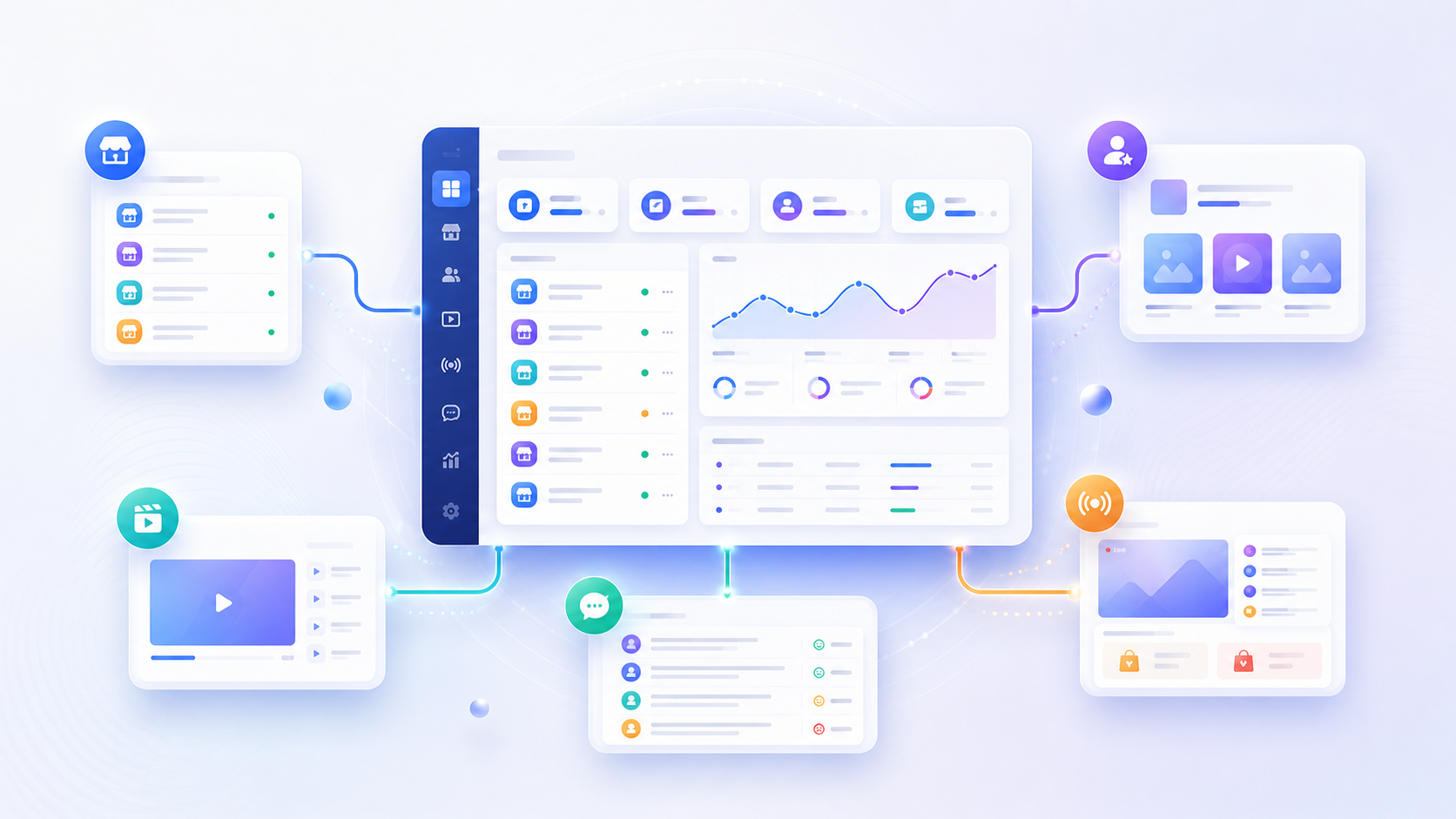
Why does the TikTok Shop team start "firefighting" when they have multiple accounts?
Many operations managers have had a misconception:
"We just need to hire two more operations staff."
But the reality is often not like that.
The team grew from 2 accounts to 10 accounts, and the addition was not just 8 accounts, but dozens of new operational links.
Assuming you are operating simultaneously today:
- 4 US TikTok Shop stores;
- 3 UK shops;
- 2 Southeast Asian stores;
- 8 collaborating experts;
- More than 30 shoppable videos to be published.
It may seem like just "posting more videos," but in reality, at least six things need to be confirmed behind each video:
- Which TikTok Shop should I post to?
- Is the correct product associated?
- Did you use the version specific to your country?
- Does the posting time conflict with the content from the influencer?
- Should we warm up for tonight's live broadcast in advance?
- Who is responsible for following up with comments after the post is published?
If any one step goes wrong, the rest of the work will be affected.
For example, an influencer has already posted a product review video, but the brand's official account has not yet posted a product introduction; people in the comments section have started asking about the product, but they can't find the corresponding video link.
Or perhaps a US store mistakenly posted the UK version of a Father's Day promotional video instead of the intended one. By the time the team realized this, the ads had already started running, and the cost of fixing it was far greater than reposting the content entirely.
These problems are not problems with TikTok Shop, but rather that the team is still using the same methods as managing a few accounts to manage dozens of accounts.
Many teams only realize at this stage that what truly needs unified management is not the accounts, but the lifecycle of each product-selling video .
A Shoppable video, from its initial concept to the final sale, typically goes through the following process:
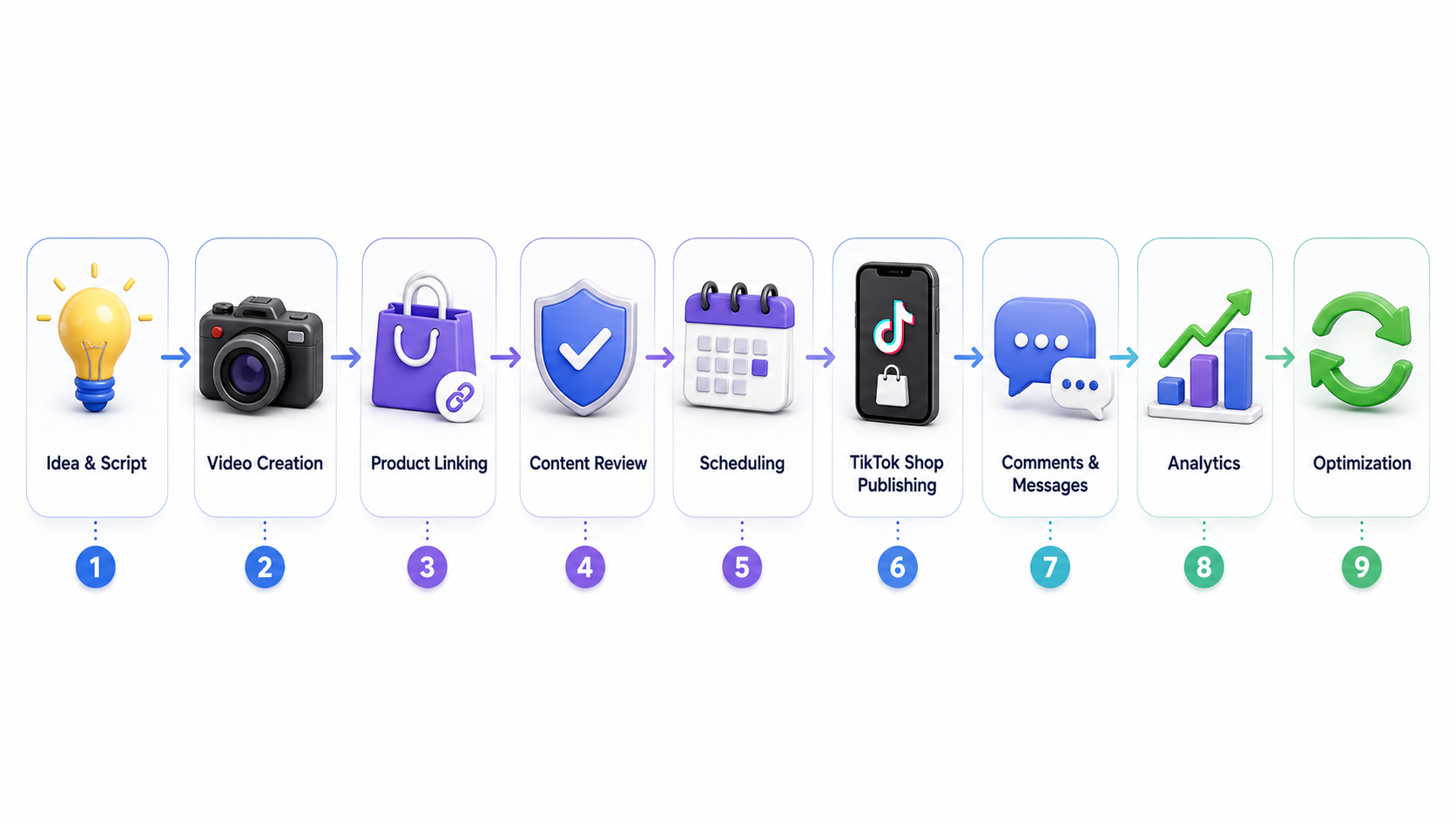
When there is only one operations person on the team, this process can be kept in mind.
When a team begins to collaborate with multiple people, this process must be incorporated into the system.
Otherwise, everyone will only see the small part that they are responsible for:
The content team believes the video is ready.
The operations team believes the influencer has already posted it;
Experts believe brand accounts will be synchronized;
Customer service believes the operations team has already responded to the comment;
Ultimately, no one knew where the entire chain of events had progressed.
This is why more and more cross-border teams are beginning to understand TikTok Shop multi-account management as Shoppable Video Publishing Workflow Management , rather than just account management.
If your team needs to post multiple TikTok Shop promotional videos every day, the first step is not to add more people, but to establish a unified posting process.
For example, you can first learn about the complete posting process of product trailer videos through TikTok Shop's product promotion videos , and then combine this with content posting to establish a unified posting portal, putting the content arrangements of different stores, different markets, and different operators into the same workflow.
For cross-border teams, if a fixed content schedule has not yet been established, it is recommended to first use a social media content calendar template to outline the release plan for the next two weeks, and then gradually migrate to a unified platform management system.
Many teams overlook a detail at this stage: video specifications are not entirely consistent across different markets.
For example, TikTok Shop product videos, regular short videos, and live stream pre-release videos all have different requirements in terms of length, size, and content. Before officially releasing, you can use a social media video specification checker to check whether the materials meet the platform's requirements, reducing rework due to format issues.
Key points
Once the team starts operating multiple TikTok Shops, the real challenge is no longer managing the accounts, but rather the complete workflow for each Shoppable Video, from creation and posting to interaction and review. Only with a unified workflow can multi-account operation truly achieve scalability.
A truly mature TikTok Shop team doesn't manage accounts, but rather each and every product-selling video.
When we communicated with many cross-border teams, we discovered a very interesting phenomenon.
Almost no team would say, "We have too many accounts."
They say more often:
Why do I still feel like I haven't accomplished anything even when I'm busy until 10 PM every night?
On the surface, this is an efficiency issue.
In reality, this is because the objects of management have changed.
When the team only had two or three accounts, the operation and management focused on those accounts.
Everyone knows exactly which backend to log into and which video to post today.
However, as the business expands and one account begins to correspond to multiple products, multiple influencers, and multiple markets, what really needs to be managed is no longer the account, but the content.
To be precise, it refers to every single Shoppable Video.
Because for TikTok Shop, a product promotion video is never a standalone file.
It naturally carries a lot of information.
Which market does it belong to?
Which product does it correspond to?
Which store are you planning to send it to?
When will it be released?
Do we need to sync with experts?
Should we warm up the live stream two hours in advance tonight?
Who is responsible for following up on the comments?
If this information is still scattered across Excel spreadsheets, chat groups, and the minds of different operations colleagues, then the larger the team, the higher the communication costs will be.
Many managers have a feeling:
Everyone is working very hard, yet they keep repeating the same thing over and over again.
"Has this video already been posted?"
"Has the expert updated today?"
Why aren't the UK stores showing the same updates?
Who was responsible for the promotional video before the live stream?
These problems occur every day.
What they really consume is not operational capabilities, but teamwork.
Later, we discovered that many established TikTok Shop teams do the same thing.
They started to focus on "videos" rather than accounts.
Every video, from the very beginning of its script, has its own lifecycle.
After the content team completes the creative concept, the product operations team will confirm the associated products; after approval, it will enter a unified release schedule; after the video is launched, customer service can see the comments immediately, and data colleagues can continue to track its subsequent performance.
The entire team revolves around the same content, rather than each person being responsible for a separate account.
This is why, even though they operate more than twenty TikTok Shops, some teams remain well-organized, while others are constantly putting out fires.
The difference is not experience.
The question is whether there is a unified workflow.
For cross-border teams, a stable publishing portal is far more important than having more operators.
By publishing content , Shoppable Videos from different stores and markets can be uniformly included in the publishing process, instead of having to log in to multiple backends and perform repetitive operations.
Once a video is ready to be published, TikTok Shop's scheduled publishing feature helps the team schedule videos according to the prime time in different countries, avoiding the need for manual uploads in the early morning due to time differences, and also preventing multiple operations teams from repeatedly modifying the publishing time.
Truly excellent teams don't discuss "what to send out today" every day.
These decisions were made a week or even two weeks in advance.
On the day of operation, what needs to be focused on is no longer the act of publishing itself, but what happens after the content goes live.
At this point, the focus of the work will naturally shift to the next stage—interaction.
For TikTok Shop, a product-selling video doesn't truly begin to generate value until it's successfully published, but rather when the first comment appears.
As the team scales up, what it really needs is a workflow for publishing product-selling videos.
Many teams have asked us the same question:
Is there a tool that can manage multiple TikTok Shop accounts simultaneously?
Actually, this is not what they really need.
Even if you can log in to twenty accounts at the same time, it doesn't mean that the team's operational efficiency will improve.
What truly determines efficiency is whether there is a workflow that everyone follows.
Many experienced cross-border e-commerce teams do not view a product promotion video as "a file," but rather as a project.
From the moment an idea is generated, it has already entered the team collaboration process.
The content team is responsible for script and material preparation; the product operations team confirms the products to be featured; the person in charge reviews whether the content complies with brand guidelines; then a unified scheduling process is initiated, with release times selected based on different countries; after the video is officially launched, customer service and operations continue to follow up on comments, private messages, and interactions; finally, based on data performance, decisions are made on whether to continue streaming, edit into a new version, or hand it over to influencers for secondary dissemination.
The entire team revolves around the same content, rather than each person being responsible for their own account.
This is why high-performing teams are increasingly less focused on "what's being released today," and more on discussing:
"Where is this content at now?"
Once everyone collaborates around the workflow, what each person sees is no longer an isolated task, but different stages of the same content.
For the TikTok Shop team, a complete video publishing workflow typically involves several key stages:
Content creation → Product association → Review → Release scheduling → Official release → Comment interaction → Data review → Secondary creation.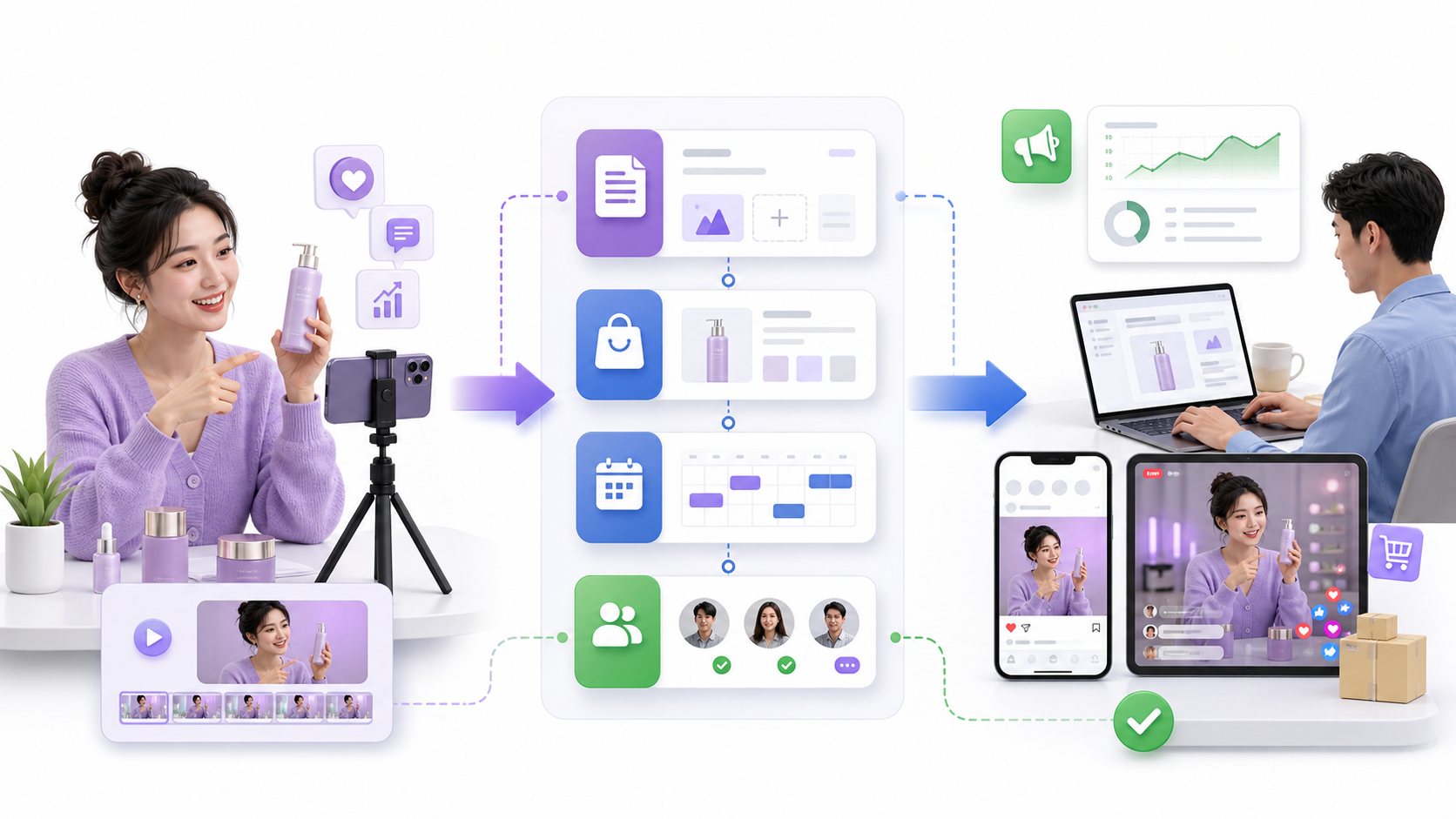
The real source of problems isn't the release process, but rather the numerous collaborative steps that occur in between.
For example, a video may have been completed but not associated with the correct product; an influencer may have posted it ahead of time, but the official account may not have completed the review process; a video from a US store may have been mistakenly scheduled for release in the UK market.
These problems will not disappear just because the team adds a few more people.
Conversely, the larger the team, the more it needs to manage the entire release process in a unified manner.
This is also why more and more cross-border brands are starting to use content publishing to manage all TikTok Shop content in a unified way, instead of having operations staff log into multiple back-ends separately.
For teams that need to plan marketing campaigns in advance, they can also combine TikTok Shop with scheduled posting to complete the posting arrangements for different countries and time zones in advance, avoiding manual duty in the early morning and reducing the communication costs caused by repeatedly modifying the posting time.
If your team hasn't yet established a fixed workflow, it's recommended to plan your content schedule for at least the next two weeks in advance. Even if you don't use professional tools right away, you can use a social media content calendar template to manage all your TikTok Shop videos in one calendar instead of scattering them across Excel spreadsheets and chat logs.
Multiple markets, multiple influencers, and multiple live streams are essentially different ways of disseminating the same content.
Many teams naturally develop new divisions of labor after reaching a certain stage of development.
Some are responsible for the US market, some for the UK market; some are responsible for the brand's official accounts, some for influencer collaborations; some are responsible for live streaming, some for customer service.
It seems that everyone has their own responsibilities.
In reality, everyone is working on the same thing:
To enable the same product to achieve more sales in different markets.
To give a very common example.
A new product is about to be officially launched in the US market.
The content team completed the product introduction video in advance;
Influencers release their experience videos three days in advance;
The official account released the brand version on the day of launch;
The live streaming team completed the live broadcast that evening;
Customer service continuously updates the FAQ based on customer reviews;
The data team analyzed which type of content generated the highest click-through rate the next day.
If these actions occur separately, they are just a few ordinary tasks.
However, if they are arranged in a unified manner around the same product and the same marketing campaign, the overall communication efficiency will be significantly improved.
Therefore, truly mature TikTok Shop teams rarely divide tasks according to "accounts" anymore, but rather collaborate according to "events" or "content".
The same product promotion video may need different language versions in different countries; different expressions are needed on influencer accounts and official accounts; and different release times are needed for live stream pre-launch promotion and official release.
These changes are not essentially about increasing work, but rather about the continued dissemination of the same content.
If the team operates in multiple countries simultaneously, it is recommended to use a cross-timezone release scheduler to plan the release time in advance, and then combine it with TikTok Shop for batch releases to unify the release plan for different accounts.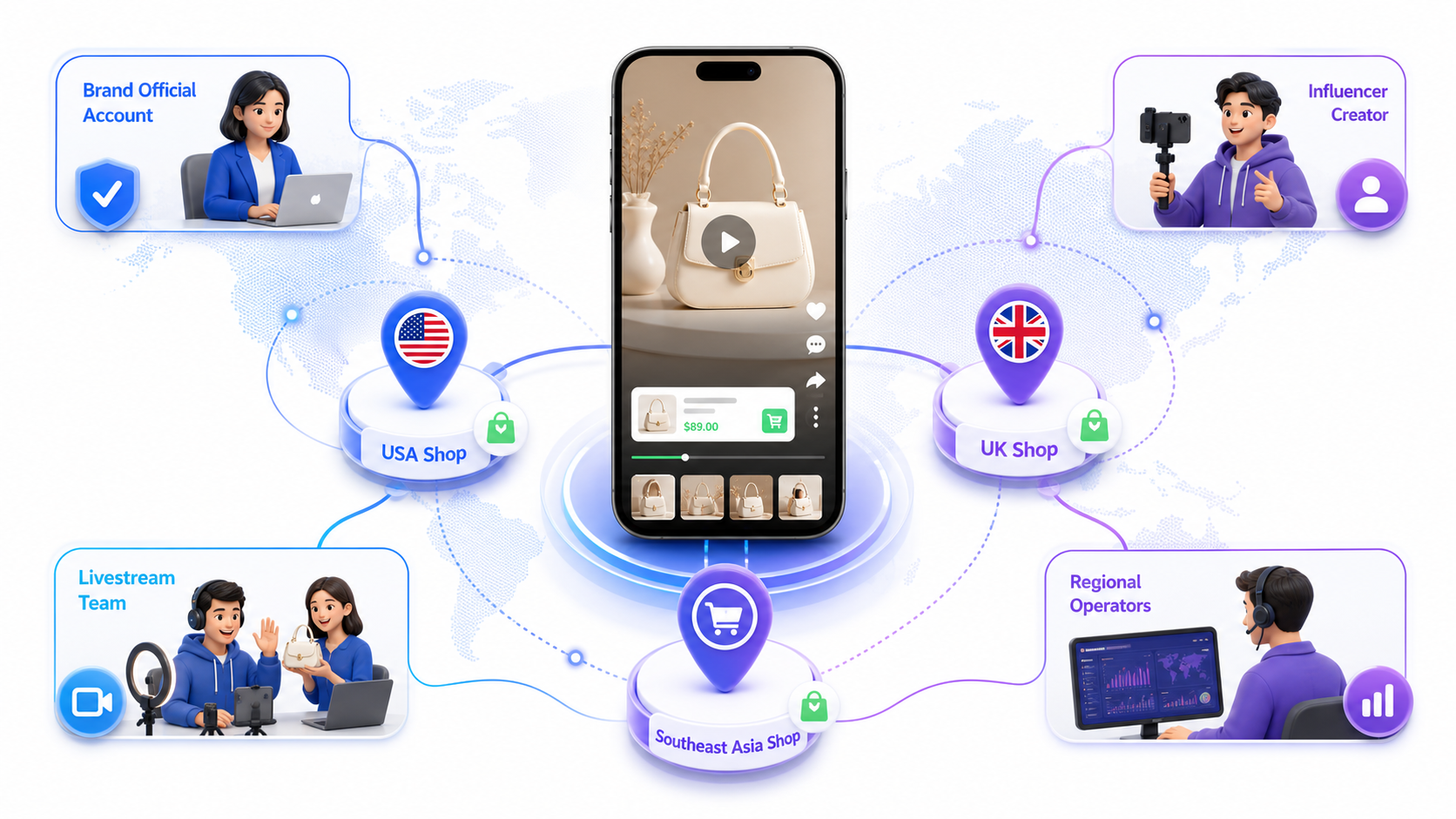 For cross-border e-commerce teams, as the number of accounts increases, what's more important than "posting more content" is "maximizing the value of the same content in different markets."
This is also the problem that e-commerce operation solutions hope to help teams solve: not by making teams do more things, but by enabling a single content creation to serve more accounts, more markets, and more sales opportunities.
A product-selling video truly begins to create value when the first comment appears.
Many operations teams pay attention to the number of views.
In reality, for TikTok Shop, the comments section is where transactions truly begin to occur.
Are there any discounts?
How long does it take to ship?
Are there any other colors?
"Can I buy it in the UK?"
If these questions are answered within minutes, users will often continue to learn about the product and may even place an order directly.
If it takes several hours for someone to reply, many users will have already left.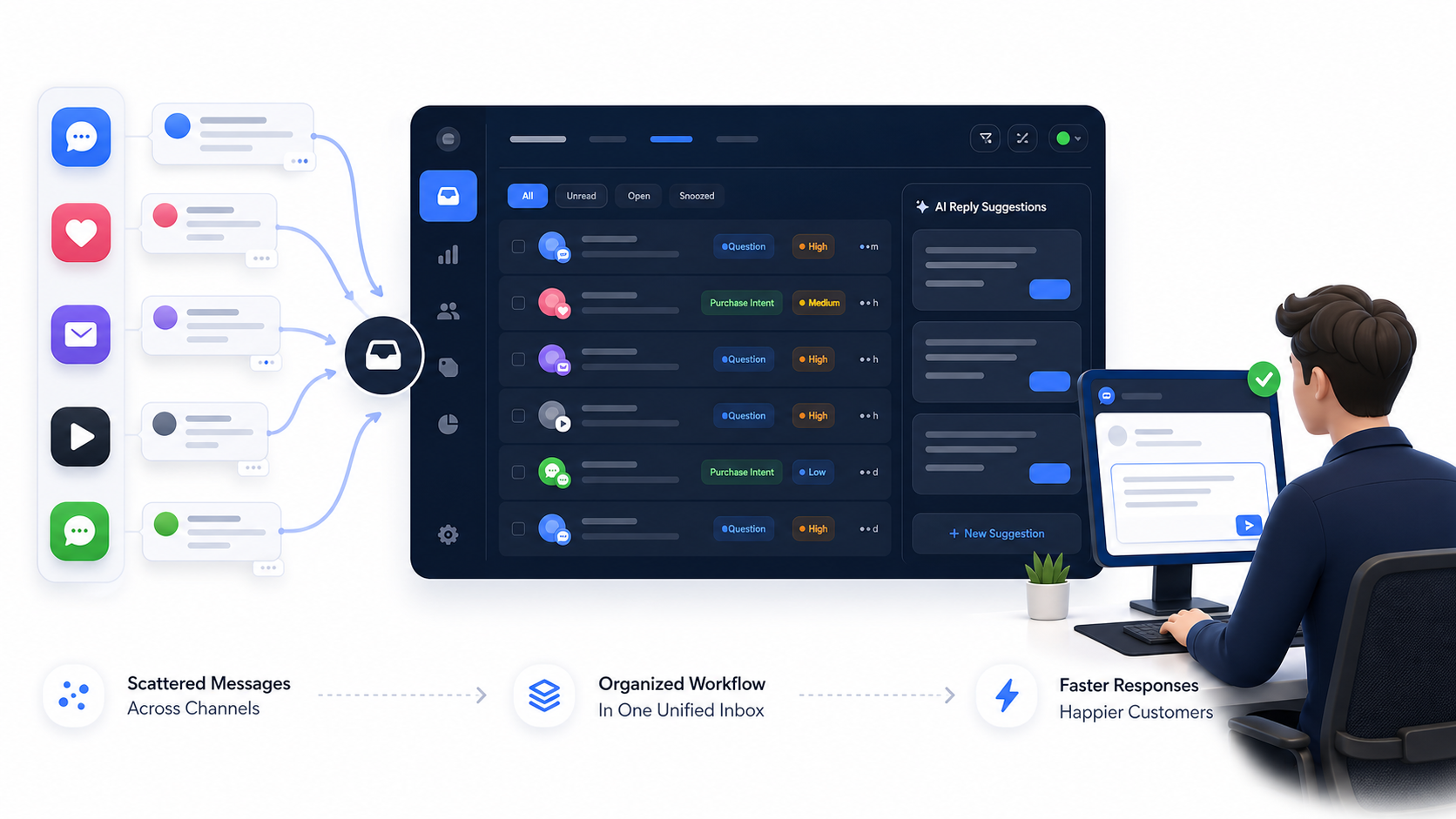
This is why many teams have found that:
What truly affects orders is not whether or not a video is published, but whether or not the traffic generated by the video is captured in a timely manner.
As the number of accounts increases, the number of comments will also grow rapidly.
The operation requires constantly switching between different TikTok Shop backends to check comments, which can easily lead to missing users who are genuinely interested in making a purchase.
Mature teams typically stop distributing comments across different accounts and instead process them all through the same workflow.
Which comments require a response from customer service?
Which items require confirmation from product operations?
What constitutes after-sales issues?
Which ones are just regular interactions?
When comments can be quickly categorized, teams can focus their limited time on users who are truly valuable.
Therefore, after releasing the product promotion video, it is even more important to establish a unified interactive management process.
Through interactive management , teams can centrally view comments and private messages from multiple platforms; for TikTok Shop, it can further integrate comment management , automatic comment replies , private message management , and automatic private message replies to reduce response delays caused by repeatedly switching backends.
For teams with a high volume of inquiries, AI automation can be used to automatically identify common problems and assign processing rules, allowing operations to spend more time on high-value users who truly require human judgment.
After all, for TikTok Shop, the successful posting of a product promotion video does not mean the job is done.
The actual transactions often happen in the comments section.
After the release, what's truly important is knowing which content is worth continuing to invest in.
Many TikTok Shop teams go through a phase:
I post a lot of videos every day, but when I review them, all I can see is the number of views.
Continue copying videos with high view counts;
Videos with low view counts are abandoned.
But for sales teams, viewership is only one part of the result.
A truly valuable Shoppable video might not be the one with the most views, but rather:
Users stay on the site longer;
The comment section shows a stronger willingness to buy;
Click for more product details;
The consultations received were more focused;
Subsequent live streams resulted in better conversion rates.
This is why mature teams don't just look at "which video went viral," but rather focus on:
Why is this video effective?
What users did it attract?
Which selling point generated interaction?
Which comments reflect real needs?
How should the next item be adjusted?
For example, it could be a beauty product.
Video A has a high number of views, but the comments are mostly focused on entertainment and interaction;
Video B has average views, but there are constant inquiries in the comments section about the price, purchase method, and effects.
For TikTok Shop, B-videos may be a more worthwhile area to continue investing in.
Therefore, the final step in the product promotion video release process is not the end, but the review.
Only by connecting publishing, interaction, and data can a team truly create a content growth cycle.
By leveraging TikTok Shop data analytics , the team can further examine content performance and conduct a unified review of different accounts and content to identify areas that truly warrant continuous optimization.
Meanwhile, for teams that need to observe market changes over the long term, they can also combine social media monitoring to pay attention to competitor activities, user feedback, and industry trends, so that content strategies are not just based on past data, but can detect market changes in advance.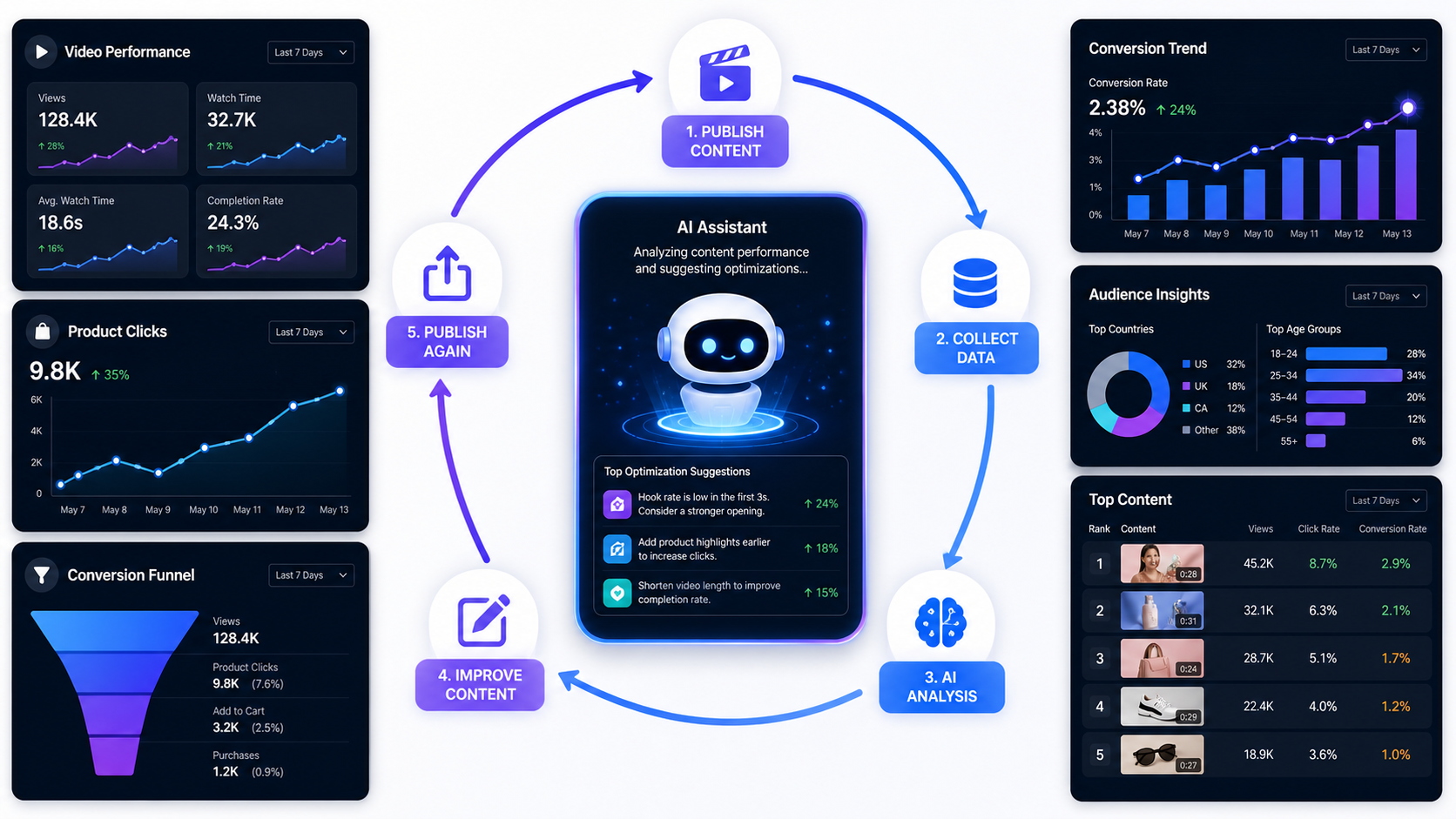
Why are more and more TikTok Shop teams starting to use a unified management platform?
Many teams don't initially want to add tools.
They prefer:
"Let's solve this with people first."
This is perfectly normal.
When the business first started, people were more flexible than the system.
However, the problem changes as the number of accounts increases.
Previously, an operations manager could remember everything.
Later, one operator needed to manage multiple accounts;
One person in charge needs to coordinate multiple teams;
A brand needs to target multiple national markets simultaneously.
At this point, continuing to rely on personal experience will lead to a significant problem:
The team's capabilities are tied to a few key individuals.
If an operations manager leaves, a lot of past experience, account rhythm, and content planning will be lost along with them.
A truly mature team will distill its experience into processes.
They don't require everyone to "remember everything," but instead let the system help the team keep track:
Which accounts are currently in operation;
What content is being published;
Which users are interacting?
Which data points are worth paying attention to?
This is also the core concept behind SocialEcho's design of a full-fledged social media AI workbench.
SocialEcho is designed for brands going global, e-commerce teams, and social media operations teams, integrating content publishing, interaction management, data analysis, and AI automation into a single workflow.
For the TikTok Shop team, it is not a replacement for operations staff, but rather a tool to help the team reduce repetitive switching, confirmations, and operations.
Teams can manage relevant accounts and content processes through the TikTok Shop platform , and combine it with the capabilities of other social media platforms to unify the operation of TikTok Shop with channels such as Facebook, Instagram, and YouTube.
Because many cross-border brands ultimately face problems that are not limited to TikTok Shop.
Once a brand enters its growth phase, it often needs to manage multiple social media platforms, multiple accounts, and multiple markets simultaneously.
At this point, a unified social media workflow becomes more important than individual platform tools.
The next phase of multi-account operation for TikTok Shop: From manual management to AI collaboration
The future operation of TikTok Shop will not simply involve adding more staff.
More teams will begin to use AI to help with repetitive tasks.
For example:
Generate video scripts for different markets based on product information;
Adjust the content expression according to the characteristics of the platform;
Automatically identify purchase intent in reviews;
Help the team organize user feedback;
Optimize the next round of content based on historical data.
However, the prerequisite for AI to truly realize its value is that it is connected to the complete operational process.
If content, accounts, comments, and data remain scattered across different places, AI can only solve single-point problems.
Truly efficient AI operations need to be built on unified data and workflows.
This is why SocialEcho doesn't just provide AI content capabilities, but aims to help teams build a complete social media operation loop.
From content creation to AI creation ;
From content publishing to TikTok Shopable Videos;
From comment interaction to AI-automated processing;
This ultimately forms a continuously optimizing growth cycle.
In conclusion, managing multiple accounts on TikTok Shop is essentially about managing the growth process.
Returning to the question at the beginning of the article:
Which TikTok Shop account hasn't posted a corresponding product promotion video today?
For a small team, this might just be a simple problem.
But for growing cross-border teams, it represents:
- Account management;
- Content collaboration;
- Product association;
- Expert collaboration;
- User interaction;
- Data review.
As the number of accounts increases, what truly determines efficiency is not who works harder, but who has a clearer and more stable operational process.
The growth of TikTok Shop is not just about posting more videos.
More importantly, it ensures that every video is properly published and managed, ultimately forming a content asset that can be continuously optimized.
FAQ
What is TikTok Shop multi-account management?
TikTok Shop multi-account management refers to the ability of a team to manage multiple TikTok Shop stores, accounts, product content, and operational processes simultaneously.
For individual sellers, managing multiple accounts may simply mean switching between accounts; but for brands and teams, it is more important to ensure that different accounts can continuously publish the right product-selling videos and maintain a consistent operational rhythm.
Can TikTok Shop allow bulk posting of product-selling videos?
Can.
For teams operating multiple stores, batch publishing can reduce repetitive operations and improve content publishing efficiency.
In addition to batch publishing, mature teams usually need to combine content scheduling, product association, publishing time management and subsequent interaction processes to form a complete video publishing workflow.
Why is it harder to manage more TikTok Shop accounts?
As the number of accounts increases, the complexity comes not only from the accounts themselves, but also from the collaborative relationships between them.
Different accounts may correspond to different markets, products, influencers, and posting times. Without a unified process, it's easy for issues like missed posts, incorrect posts, or information asynchrony to occur.
What is TikTok Shop Shoppable Video?
Shoppable Video refers to video content that can be linked to product information, allowing users to directly learn about products and complete the purchase process through the video.
For TikTok Shop sellers, Shoppable Videos are an important way to connect content and transactions.
How should the TikTok Shop team manage influencer videos?
Mature teams don't treat influencer videos as independent collaborative projects, but rather integrate influencer content into their overall content workflow.
The timing of influencer posts, official account content, live stream plans, and comment feedback should all be coordinated around the same product and marketing goals.
Which TikTok Shop teams are suitable for SocialEcho?
SocialEcho is better suited for brands, e-commerce teams, and operations teams that need to manage multiple social media accounts, multi-market content, and team collaboration processes.
If the team has moved from single-account operation to multi-account, multi-platform, and multi-member collaboration, it may be worthwhile to use a unified platform to manage content publishing and interaction processes.
Start building a more efficient multi-account collaboration process for TikTok Shop.
Are you still switching back and forth between spreadsheets, chat groups, and multiple account backends?
SocialEcho brings together the multi-account content scheduling, comment and private messaging, team collaboration, and review processes related to TikTok Shop onto a single platform, allowing for better integration of shop accounts, influencer content, live stream announcements, and customer service responses.
There's no need to overhaul the entire process at once. Start by integrating a few core accounts, spend a week getting content publishing, interaction handling, and team collaboration running smoothly, and then gradually expand to more marketplaces and accounts.
Sign up for SocialEcho now and start your free trial!
;}.cls-2{fill:%230868f7;}.cls-3{fill:url(%23未命名的渐变_44);}.cls-4{fill:%23333;}%3c/style%3e%3clinearGradient%20id='未命名的渐变_8'%20x1='33.73'%20y1='100.61'%20x2='-0.03'%20y2='-1.06'%20gradientUnits='userSpaceOnUse'%3e%3cstop%20offset='0'%20stop-color='%237ae9fb'/%3e%3cstop%20offset='0.67'%20stop-color='%232b90f8'/%3e%3cstop%20offset='1'%20stop-color='%230868f7'/%3e%3c/linearGradient%3e%3clinearGradient%20id='未命名的渐变_44'%20x1='27.86'%20y1='18.67'%20x2='68.36'%20y2='22.22'%20gradientUnits='userSpaceOnUse'%3e%3cstop%20offset='0'%20stop-color='%235ac7f2'/%3e%3cstop%20offset='1'%20stop-color='%230868f7'/%3e%3c/linearGradient%3e%3c/defs%3e%3cpath%20class='cls-1'%20d='M29,28.74V81.91l-9.51-3.68v0L8.52,74A7.17,7.17,0,0,1,4,67.32V24.54A3.76,3.76,0,0,1,9.08,21Z'/%3e%3cpath%20class='cls-2'%20d='M68.09,78.07a13.15,13.15,0,0,1-17.9,12.06L29,81.91h0V28.74L50.19,37A13.17,13.17,0,0,0,68.08,25.3h0Z'/%3e%3cpath%20class='cls-3'%20d='M68.08,25.3a13.19,13.19,0,0,1-6.73,10.87A13.09,13.09,0,0,1,50.19,37L29,28.74V6A3.76,3.76,0,0,1,34.1,2.52l25.59,9.91A13.22,13.22,0,0,1,68.08,25.3Z'/%3e%3cpath%20class='cls-4'%20d='M129.06,81.76a4.33,4.33,0,0,1-3.19-1.31,4.4,4.4,0,0,1-1.31-3.24V56.86H97.65V77.21a4.36,4.36,0,0,1-1.35,3.2A4.68,4.68,0,0,1,93,81.76a4.32,4.32,0,0,1-3.19-1.31,4.37,4.37,0,0,1-1.32-3.24V27.27A4.58,4.58,0,0,1,89.83,24a4.59,4.59,0,0,1,7.82,3.27V48.15h26.91V27.27A4.58,4.58,0,0,1,125.91,24a4.59,4.59,0,0,1,7.82,3.27V77.21a4.37,4.37,0,0,1-1.36,3.2A4.65,4.65,0,0,1,129.06,81.76Z'/%3e%3cpath%20class='cls-4'%20d='M163.77,81.66c-6.57,0-11.76-1.92-15.44-5.7s-5.54-9.07-5.54-15.74a26.76,26.76,0,0,1,2.09-10.43,17.72,17.72,0,0,1,6.67-8.06,19.15,19.15,0,0,1,10.68-2.95,19,19,0,0,1,10.46,2.8,18.7,18.7,0,0,1,6.55,7.36,22.53,22.53,0,0,1,2.36,10.28A4.51,4.51,0,0,1,177,63.77H152.23a10.8,10.8,0,0,0,3.49,6.65c2,1.68,4.88,2.52,8.66,2.52a22.25,22.25,0,0,0,7.54-1.21c.74-.3,1.55-.67,2.37-1.07a3.75,3.75,0,0,1,1.84-.4,4.09,4.09,0,0,1,3,1.15,4,4,0,0,1,1.12,3,4.38,4.38,0,0,1-2.58,3.82,32.34,32.34,0,0,1-6.36,2.61A28.67,28.67,0,0,1,163.77,81.66ZM172.4,55.9a9.72,9.72,0,0,0-1.63-4.56A9.9,9.9,0,0,0,167,48a10.38,10.38,0,0,0-4.64-1.14,12,12,0,0,0-4.77,1.06,9.54,9.54,0,0,0-4.89,5.66,11.78,11.78,0,0,0-.51,2.3Z'/%3e%3cpath%20class='cls-4'%20d='M193,81.64a4.49,4.49,0,0,1-4.51-4.55V27.28A4.58,4.58,0,0,1,189.84,24a4.48,4.48,0,0,1,3.28-1.36A4.36,4.36,0,0,1,196.35,24a4.46,4.46,0,0,1,1.31,3.31V77.09a4.34,4.34,0,0,1-1.35,3.2A4.67,4.67,0,0,1,193,81.64Z'/%3e%3cpath%20class='cls-4'%20d='M263.79,81.71a5.7,5.7,0,0,1-4.2-1.74,5.76,5.76,0,0,1-1.73-4.19V27.37a4.58,4.58,0,0,1,1.35-3.27A4.59,4.59,0,0,1,267,27.37V72.53h24a4.58,4.58,0,0,1,3.27,7.82A4.66,4.66,0,0,1,291,81.71Z'/%3e%3cpath%20class='cls-4'%20d='M424.48,81.74a4.71,4.71,0,0,1-2.71-.88,5.43,5.43,0,0,1-1-1l-.07-.09-12.41-17-5.41,5v9.44a4.31,4.31,0,0,1-1.36,3.19,4.66,4.66,0,0,1-3.3,1.36A4.29,4.29,0,0,1,395,80.42a4.36,4.36,0,0,1-1.32-3.23V27.37A4.58,4.58,0,0,1,395,24.1a4.52,4.52,0,0,1,6.58.12,4.54,4.54,0,0,1,1.24,3.15V56.31l17.72-16.38.05,0a4.8,4.8,0,0,1,2.94-1.11,4.4,4.4,0,0,1,3.27,1.2,4.57,4.57,0,0,1,1.2,3.27,4.44,4.44,0,0,1-.77,2.33,7.45,7.45,0,0,1-1.43,1.65l-11,9.64,13.34,17.68a5,5,0,0,1,1,2.71,4.12,4.12,0,0,1-1.36,3.24A4.64,4.64,0,0,1,424.48,81.74Z'/%3e%3cpath%20class='cls-4'%20d='M317.93,81.76a21.5,21.5,0,1,1,21.17-21.5A21.37,21.37,0,0,1,317.93,81.76Zm0-34.1a12.61,12.61,0,1,0,12.42,12.6A12.52,12.52,0,0,0,317.93,47.66Z'/%3e%3cpath%20class='cls-4'%20d='M212.18,101.22a4.12,4.12,0,0,1-3.05-1.26,4.17,4.17,0,0,1-1.26-3.1V43.34a4.37,4.37,0,0,1,1.3-3.14,4.26,4.26,0,0,1,3.13-1.3,4.19,4.19,0,0,1,3.1,1.26,4.32,4.32,0,0,1,1.26,3.16,20.77,20.77,0,0,1,13-4.54,21.51,21.51,0,0,1,0,43,20.51,20.51,0,0,1-13-4.57V96.86a4.15,4.15,0,0,1-1.3,3.06A4.5,4.5,0,0,1,212.18,101.22Zm17.43-53.63c-6.23,0-12.93,4.11-12.93,12.72a12.73,12.73,0,0,0,25.46,0A12.71,12.71,0,0,0,229.61,47.59Z'/%3e%3cpath%20class='cls-4'%20d='M365.76,81.76a21.5,21.5,0,1,1,21.18-21.5A21.37,21.37,0,0,1,365.76,81.76Zm0-34.1a12.61,12.61,0,1,0,12.42,12.6A12.52,12.52,0,0,0,365.76,47.66Z'/%3e%3c/svg%3e)