Telegram Registration & Safety Checker
Check registration policy by country, fact-check +86 risks, and score your account security — three tools in one.
A Telegram policy quick-reference maintained by SocialEcho. Data is hand-verified and refreshed monthly; facts and risk info only.
- Can register
- Yes, with caveats
- Risk level
- High
- Code delivery
- SMS / In-app push
- Known fees
- In some high-abuse regions (incl. +86) Telegram may officially require a one-week Premium purchase at signup to cover SMS costs; receiving the SMS itself is free
Known caveats
- Intl. verification SMS is often filtered/delayed by mainland carriers — most failures happen at code delivery, not eligibility
- New +86 accounts face stricter anti-abuse screening; enabling 2FA right after signup significantly lowers limitation risk
Data verified: 2026-07
Next steps
Account sorted — now run your Telegram ops
More free tools:Telegram Channel ViewerTime Zone ConverterBest Time Slot Finder
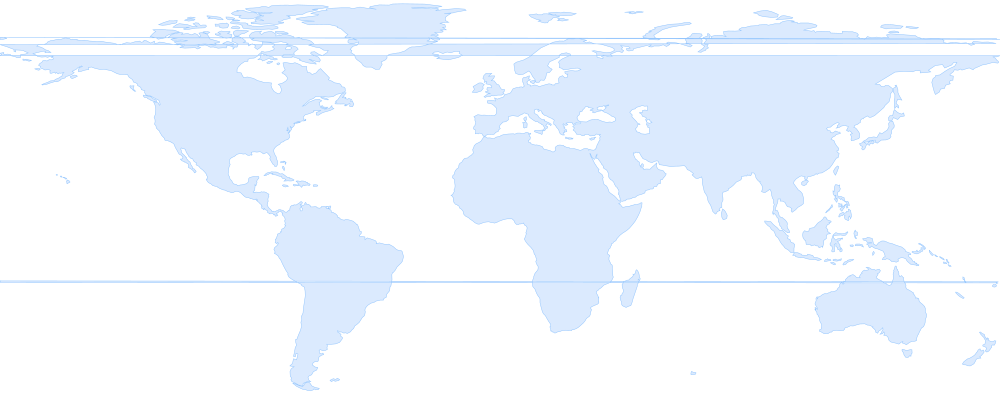
Global registration policy map
Click a country on the map to see its registration policy and risks
Mainland China+86
- Can register
- Yes, with caveats
- Risk level
- High
- Code delivery
- SMS / In-app push
- Known fees
- In some high-abuse regions (incl. +86) Telegram may officially require a one-week Premium purchase at signup to cover SMS costs; receiving the SMS itself is free
Known caveats
- Intl. verification SMS is often filtered/delayed by mainland carriers — most failures happen at code delivery, not eligibility
- New +86 accounts face stricter anti-abuse screening; enabling 2FA right after signup significantly lowers limitation risk
Data verified: 2026-07
Expand the full 18-region comparison table
| Region | Can register | Verification | Risk | Notes |
|---|---|---|---|---|
| Mainland China (+86) | Yes, with caveats | SMS / In-app push | High | Intl. verification SMS is often filtered/delayed by mainland carriers — most failures happen at code delivery, not eligibility; New +86 accounts face stricter anti-abuse screening; enabling 2FA right after signup significantly lowers limitation risk |
| Hong Kong (+852) | Yes | SMS / In-app push | Low | Reliable code delivery; widely used by cross-border teams on physical or contract SIMs |
| Taiwan (+886) | Yes | SMS / In-app push | Low | Stable delivery; prepaid SIMs require ID, virtual number ranges may be rejected |
| United States (+1) | Yes | SMS / In-app push | Low | Physical SIMs are reliable; VoIP ranges (e.g. Google Voice) are widely rejected by Telegram |
| United Kingdom (+44) | Yes | SMS / In-app push | Low | Stable delivery; cheap pay-as-you-go SIMs get reclaimed by carriers if left untopped for months |
| Singapore (+65) | Yes | SMS / In-app push | Low | Stable delivery; SIM registration requires ID with a per-person card cap |
| Malaysia (+60) | Yes | SMS / In-app push | Low | Stable delivery with cheap prepaid SIMs; ID registration is enforced |
| Indonesia (+62) | Yes | SMS / In-app push | Medium | Prepaid SIMs must be registered with a national ID (NIK); unregistered cards can't receive codes |
| Vietnam (+84) | Yes | SMS / In-app push | Medium | Regulation tightened since 2025 — unregistered SIMs are being cut off; bulk-registration ranges trip anti-abuse checks |
| Thailand (+66) | Yes | SMS / In-app push | Low | Stable delivery; tourists can register prepaid SIMs with a passport |
| Philippines (+63) | Yes | SMS / In-app push | Medium | The SIM Registration Act deactivated unregistered cards; rural networks can delay code delivery |
| Japan (+81) | Yes | SMS / In-app push | Low | Stable delivery; data-only SIMs have no SMS — pick a plan that includes texting |
| South Korea (+82) | Yes | SMS / In-app push | Low | Stable delivery; SIMs require identity verification and tourist SIMs expire quickly |
| UAE (+971) | Yes | SMS / In-app push | Medium | Registration works, but Telegram voice/video calls are restricted on local networks |
| Saudi Arabia (+966) | Yes | SMS / In-app push | Medium | Registration works; calling is intermittently restricted — businesses should pair with official API channels |
| Brazil (+55) | Yes | SMS / In-app push | Low | Stable delivery; brief court-ordered blocks have occurred and been lifted — long-term availability is good |
| Mexico (+52) | Yes | SMS / In-app push | Low | Stable delivery with easy prepaid SIMs; a common registration base for LatAm ops |
| Russia (+7) | Yes | SMS / In-app push | Medium | Hugely popular domestically; cross-border code delivery can lag, rarely chosen by overseas teams |
Compiled from Telegram's official FAQ and public sources; verified 2026-07, refreshed monthly. (Data verified: 2026-07)
How it works
Three steps to a clear answer
Pick a region
Choose where your number is from and instantly see registration policy, code delivery and risk level.
Read the +86 deep-dive
Why mainland-China signups fail, the real risks, and the 'paid codes' rumor fact-checked.
Score your security
Tick through 12 weighted safety items and get a 0-100 score with what to fix first.
Why this checker
Scattered policy folklore, verified into one table
18 high-traffic regions
Mainland China, HK, TW, US, UK, SEA, Middle East, LatAm — the places cross-border teams actually register from.
Verified monthly
Every record carries a verification date and is re-checked monthly — not a one-off scrape.
Rumors fact-checked
'Telegram charges for codes', 'every +86 gets banned' — each claim checked against official positions.
12-point security score
2FA, session hygiene, privacy settings — weighted and quantified.
Facts only
No account selling, no SMS-farm links, no rule-bypass guidance. Just what keeps you out of trouble.
By SocialEcho
Maintained by the team behind SocialEcho's Telegram marketing tools.
Who uses it
Real cross-border scenarios
Global ops teams
Pick registration regions and debug missing verification codes.
Support teams
Run the security checklist before serving customers over Telegram.
Community managers
Assess number-range risk before scaling multi-account operations.
Indie developers
Understand account limits before building on the Bot API.
How Telegram registration differs by country
Telegram registration is open to phone numbers from nearly every country: one number, one account, with the login code delivered by SMS or in-app push to an already-signed-in device (voice-call codes only serve existing 2FA-enabled accounts). The real differences aren't about eligibility — they're about whether codes actually arrive (local carriers' international-SMS filtering), how abused a number range historically is (which drives anti-spam screening of new accounts), and how strictly the country enforces SIM registration (which determines number stability).
Take +86 mainland China: registration isn't banned, but international code SMS is frequently filtered or delayed by carriers — the single biggest cause of 'can't register' reports. The +86 range also carries a high historic abuse rate, so brand-new accounts that immediately mass-join groups or DM strangers tend to get limited by SpamBot. By contrast, physical SIMs from Hong Kong, Singapore, the US or the UK deliver codes reliably and face friendlier screening, which is why cross-border teams favor them. Across Southeast Asia, SIM real-name rules have tightened — Indonesia's NIK binding, the Philippines' SIM Registration Act, Vietnam's 2025 cleanup — and unregistered SIMs simply stop receiving codes.
Whichever region you register from, post-signup security matters more than region choice: enable two-step verification with a recovery email, prune active sessions regularly, hide your phone number, and restrict who can add you to groups. The checklist tab turns those settings into 12 weighted items and scores you live. Data on this page is hand-verified monthly by SocialEcho (current version 2026-07). This tool provides facts and risk information only — no account vendors, no SMS farms, no bypass guidance.
FAQ
The questions people actually ask
Can a Chinese (+86) phone number register Telegram?
Yes. Telegram doesn't block +86. Most failures happen at code delivery — international SMS gets filtered or delayed by mainland carriers. First-time signups can't fall back to voice calls (that channel only serves existing 2FA-enabled accounts); retry later or receive the code via in-app push on an already-logged-in device.
Does Telegram charge for verification codes?
Partly true. Telegram doesn't charge per code, but since 2024 it officially requires, in some high-abuse regions (incl. +86), a one-week Premium purchase at signup to cover SMS costs — a disclosed official fee. What to actually avoid: Fragment's paid +888 numbers (optional) and third-party SMS-receiving services (unaffiliated, against the terms).
What are the actual risks of registering with +86?
Two: code delivery (international SMS filtering) and stricter anti-abuse screening (the +86 range has high historic abuse). Enable 2FA right after signup, complete your profile, and use the account normally for 1-2 weeks before scaling activity.
Which region's numbers are most reliable?
For delivery stability and screening friendliness: physical SIMs from Hong Kong, Singapore, the US and the UK. Avoid VoIP ranges like Google Voice — Telegram rejects most of them.
How do I audit my account's security after signing up?
Use the Security Checklist tab: 12 weighted items covering 2FA, recovery email, session management and privacy settings, scored 0-100 live with fix-first suggestions. Two-step verification carries the most weight.
Is using Telegram for business support compliant?
Yes — Telegram allows commercial use and ships a Bot API and Business features. Keep it compliant: no unsolicited bulk messaging, share @usernames instead of staff numbers, enforce 2FA on team accounts, and understand that only Secret Chats are end-to-end encrypted.
How often is this data updated?
Monthly, by hand. Every region record shows its verification date (currently 2026-07); significant policy changes are updated ahead of schedule.
Secure the account, then scale the channel
SocialEcho runs publishing, messaging, listening and analytics across 11 platforms including Telegram.